
DécryptageStates & Communities
What a labour shortage claim needs before anyone can test it
A shortage is a claim that a market is not clearing at a stated price. By the end you will know the five things such a claim has to name, and why the same job carries different prices in different states.
Prepared by
Last reviewed Published 3 minute read

Illustration : The Cefa Brief
A labour shortage is a claim about a market. It says that at the wage on offer, employers cannot hire the people they need, and that this has held long enough to be a condition rather than a bad quarter. Put that way, the claim can be checked. Put as a bare statement that workers cannot be found, it cannot be, because the sentence is missing the price.
The wage is the first thing to look for and the thing most often left out. Every assertion of scarcity implies a price at which the scarcity holds. An employer who cannot hire at one rate may fill the same posts at another. Whether that gap is a shortage or a bargaining position depends on the rest of the market, which is why the other four elements matter.
Notes: Source: U.S. Bureau of Labor Statistics, Occupational Employment and Wage Statistics, 2025, state level, cross-industry. Eight states in which the occupation is unusually concentrated; others employ it too. Not adjusted for the cost of living.
Source: The Cefa Brief
Chart description
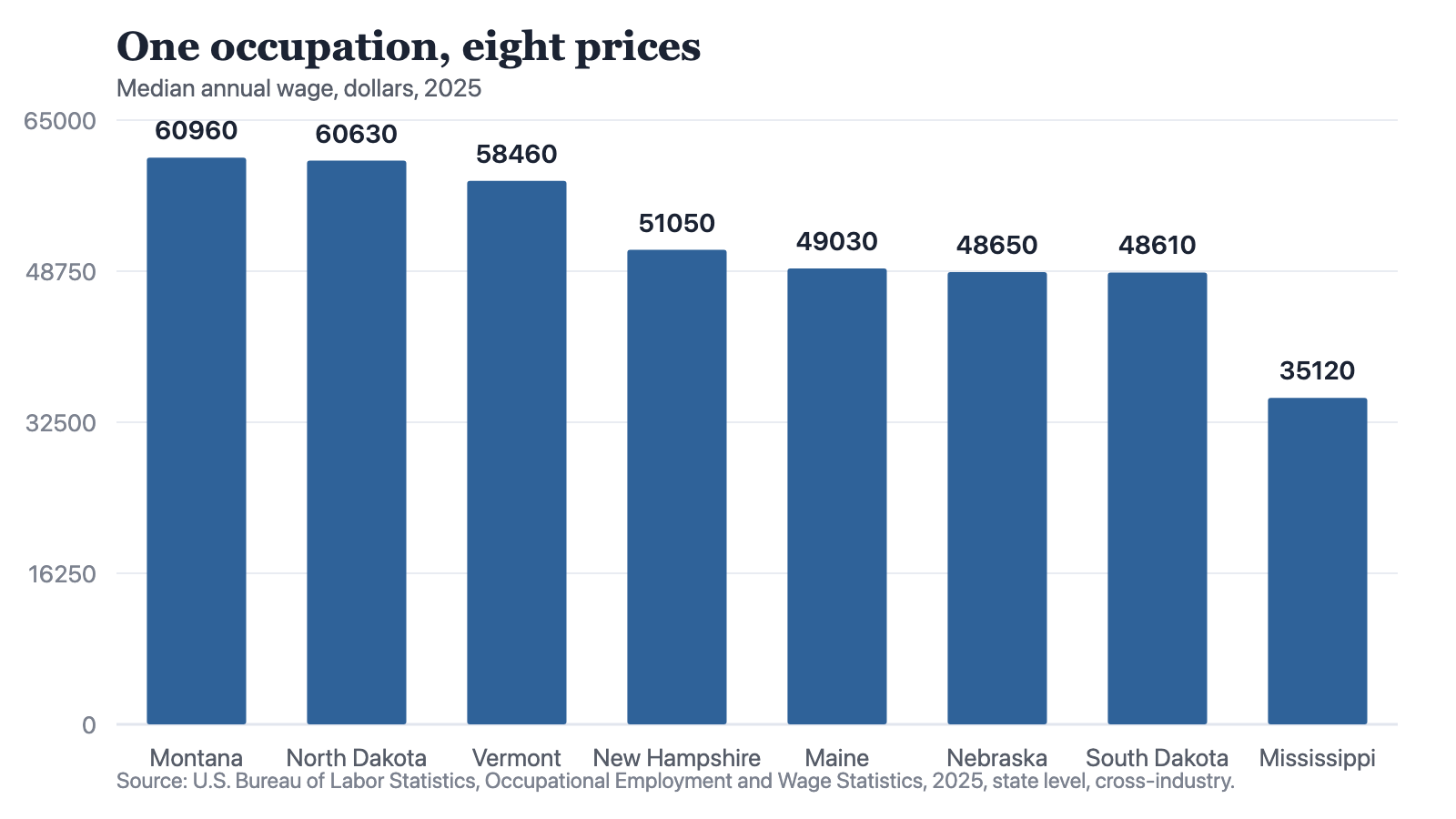
Eight bars, ordered from longest to shortest. Montana and North Dakota are almost the same length at the top, at 60,960 and 60,630 dollars. Vermont follows a little behind at 58,460. Then a step down to a tightly packed group of four that is hard to tell apart by eye: New Hampshire at 51,050, Maine at 49,030, Nebraska at 48,650 and South Dakota at 48,610. Mississippi stands well clear at the bottom at 35,120, separated from the group above it by a gap wider than the entire spread among those four. The shape is three long bars, four of roughly equal middling length, and one conspicuously short one.
Eight bars, ordered from longest to shortest. Montana and North Dakota are almost the same length at the top, at 60,960 and 60,630 dollars. Vermont follows a little behind at 58,460. Then a step down to a tightly packed group of four that is hard to tell apart by eye: New Hampshire at 51,050, Maine at 49,030, Nebraska at 48,650 and South Dakota at 48,610. Mississippi stands well clear at the bottom at 35,120, separated from the group above it by a gap wider than the entire spread among those four. The shape is three long bars, four of roughly equal middling length, and one conspicuously short one.
The five things a claim has to name
- The occupation, defined at a level someone can actually hire at. Skilled trades is not an occupation. Highway maintenance worker is.
- The place, drawn as the area people commute within rather than as a state or a country.
- The wage on offer, and what that wage was a year earlier.
- The period. Posts open for a fortnight are recruitment. Posts open for a year are something else.
- The comparison. What happened to hiring when the wage rose, or the plain admission that it has not been raised.
The chart shows why the place cannot be left out. One occupation, defined the same way by the same agency in every state, carries very different prices across the eight shown. An employer sitting in the middle of that range who advertises near the bottom of it is not facing a national shortage of highway maintenance workers. The arithmetic runs the other way too. An employer at the top of the range competes with everyone else at the top, and the pool being drawn from is the size of one state's, not the country's.
What a shortage is not
A vacancy count is not a shortage. Vacancies exist in every functioning labour market, because people retire and firms grow. High turnover is not a shortage either; it is usually a statement about the job. A thin training pipeline is a real problem with a lead time measured in years, and it calls for a different remedy than a pay review does. A licensing queue is an administrative constraint that recruiting cannot clear. And a shortage of housing near the work looks identical from the employer's desk and is not a labour market problem at all.
Every claim of scarcity implies a price. A shortage statement with no wage in it is not yet a claim about the world.
Where the disagreement is
Economists and workforce practitioners genuinely disagree about how often a real shortage exists, and the disagreement is about adjustment speed rather than about logic. The standard economic position is that labour markets clear like other markets: persistent unfilled posts are evidence that the offered wage sits below what the local market requires, and the remedy lies in the employer's own hands. The practitioner position accepts that and denies that the adjustment is quick. Licences take months to issue and clearances longer, an apprenticeship longer still, a worker willing to move may find nowhere to live, and employers in small markets can be slow to learn what the going rate has become. Both camps agree the word describes something. They disagree about whether raising pay would resolve it inside a budget cycle.
A test you can apply. When you meet a shortage claim, write down five things: the occupation, the commuting area, the wage offered, how long the posts have stood open, and what the wage was a year ago. If one is missing, ask for it before agreeing that a public programme is the answer. If all five are there and the wage has risen while the posts stayed open, the claim is doing real work, and the question of what to do about it is worth the argument.
About the author
Each author told us that for this piece they hold no interest a reader would think relevant.
Explainers are written and kept up to date by The Cefa Brief’s editors. An Explainer is background CEFA stands behind. It is not one author’s argument, and it is not a CEFA position on what anyone should do. If something here is wrong or out of date, write to applied@thecefa.org.
© 2026 Center for Economics & Foreign Affairs. To republish it, see our republication terms. Republishing
Share
The Cefa Brief · applied.thecefa.org/cefa-brief/what-a-labour-shortage-claim-needs · Printed from the web edition