
What a completion guarantee covers and when it falls away
Between financial close and the day a plant works, a project has debt and no revenue. A completion guarantee is the sponsor's promise to stand in that gap. By the end you will know what triggers its release, what it absorbs while it lasts, and why the release date is negotiated harder than the amount.
Prepared by
Last reviewed Published 4 minute read

Illustration : The Cefa Brief
A project financed on its own cash flow has a hole in the middle of it. Lenders agree to be repaid out of what the asset earns, but between financial close and the day the asset earns anything there are years of spending, a construction contract that can fail, and interest accruing on drawn debt. During that stretch the security is a building site. A completion guarantee is the instrument that covers the stretch: an undertaking from the sponsor, given to the lenders, to stand behind the debt until the project has been certified as complete.
The point of the guarantee is not that it lasts. It is that it ends. While it is in force the loan is effectively recourse to the sponsor's balance sheet, which is why sponsors want the end date early and lenders want it late. On release, the debt becomes what it was always meant to be, limited to the project and its revenues, and the sponsor's exposure is capped at the equity already committed.
What counts as completion
Completion in a loan agreement is a defined term and it is rarely the day construction stops. Physical or mechanical completion means the plant is built and can be started. Financial or project completion, the test that actually releases the guarantee, means the plant has been shown to work at the standard the model assumed, and an independent engineer has certified it. The gap between the two is where completion guarantees are drawn on.
- Performance tests passed at a stated output, efficiency and emissions standard, held for a defined period rather than demonstrated once.
- Certification by an independent engineer appointed by the lenders, not by the sponsor or the contractor.
- All permits, licences and interconnection or offtake agreements in force, with no unremedied breach.
- Reserve accounts funded to the levels the agreement requires, including the debt service reserve.
- In many structures, a coverage ratio achieved over a stated number of consecutive periods of real operation, not projected.
What it absorbs while it lasts
The guarantee typically covers three things. The first is cost overrun: money above the sanctioned budget needed to finish, which the sponsor must inject as equity or subordinated debt rather than borrow. The second is debt service falling due before the project earns, including interest that was expected to be capitalised and now is not. The third is delay itself, because an extended construction period lengthens the interest bill and can push the project past a longstop date, at which point the guarantee often converts from a promise to finish into an obligation to repay. A sponsor with a fixed-price turnkey construction contract passes much of the first item to the contractor, but the guarantee to the lenders remains the sponsor's, and a contractor's liquidated damages are usually capped well below the loan.
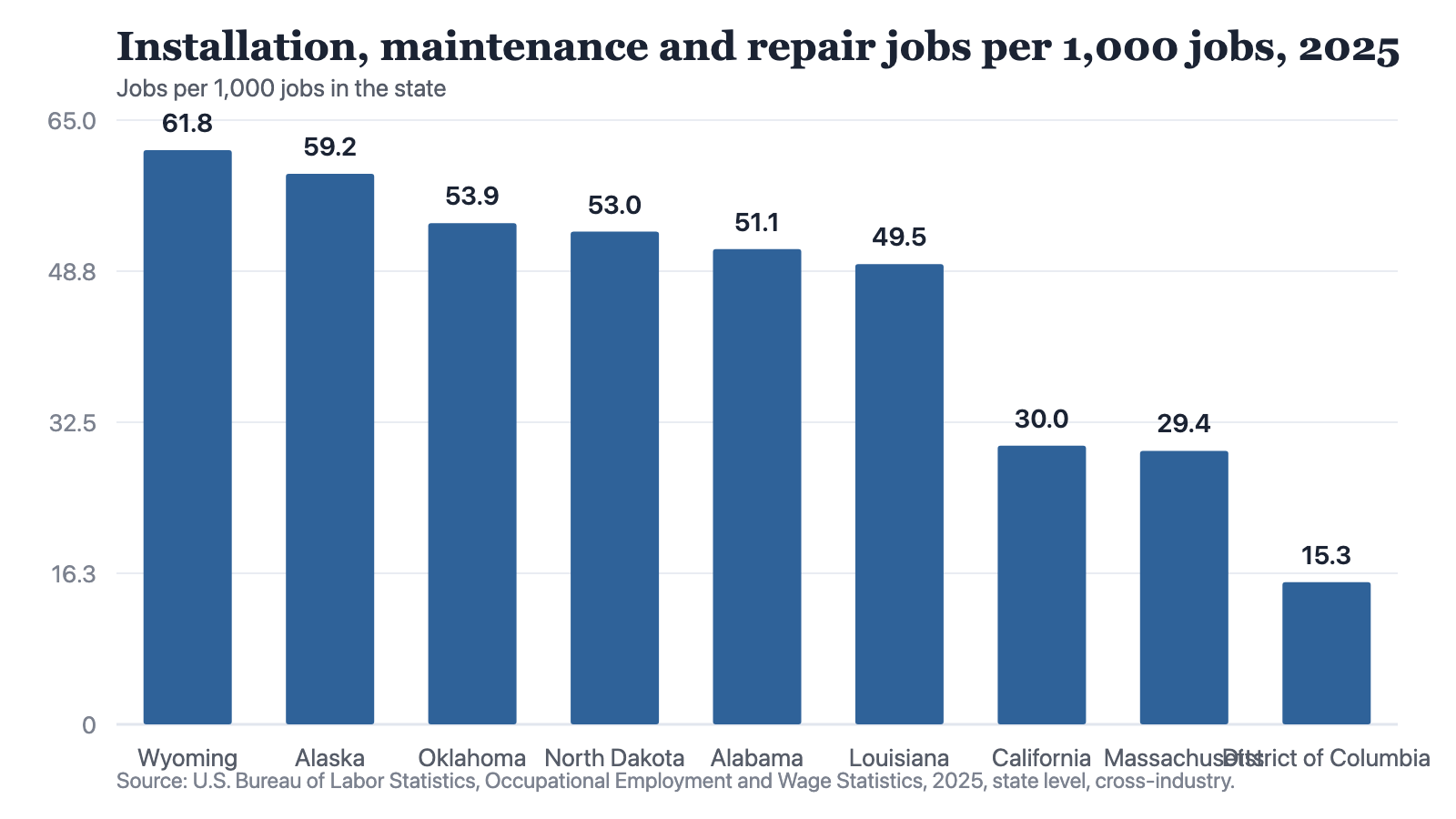
Notes: Source: U.S. Bureau of Labor Statistics, Occupational Employment and Wage Statistics, 2025, state level, cross-industry. All industries, not project work.
Source: The Cefa Brief
Chart description
Nine horizontal bars in descending order. Wyoming leads at 61.8 jobs per 1,000, with Alaska close behind at 59.2. Oklahoma, North Dakota, Alabama and Louisiana form a tight block between 53.9 and 49.5. Then the chart steps down sharply: California at 30.0 and Massachusetts at 29.4 sit at roughly half the leading bar, and the District of Columbia at 15.3 is a quarter of it. The pattern separates resource and heavy-industry states from service-weighted ones.
Nine horizontal bars in descending order. Wyoming leads at 61.8 jobs per 1,000, with Alaska close behind at 59.2. Oklahoma, North Dakota, Alabama and Louisiana form a tight block between 53.9 and 49.5. Then the chart steps down sharply: California at 30.0 and Massachusetts at 29.4 sit at roughly half the leading bar, and the District of Columbia at 15.3 is a quarter of it. The pattern separates resource and heavy-industry states from service-weighted ones.
Schedule risk is what the guarantee is mostly absorbing, and schedule risk in the commissioning period is partly a labour question. Getting from a plant that starts to a plant that holds its rated output for a month is fitting, calibration, fault-finding and repeat testing, done by the maintenance and repair trades. A market where that trade base is thick relative to everything else has a deeper bench to draw on; a market where it is thin is competing for the same people with every other employer that owns equipment. The chart is not a forecast about any project and the survey counts all industries rather than construction sites. It shows that the bench a project draws from runs from 61.8 jobs per 1,000 at the top of the chart to 15.3 at the bottom, which is the kind of variance a guarantee has to be sized against.
Where the argument sits
Three terms carry the negotiation. The first is whether the guarantee is uncapped or capped at a stated sum, since a cap turns an open promise into a priced one. The second is the longstop date, because a sponsor that misses it can owe the whole loan on a project that is nearly finished. The third is the guarantor's own credit, which is why lenders ask for the parent rather than the project subsidiary and add rating triggers requiring a letter of credit if the parent is downgraded. Sponsors answer that an uncapped guarantee with a tight longstop puts the whole balance sheet behind one asset and makes the financing recourse in all but name. Lenders answer that a capped guarantee releasing on mechanical completion leaves them holding a plant that has never been proved to work.
The test to apply is to read the definition rather than the headline. In any description of a project financing, find the sentence that defines completion and check whether it requires sustained performance certified by an independent engineer or only that construction has finished. Then find the release date and the longstop date. If completion is defined loosely, the guarantee ends before the risk does, and whatever the financing is called, the lenders have taken construction risk without being paid for it.
About the author
Each author told us that for this piece they hold no interest a reader would think relevant.
Explainers are written and kept up to date by The Cefa Brief’s editors. An Explainer is background CEFA stands behind. It is not one author’s argument, and it is not a CEFA position on what anyone should do. If something here is wrong or out of date, write to applied@thecefa.org.
© 2026 Center for Economics & Foreign Affairs. To republish it, see our republication terms. Republishing
Share
The Cefa Brief · applied.thecefa.org/cefa-brief/what-a-completion-guarantee-covers · Printed from the web edition