
What upstream and downstream mean in an energy supply chain
The words split an industry into three stages with different economics, different regulators and different failure modes. By the end you will know where each boundary falls and why the stage a policy attaches to decides who pays for it.
Prepared by
Last reviewed Published 3 minute read

Illustration : The Cefa Brief
Upstream, midstream and downstream divide an industry by what has happened to the material. Upstream covers everything up to the point where the raw material is out of the ground and fit to be moved. Midstream is the moving and the storing. Downstream is the conversion into products and their sale. The vocabulary began in petroleum and has been borrowed since by mining, chemicals and semiconductors, where the stages differ but the logic of the split is the same.
The division is not decorative, because each stage earns its money in a different way. Upstream margin tracks the commodity price almost directly: the cost of lifting a barrel is roughly fixed, so the profit is whatever the price happens to be that quarter. Midstream behaves like a toll road, charging a fee per unit moved under long contracts, which is why it is valued as infrastructure rather than as a commodity business. Downstream earns the spread between what the input costs and what the products fetch, which means a refiner can have an excellent year while the price of crude is falling.
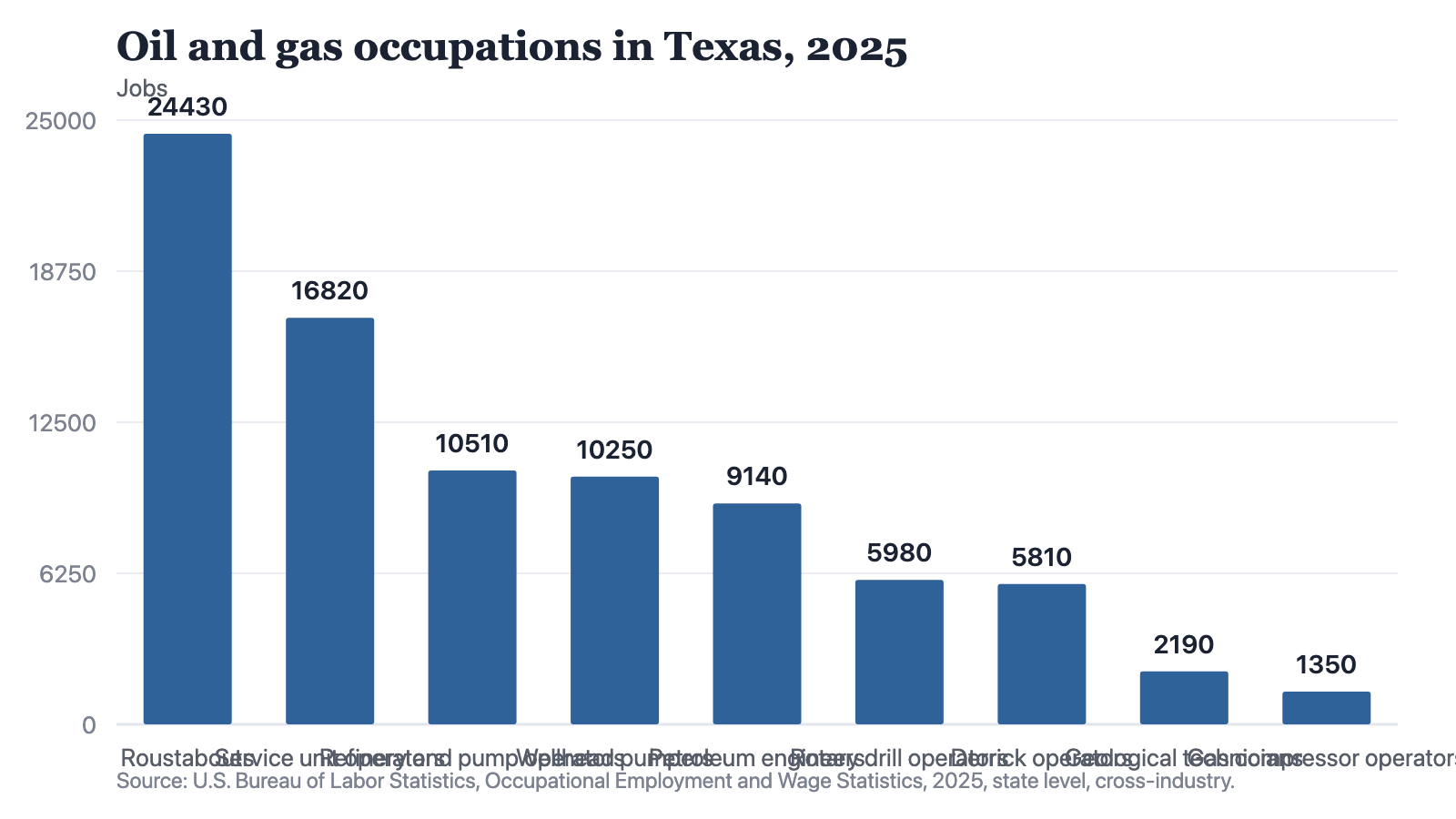
Notes: Field and drilling work at one end, pipelines and refining at the other. Occupations Texas holds at an ordinary national share are not shown. Bar labels are shortened to fit. Their full Bureau of Labor Statistics titles are: Petroleum Pump System Operators, Refinery Operators, and Gaugers; Pump Operators, Except Wellhead Pumpers; Derrick Operators, Oil and Gas; Roustabouts, Oil and Gas. A shortened label covers exactly the occupation its full title names, no more and no less.
Source: The Cefa Brief
Chart description
Nine bars ordered from longest to shortest. Roustabouts, the general field labour on producing sites, is much the longest at 24,430 jobs, clearly ahead of service unit operators at 16,820. Three bars of similar length sit in the middle: refinery and pump operators at 10,510, wellhead pumpers at 10,250 and petroleum engineers at 9,140. Then a matched pair, rotary drill operators at 5,980 and derrick operators at 5,810. The last two are far shorter than anything above them: geological technicians at 2,190 and gas compressor operators at 1,350. The shape is a heavy head of field occupations and a thin tail of technical and pipeline ones.
Nine bars ordered from longest to shortest. Roustabouts, the general field labour on producing sites, is much the longest at 24,430 jobs, clearly ahead of service unit operators at 16,820. Three bars of similar length sit in the middle: refinery and pump operators at 10,510, wellhead pumpers at 10,250 and petroleum engineers at 9,140. Then a matched pair, rotary drill operators at 5,980 and derrick operators at 5,810. The last two are far shorter than anything above them: geological technicians at 2,190 and gas compressor operators at 1,350. The shape is a heavy head of field occupations and a thin tail of technical and pipeline ones.
Where the boundaries fall
- Upstream is exploration, drilling, completion and production. The occupations are geological technicians, drill and derrick crews, wellhead pumpers, and the field labour that keeps producing sites running.
- Midstream is gathering lines, trunk pipelines, compression, storage, and the terminals where material changes carrier. The occupations are compressor and pumping station operators and the trades that maintain the line.
- Downstream is refineries and petrochemical plants, and the distribution and retail of finished products. The occupations are process operators and the maintenance trades that keep a continuous plant running.
Why the line decides who a policy touches
Almost every instrument in energy policy attaches to one stage and not the others. Leasing terms and royalty rates are upstream: they change what it costs to take the resource out, and they reach the operator of the well. Pipeline siting and tariff regulation are midstream: they change what it costs to move, and they reach a company that may own none of the molecules in its own pipe. Fuel specifications, emissions rules on process plants and product taxes are downstream. A measure aimed at production but written as a downstream rule will be absorbed by refiners and passed on to consumers long before it changes anybody's drilling plan.
The stages also break at different speeds. Upstream capacity can be added within months when the price justifies it, because drilling a well is quick compared with anything else in the chain. Midstream is a permitting and construction problem measured in years. Downstream is slower still, and in most wealthy countries the number of plants has been falling for decades rather than rising. That is why shortages rarely appear where people expect them. The binding constraint tends to be the stage with the longest build time, not the stage with the least material in the ground.
Ask which stage a rule attaches to. The answer usually tells you who pays for it.
The boundary between midstream and downstream is genuinely contested, and not only as vocabulary. Plants that strip liquids out of natural gas are treated as upstream by some classifications and midstream by others, and the choice changes which regulator has jurisdiction, how the asset is taxed, and how it is valued when it is sold. Analysts also disagree about integration. One view is that a company spanning all three stages is insulated, because the stages rarely have bad years at the same time. The other is that integration conceals which part of the business is actually earning, and that investors discount the mixture against the sum of its parts for exactly that reason.
When a company, a country or a programme is described as a major energy player, ask which stage it occupies and which it only buys from. A state with large reserves and no refineries is upstream only, and sells at whatever the market pays for raw material. A state with refineries and no reserves is downstream only, and lives at the mercy of whoever sells it feedstock. The two have opposite vulnerabilities, and neither of them is visible in a figure for total production.
About the author
Each author told us that for this piece they hold no interest a reader would think relevant.
Explainers are written and kept up to date by The Cefa Brief’s editors. An Explainer is background CEFA stands behind. It is not one author’s argument, and it is not a CEFA position on what anyone should do. If something here is wrong or out of date, write to applied@thecefa.org.
© 2026 Center for Economics & Foreign Affairs. To republish it, see our republication terms. Republishing
Share
Related

The Cefa Brief · applied.thecefa.org/cefa-brief/what-upstream-and-downstream-mean · Printed from the web edition