
What a permitting timeline is made of
A permit is the last document in a sequence, not a single decision. By the end you will be able to name the separate stages a permitting clock runs through, and say which of them a given reform would actually shorten.
Prepared by
Last reviewed Published 3 minute read

Illustration : The Cefa Brief
A permit is a document. The timeline people argue about is the sequence that produces it, and that sequence is made of parts that behave differently. Some of it is agency work. Some of it is the applicant's own work. Some of it is neither: it is a file sitting in a queue while somebody else's file is read.
Treating all of it as one number is what makes permitting debates circular. Two officials can both be telling the truth when one says review took a few weeks and the other says the project waited years, because they are measuring different segments of the same line.
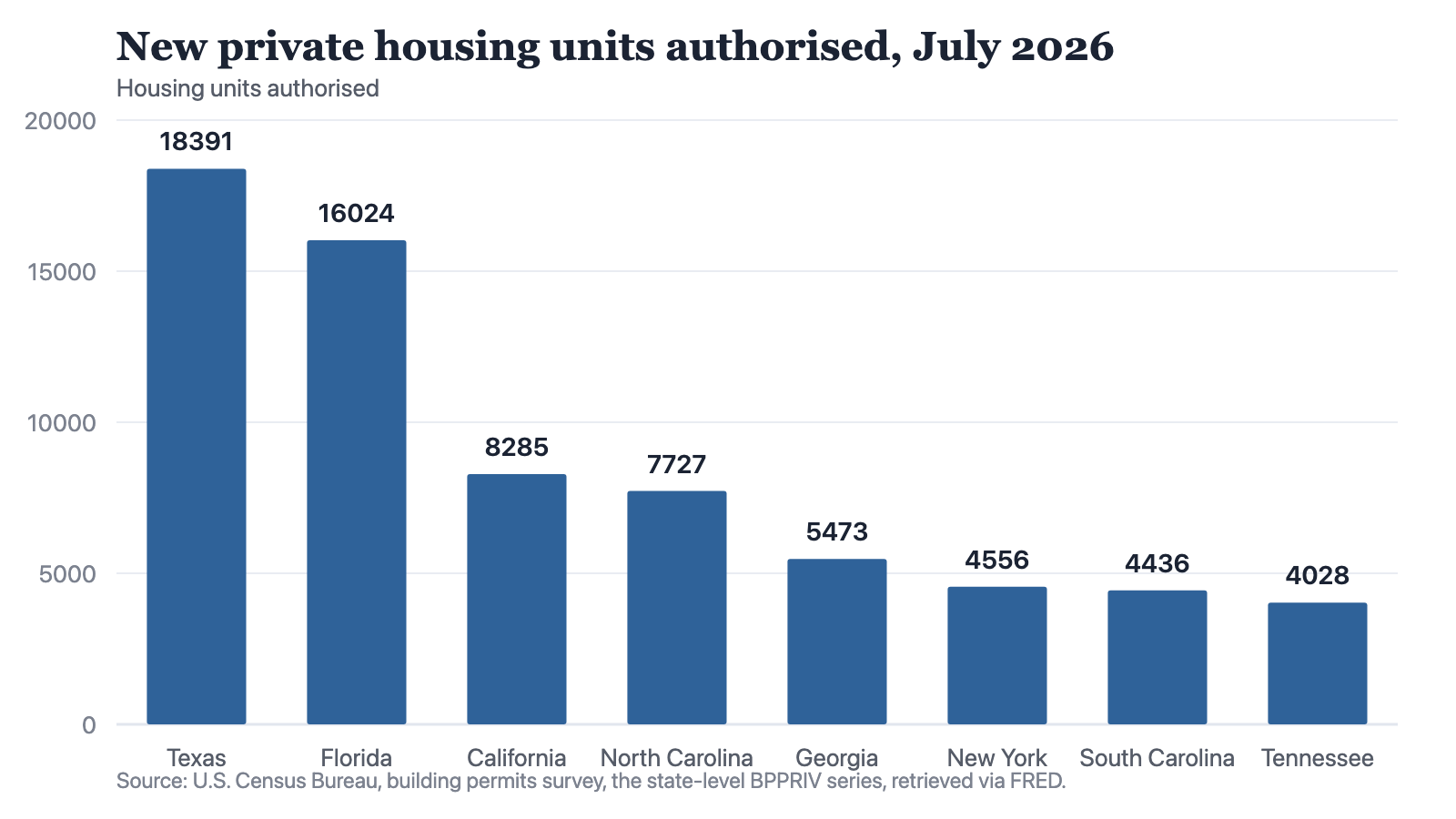
Notes: A permit count measures output, not duration. These are authorisations issued in one month, not projects that cleared review in one month.
Source: The Cefa Brief
Chart description
Eight bars in descending order. Texas is the tallest at 18,391 units authorised and Florida is close behind at 16,024, so the chart opens with a pair well clear of everything else. The third bar, California at 8,285, is about half the height of Florida's, and North Carolina at 7,727 sits just below it. The remaining four form a flat tail between roughly five and a half thousand and four thousand units: Georgia at 5,473, New York at 4,556, South Carolina at 4,436 and Tennessee at 4,028. The overall shape is a steep drop from the leading pair into a long, nearly level tail.
Eight bars in descending order. Texas is the tallest at 18,391 units authorised and Florida is close behind at 16,024, so the chart opens with a pair well clear of everything else. The third bar, California at 8,285, is about half the height of Florida's, and North Carolina at 7,727 sits just below it. The remaining four form a flat tail between roughly five and a half thousand and four thousand units: Georgia at 5,473, New York at 4,556, South Carolina at 4,436 and Tennessee at 4,028. The overall shape is a steep drop from the leading pair into a long, nearly level tail.
The stages a clock runs through
Most permitting regimes, whatever the sector and whatever the level of government, contain the same stations in roughly the same order. The names change from statute to statute. The work does not.
- Pre-application contact, in which the applicant learns what the agency will want and the agency learns what is coming.
- Intake and completeness review, in which an application is either accepted or returned for missing material. A returned application usually stops the official clock and restarts it on resubmission.
- Substantive review by the lead agency against whatever standard governs the decision.
- Referral to the other bodies whose consent is required — environmental, historic, utility, fire, transport — each running its own clock, sometimes in parallel and sometimes not.
- Public notice and comment, and any hearing the statute requires.
- Decision, with conditions attached to it.
- The challenge window, during which the decision can still be appealed and is not yet safe to build on.
Where the time actually goes
The two stages that most often dominate are the two least likely to appear in an agency's published performance figure. The first is queue time before substantive review begins, which is a function of staffing rather than statute. The second is the loop between completeness review and resubmission, which belongs partly to the applicant and is therefore easy for an agency to exclude from its own average without anyone alleging bad faith.
Sequencing matters as much as duration. Consents that could be sought at the same time are routinely sought one after another, because the second body will not open a file until the first has closed one. Very little in the underlying statutes requires that order. It is administrative habit, and it is the part of a timeline that costs nothing to change.
Where analysts genuinely disagree is over which segment binds. One camp holds that the constraint is statutory: the scope of review the law requires, and the exposure to litigation afterwards, which pushes agencies to build records thick enough to survive a challenge. The other holds that the constraint is capacity: too few reviewers, ageing case-management systems, and a queue that would clear under any statute if it were staffed. The two diagnoses point at different reforms, and a reform aimed at the wrong segment can shorten a published statistic without shortening anything a builder experiences.
So when a permitting figure is quoted, put three questions to it. Which event starts the clock — first contact with the agency, or the day a complete application was accepted? Which event stops it — the decision, or the end of the window in which that decision can be challenged? And does the count include the periods when the file was back with the applicant? A timeline that begins at completeness and ends at issuance can look short in a jurisdiction where nothing gets built.
About the author
Each author told us that for this piece they hold no interest a reader would think relevant.
Explainers are written and kept up to date by The Cefa Brief’s editors. An Explainer is background CEFA stands behind. It is not one author’s argument, and it is not a CEFA position on what anyone should do. If something here is wrong or out of date, write to applied@thecefa.org.
© 2026 Center for Economics & Foreign Affairs. To republish it, see our republication terms. Republishing
Share
The Cefa Brief · applied.thecefa.org/cefa-brief/what-a-permitting-timeline-is-made-of · Printed from the web edition