
DécryptageStates & Communities
What a new business application actually counts
Business applications are the fastest local signal of new enterprise, and the most often oversold. By the end you will know what the filing is, how far it sits from a business with employees, and what the count cannot tell a city.
Prepared by
Last reviewed Published 2 minute read

Illustration : The Cefa Brief
A business application is a filing with the Internal Revenue Service for an employer identification number, the tax number a firm needs to open a bank account, register with a state, or put anyone on a payroll. The Census Bureau counts those filings, strips out the categories that are plainly not businesses, such as estates and trusts, assigns each one to a state, and publishes the totals. That is the whole of the statistic. It is a count of paperwork with a stated business purpose.
Its appeal to a mayor’s office is speed. Most economic statistics describe a quarter or a year that has already closed. Applications are filed online and counted monthly, so they turn before employment does, and they turn sharply. That is also the source of most of the trouble people get into with them.
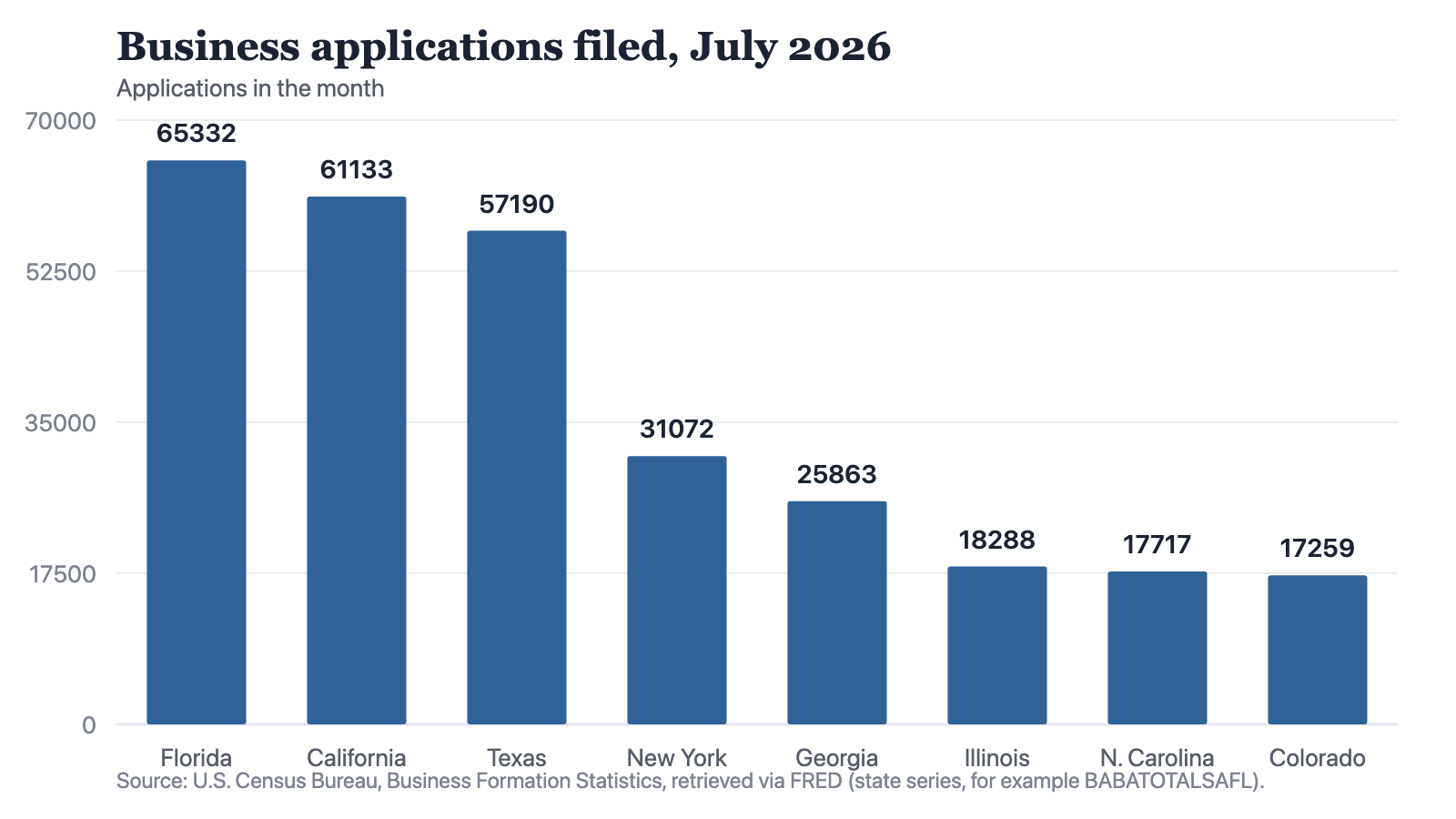
Notes: U.S. Census Bureau, Business Formation Statistics, retrieved via FRED (state series). Applications filed in July 2026. An application is a tax registration, not an operating business.
Source: The Cefa Brief
Chart description
Eight bars of business applications filed in July 2026. Florida is tallest at 65,332, with California at 61,133 and Texas at 57,190 close behind, so the first three bars are of a similar height and stand far above the rest. New York follows at 31,072, roughly half of Florida, and Georgia at 25,863. The final three are tightly bunched and short: Illinois at 18,288, North Carolina at 17,717 and Colorado at 17,259, each about a quarter of the leading bar. The ordering tracks the size of the states as much as anything else, which is the chart’s main caution: these are raw monthly counts, not rates per head.
Eight bars of business applications filed in July 2026. Florida is tallest at 65,332, with California at 61,133 and Texas at 57,190 close behind, so the first three bars are of a similar height and stand far above the rest. New York follows at 31,072, roughly half of Florida, and Georgia at 25,863. The final three are tightly bunched and short: Illinois at 18,288, North Carolina at 17,717 and Colorado at 17,259, each about a quarter of the leading bar. The ordering tracks the size of the states as much as anything else, which is the chart’s main caution: these are raw monthly counts, not rates per head.
What the filing is, and is not
An application is a registration. It is not a lease, a loan, a first customer or a payroll. One person can file several in a year, one for each entity, and a single filing can stand behind a consulting practice, a rental property company, a holding entity created for a single transaction, or a firm that will employ two hundred people. The count treats all of them alike, because at the moment of filing the tax system cannot tell them apart either.
- It counts filings, not firms, so one owner with three entities appears three times.
- It counts intent at a single moment, before any capital is spent or any premises taken.
- It carries no measure of size, revenue or employment.
- It is a raw count by state, so comparing two states compares their populations as well as their business formation.
- It says nothing about survival, because a filing that closes within a year is never subtracted.
From a filing to a payroll
The Census Bureau knows the gap is the interesting part, so it publishes more than the headline total. It separates applications with characteristics associated with becoming employers, such as a stated plan to pay wages or an industry that ordinarily hires, from the rest. It then follows filings forward and reports how many became businesses with payroll within four quarters and within eight. The distance between the count on the chart and those later figures is where a local claim about new businesses either holds up or does not.
A filing is intent. Payroll is a business. The statistic measures the first and is cited as though it measured the second.
Where the disagreement is real
Economists do not agree about what the rise in applications since 2020 represents. One reading is a genuine broadening of entrepreneurship, helped by cheaper online formation, remote work and the movement of people between states. Another is a change in legal packaging: contractors, gig workers and sole proprietors incorporating activity they were already doing, partly for tax and liability reasons. The two readings imply very different things for a local economy, and the application count alone cannot separate them, which is why the follow-on employer figures matter more than the monthly headline.
When a local official announces a record number of new businesses, apply one test. Ask how many of those filings had employees on a payroll a year later, and ask whether the comparison being drawn is against the same place’s own record rather than against a larger state. If neither answer is available, what has been announced is a count of forms.
About the author
Each author told us that for this piece they hold no interest a reader would think relevant.
Explainers are written and kept up to date by The Cefa Brief’s editors. An Explainer is background CEFA stands behind. It is not one author’s argument, and it is not a CEFA position on what anyone should do. If something here is wrong or out of date, write to applied@thecefa.org.
© 2026 Center for Economics & Foreign Affairs. To republish it, see our republication terms. Republishing
Share
The Cefa Brief · applied.thecefa.org/cefa-brief/what-a-business-application-counts · Printed from the web edition