
DécryptageInternational Partners
What a bilateral tax treaty changes for an investor
A tax treaty is not a tax cut. By the end of this you will know which government gives up what, why the permanent establishment article decides more than the rate articles do, and which taxes a treaty never reaches.
Prepared by
Last reviewed Published 3 minute read

Illustration : The Cefa Brief
A tax treaty is not a tax cut, and it does not lower anybody's rate in general. It is an allocation agreement between two governments about which of them may tax a given item of income when a resident of one earns it in the other, and how much the country where the income arises may keep at the border.
Without a treaty, double taxation is the default rather than the accident. The country where a payment originates withholds at its own statutory rate on dividends, interest and royalties as the money leaves. The country where the recipient is resident then taxes the same income again as part of worldwide income, and allows a credit for foreign tax that is capped, bound to a period, and frequently incomplete. The gap between the tax paid abroad and the credit allowed at home is a real cost, and compressing it is what the treaty is for.
Permanent establishment is the pivot
The most consequential article defines a permanent establishment. Below that threshold, business profits earned in the other country are taxable only at home. Above it, the other country may tax the profits attributable to the local presence, and the investor acquires a filing obligation, a transfer pricing question and an audit exposure it did not have the week before. The definition turns on a fixed place of business, or on an agent who habitually concludes contracts on the company's behalf, and treaties add a duration threshold for construction and installation sites. That duration is negotiated pair by pair. It is not a standard number, and a construction programme can cross it without anyone having decided to.
Around that pivot sit the working articles. Reduced withholding rates by category of income. A tie-breaker that assigns a single residence when both countries claim one. A mutual agreement procedure for disputes. Exchange of information between the two tax administrations. And a limitation on benefits article, whose purpose is to stop a company resident in a third country from renting the treaty through a shell.
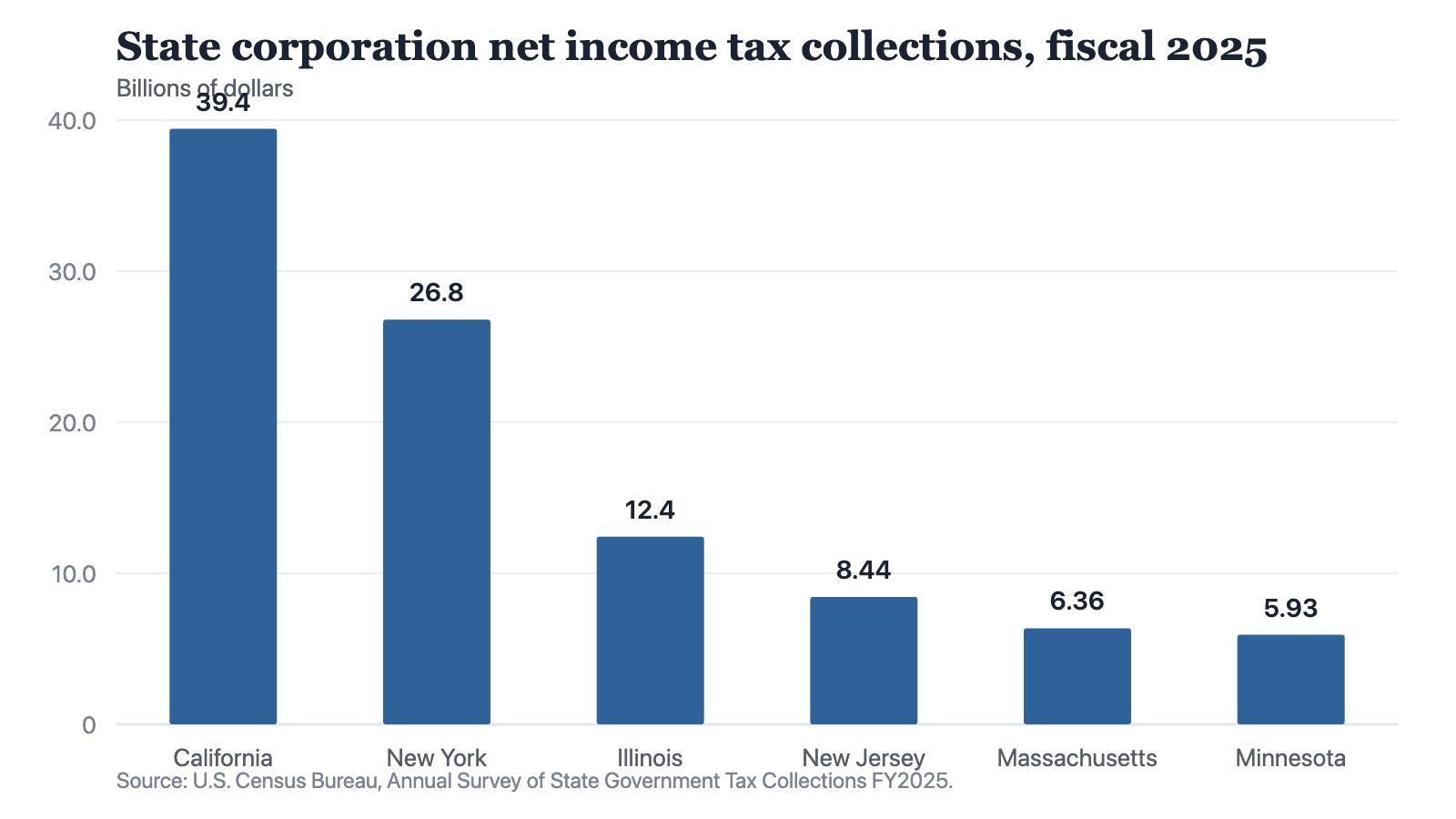
Notes: Nevada, Texas, Washington and Wyoming levied no corporation net income tax in fiscal 2025 and so do not appear. Collections are state aggregates for the year, not rates faced by any one company. Source: U.S. Census Bureau, Annual Survey of State Government Tax Collections FY2025.
Source: The Cefa Brief
Chart description
A bar chart of six bars in billions of dollars. California is by far the tallest at 39.42, followed by New York at 26.79. Illinois at 12.42 is under half of New York. New Jersey at 8.44, Massachusetts at 6.36 and Minnesota at 5.93 form a low tail. The top two bars together exceed the other four combined.
A bar chart of six bars in billions of dollars. California is by far the tallest at 39.42, followed by New York at 26.79. Illinois at 12.42 is under half of New York. New Jersey at 8.44, Massachusetts at 6.36 and Minnesota at 5.93 form a low tail. The top two bars together exceed the other four combined.
The chart is here to mark the treaty's edge. A tax treaty binds the federal government, which negotiated and ratified it. The states are not parties to it and are not bound by it. In fiscal 2025 California collected 39.42 billion dollars in corporation net income tax and New York 26.79 billion, while Nevada, Texas, Washington and Wyoming levied no such tax at all. Washington instead collected 23.38 billion dollars that year under general sales and gross receipts taxes. An investor's treaty-protected federal position says nothing about any of it.
What the treaty does not reach
- State and local income, franchise and gross receipts taxes, levied by governments that never signed it.
- Customs duties and tariffs, which are trade instruments and sit under a different body of law.
- Payroll and social insurance contributions, which are handled by separate totalisation agreements where such agreements exist at all.
- Domestic anti-abuse rules, which many treaties expressly preserve.
- The refund itself. A reduced rate at source has to be claimed with certification, and an over-withheld amount comes back through a procedure rather than automatically.
Disputes have their own machinery. Where both countries tax the same income anyway, the investor petitions the competent authority in its own country, which then negotiates with its counterpart in the other. The taxpayer is a petitioner in that process rather than a party to it, and some treaties add arbitration if the two authorities cannot agree within a set period. It works, and it is slow, which is why structuring is normally done to avoid needing it.
Signed is not in force
A treaty signed by negotiators changes nothing on its own. It has to be ratified on both sides under each country's constitutional process and the instruments exchanged, and the effective dates commonly differ by tax: one date for amounts withheld at source, a later one for taxes charged on a full taxable year. Protocols amending an existing treaty run the same course. A financial model that assumes a reduced withholding rate from a treaty still awaiting ratification carries a timing risk nobody has priced.
Three questions settle most of it. Is the treaty in force between these two countries today, and from which date for this kind of payment. Would the structure survive the limitation on benefits article if a tax administration read it strictly. And what is the state level exposure, which the treaty never touched, which differs from state to state, and which in four states is no corporation net income tax at all.
About the author
Each author told us that for this piece they hold no interest a reader would think relevant.
Explainers are written and kept up to date by The Cefa Brief’s editors. An Explainer is background CEFA stands behind. It is not one author’s argument, and it is not a CEFA position on what anyone should do. If something here is wrong or out of date, write to applied@thecefa.org.
© 2026 Center for Economics & Foreign Affairs. To republish it, see our republication terms. Republishing
Share
The Cefa Brief · applied.thecefa.org/cefa-brief/what-a-bilateral-tax-treaty-changes · Printed from the web edition