
CommentaireStates & Communities
Four states now fund themselves on a price they do not set
Severance is 47.2 percent of North Dakota's state tax collections and 43.9 percent of Alaska's. That is not a revenue line. It is a position in a commodity, held by a government that has to write a budget every year.
by
Published 4 minute read

Illustration : The Cefa Brief
There is a category error at the centre of how severance states are discussed, and it costs them money. Severance revenue is treated as a tax like any other, subject to the same budget conventions as a sales tax or an income tax. It is not like any other. It is the proceeds of selling part of the state's balance sheet, at a price set somewhere else, and the accounting convention that calls it income is doing a great deal of quiet work.
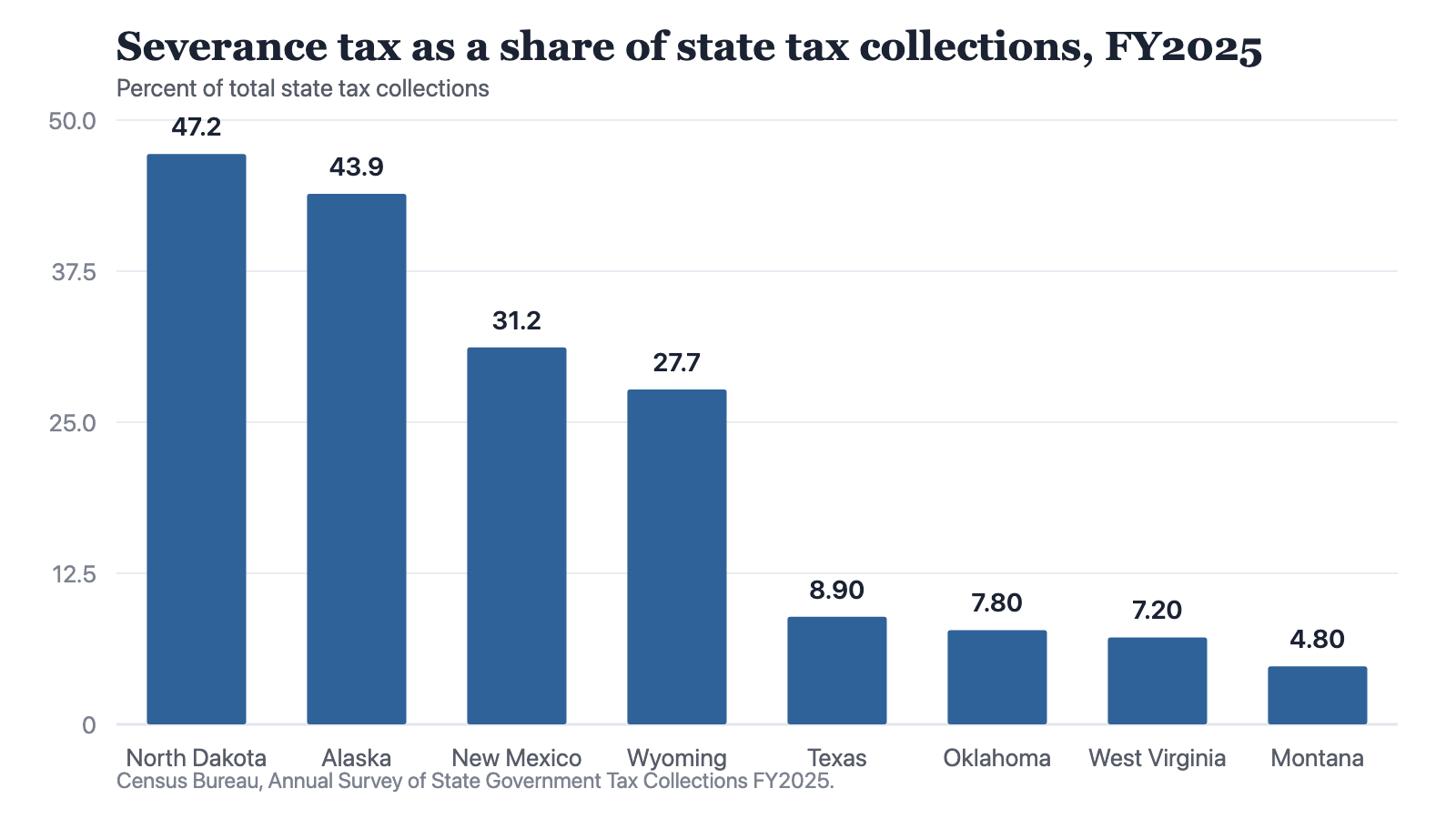
The scale is easy to state. In fiscal year 2025 North Dakota collected $2.60 billion in severance tax against $5.52 billion in total state tax collections, or 47.2 percent. Alaska collected $741 million of $1.69 billion, 43.9 percent. New Mexico collected $4.66 billion of $14.94 billion, 31.2 percent. Wyoming collected $712 million of $2.57 billion, 27.7 percent. Four states raise more than a quarter of everything they levy from extraction.
What the share actually measures
Notes: State-level collections only. Local taxes, federal royalties and private landowner payments are outside this file, so the figures understate extraction's total contribution to public revenue in these places.
Source: The Cefa Brief
Chart description
A bar chart of severance tax as a percentage of total state tax collections for fiscal year 2025. North Dakota is highest at 47.2 percent, followed by Alaska at 43.9 and New Mexico at 31.2. Wyoming is 27.7. There is then a large gap to Texas at 8.9, Oklahoma at 7.8, West Virginia at 7.2 and Montana at 4.8.
A bar chart of severance tax as a percentage of total state tax collections for fiscal year 2025. North Dakota is highest at 47.2 percent, followed by Alaska at 43.9 and New Mexico at 31.2. Wyoming is 27.7. There is then a large gap to Texas at 8.9, Oklahoma at 7.8, West Virginia at 7.2 and Montana at 4.8.
Below those four the picture changes shape entirely. Texas raises the largest severance sum in the country, $8.00 billion, and it is 8.9 percent of a tax base of $89.94 billion. Oklahoma is at 7.8 percent, West Virginia 7.2, Montana 4.8, Louisiana 2.0. The same industry produces a dominant revenue source in one state and a rounding-adjacent line in another, and the difference is not geology. It is the size of everything else.
That is the first reason the share matters more than the sum. A severance dollar in Texas is diversified by eighty-two billion dollars of other collections. A severance dollar in North Dakota is nearly half the state's own tax revenue, sitting next to $1.38 billion of general sales and $425 million of individual income tax. The exposure is not to extraction; it is to extraction relative to everything the state could tax instead.
The exposure is not to extraction. It is to extraction relative to everything the state could tax instead.
Two objections, one of them serious
The first objection is that these states know exactly what they are holding. Alaska and Wyoming both run permanent funds built from mineral revenue, which exist precisely to convert a flow into a stock. That is a real answer to the depletion problem and it deserves credit. It is not an answer to the exposure in this table, because what the table shows is the operating base: the money that pays this year's schools and troopers. A fund can hold the capital and the budget can still depend on the price.
The second objection is stronger and it is the one I would press hardest if I were defending these arrangements. Severance is partly exported. A large share of the burden falls on buyers outside the state, which means a severance dollar is cheaper politically and economically than an income-tax dollar raised from residents. Wyoming levies no individual income tax and no corporate net income tax; Alaska levies no individual income tax and has no general sales line at all. They are not neglecting to diversify. They have chosen an instrument that lets other people pay.
My answer is that exporting a tax says who bears it, not how reliably it arrives. A severance regime hands the legislature a revenue line whose size is set by a price formed in markets the state does not participate in and cannot influence. That is the definition of a position, and holding one is a legitimate choice. Reporting it as though it were a tax base is where the error enters.
What honest accounting would require
I want to be careful about what this file can and cannot show. It holds a single fiscal year. It can establish how much of a state's tax base currently depends on extraction. It cannot show volatility, because there is no second year in it, and I am not going to assert a swing I have not measured. Exposure is the claim; instability is an inference the reader can draw or decline.
- A severance state's budget documents should show the assumed commodity price on the revenue page, in the same way a pension fund shows its discount rate.
- Anyone underwriting these states, including federal partners allocating on a formula, should read the share rather than the dollar total. North Dakota at 47.2 percent and Texas at 8.9 percent are not the same kind of counterparty.
- The fifteen jurisdictions that record no severance line at all are not comparable to the four that record a line of zero. The Census file marks a tax the state does not levy differently from one it levies that yielded nothing, and collapsing the two loses a real distinction.
None of this is an argument against extraction or against taxing it. A state sitting on a resource should charge for it, and charge well. The argument is about the label. Call the line what it is, a distribution from an asset that is being consumed, and the questions that follow are the right ones: how much of it should be spent this year, how much should be converted into something that outlasts the deposit, and what the budget looks like at a price nobody wants to put in the forecast.
About the author

Each author told us that for this piece they hold no interest a reader would think relevant.
This commentary carries its author's name because the view in it is the author's own. An editor reviewed it before publication, which is not the same as agreeing with it. It is not a position of the Center for Economics & Foreign Affairs or of Applied America.
© 2026. The author or authors hold the copyright in this commentary; CEFA publishes it with their permission. This edition, its editing and its presentation are © 2026 Center for Economics & Foreign Affairs. To republish it, see our republication terms. Republishing
Share
The Cefa Brief · applied.thecefa.org/cefa-brief/severance-is-a-position · Printed from the web edition