
ExplicativoStates & Communities
Building permits and what they signal before the construction shows up
A permit is an authorisation, not a building. By the end you will know why the series moves before construction spending does, and why a single month of it is close to useless on its own.
Prepared by
Last reviewed Published 3 minute read

Ilustración: The Cefa Brief
A building permit is a local government's authorisation to construct. Before ground is broken in almost every populated part of the United States, someone applies to a city or a county, and the jurisdiction issues a permit covering a stated number of housing units. The Census Bureau collects those counts from the jurisdictions that issue them and publishes them every month, by state and by metropolitan area, with no sampling of builders and no waiting for anyone to report a sale.
The sequence is what makes the series useful. A permit is issued, then the project starts, then it is completed, then someone moves in. Each step takes time, and the gaps run to months for a single-family house and longer for an apartment building. Anything that changes a builder's mind, whether the cost of money, the price of materials or the expected price of the finished unit, shows up in permits before it shows up in construction spending, in employment on site, or in completed homes.
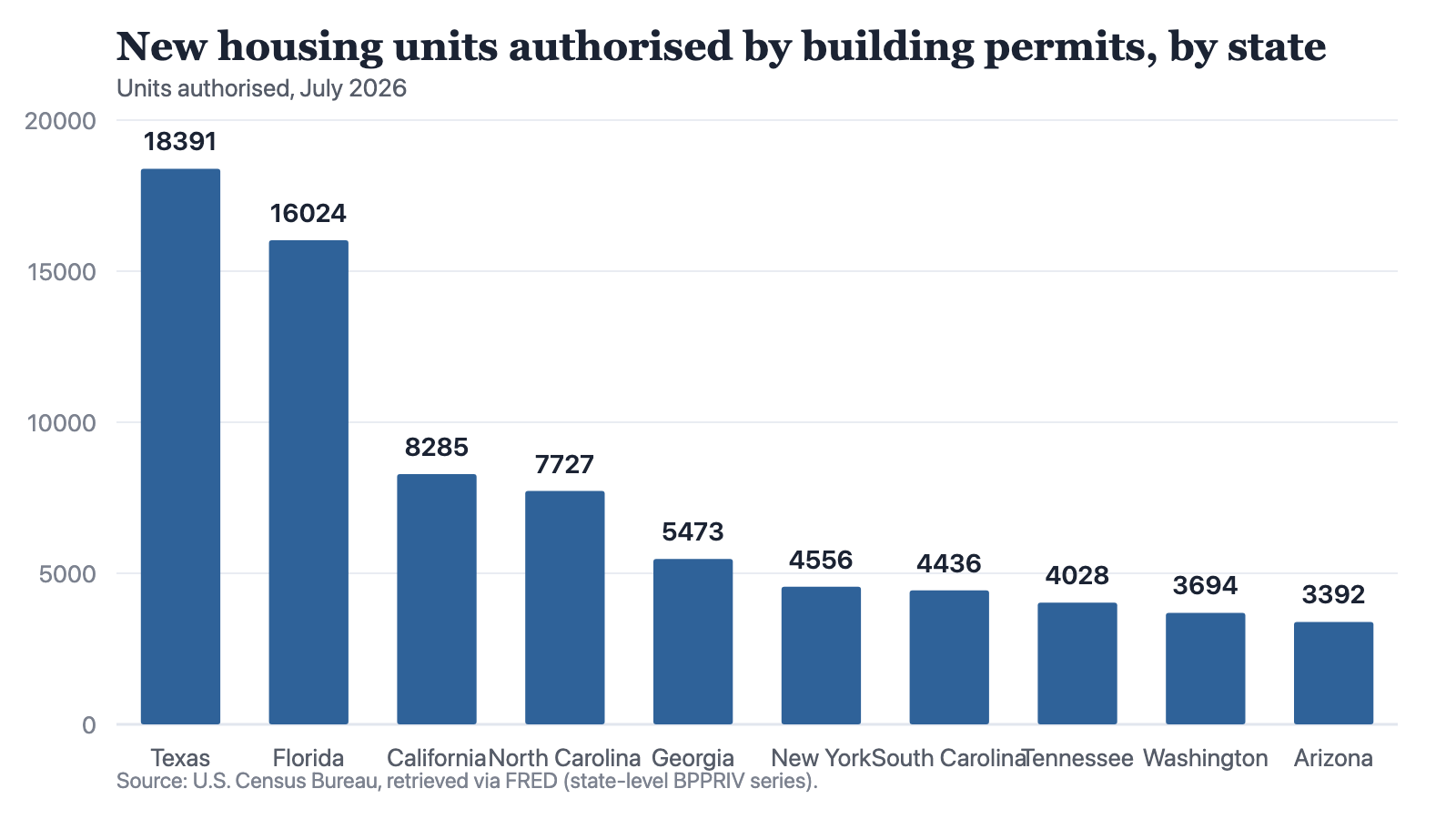
Notes: Source: U.S. Census Bureau, retrieved via FRED (state-level BPPRIV series). Units authorised are not units started; permits lapse and projects are shelved.
Source: The Cefa Brief
Chart description
Ten bars, ordered from most units to fewest. Texas is longest at 18,391 units authorised and Florida is close behind at 16,024, so the pair dominates the chart. California follows at 8,285 and North Carolina at 7,727, a clear step down from the top two. The remaining six bars descend gently and stay close together: Georgia at 5,473, New York at 4,556, South Carolina at 4,436, Tennessee at 4,028, Washington at 3,694 and Arizona at 3,392. The shape is a steep drop after the first two states and then a long shallow tail.
Ten bars, ordered from most units to fewest. Texas is longest at 18,391 units authorised and Florida is close behind at 16,024, so the pair dominates the chart. California follows at 8,285 and North Carolina at 7,727, a clear step down from the top two. The remaining six bars descend gently and stay close together: Georgia at 5,473, New York at 4,556, South Carolina at 4,436, Tennessee at 4,028, Washington at 3,694 and Arizona at 3,392. The shape is a steep drop after the first two states and then a long shallow tail.
What the count actually counts
The number is units authorised, not projects, dollars or square feet. A studio in a mid-rise counts as one unit and a five-bedroom house counts as one unit. A single approval for a large apartment building can add hundreds of units to a state's month. That is not a flaw in the data. It is what the data is. But it means an identical total can sit on top of a completely different mix, and the mix is what determines how much construction work, spending and material the total implies.
Nor is a permit a start. Permits expire. Projects are shelved when financing falls through. In some periods the interval between authorisation and ground-breaking widens for reasons that have nothing to do with demand for housing. The Census Bureau publishes housing starts as a separate series for exactly this reason.
A permit records a decision to build. It does not record a building.
One month is noise
The monthly state series is volatile, and the smaller the jurisdiction the more violent the swings. The District of Columbia, Connecticut, Massachusetts and Arizona all authorised fewer units in July 2026 than in June; Ohio and Nebraska authorised more. California fell over the same two months and Texas rose. None of that requires an economic explanation. In a small jurisdiction, one approved apartment complex, or one that slipped across a month boundary, is the entire signal.
- Check whether the figure is a single month or a moving average. Single months move for administrative reasons as often as economic ones.
- Check the size of the place. In a small state one project can dominate the total; in Texas or Florida it cannot.
- Check whether single-family and multifamily units are separated. They respond to different pressures and at different speeds, and a total hides the difference.
- Check what the comparison is against. A month set against the same month a year earlier removes the seasonal pattern that a month-against-month comparison leaves in.
Where forecasters disagree
That permits lead is not in dispute. How long the lead is, and how much it is worth, very much is. Some forecasters treat permits as the most reliable early indicator available at state level, on the grounds that they are administrative records rather than survey responses, so they arrive quickly and close to complete. Others argue the lead has lengthened and loosened: approval-to-start times have grown in many jurisdictions, and a larger share of authorised multifamily units now waits on financing that may never arrive. Both sides are reading the same series and disagreeing about how long a permit's information stays fresh.
A test you can apply. Before treating a permit number as news, ask what would have to be true for it to be an administrative artefact instead: a single large approval, a project that slipped across a month boundary, a jurisdiction that changed its fees or its staffing. If you cannot rule those out, you are looking at a data point rather than a turn.
About the author
Each author told us that for this piece they hold no interest a reader would think relevant.
Explainers are written and kept up to date by The Cefa Brief’s editors. An Explainer is background CEFA stands behind. It is not one author’s argument, and it is not a CEFA position on what anyone should do. If something here is wrong or out of date, write to applied@thecefa.org.
© 2026 Center for Economics & Foreign Affairs. To republish it, see our republication terms. Republishing
Share
The Cefa Brief · applied.thecefa.org/cefa-brief/building-permits-as-an-early-signal · Printed from the web edition