
ErklärstückInternational Partners
How a sovereign wealth fund differs from a reserve fund
Both are pools of public money held outside the spending accounts, and the names are used interchangeably. By the end of this you will know the three rules that separate them, why a resource levy so often produces one, and why a central bank's reserves are a third thing again.
Prepared by
Last reviewed Published 4 minute read

Abbildung: The Cefa Brief
A sovereign wealth fund and a reserve fund are both pools of public money held outside the ordinary spending accounts, and the two names are swapped for each other freely in announcements. They are built for different purposes, and the difference shows up in their rules rather than in their balances. A reserve fund exists to be spent. It carries a budget across a bad year, and it has done its job if the schools stayed open when revenue fell. A sovereign wealth fund exists to turn something temporary into something permanent, usually a depleting resource or a long run of surpluses, and its job is judged over decades.
Three rules define either vehicle. The deposit rule says what must go in and when. The withdrawal rule says what may come out, to whom, and on whose signature. The investment mandate says what the money may be held in. Read those three and the name on the door stops mattering.
The deposit rule does most of the work
Deposits are tied to a source. The commonest is a share of resource revenue, set as a fixed percentage of royalties or of a severance tax on production, so that the transfer happens without anyone voting for it each year. The second is a surplus rule, under which collections above a forecast or above a price threshold are swept automatically. The third is a transfer from the central bank, in which foreign exchange accumulated through monetary operations is moved into a separately managed portfolio. Only the third begins life on a central bank balance sheet, and that origin follows the money: assets moved out of reserves may still be leaned on when the country's external position is assessed.
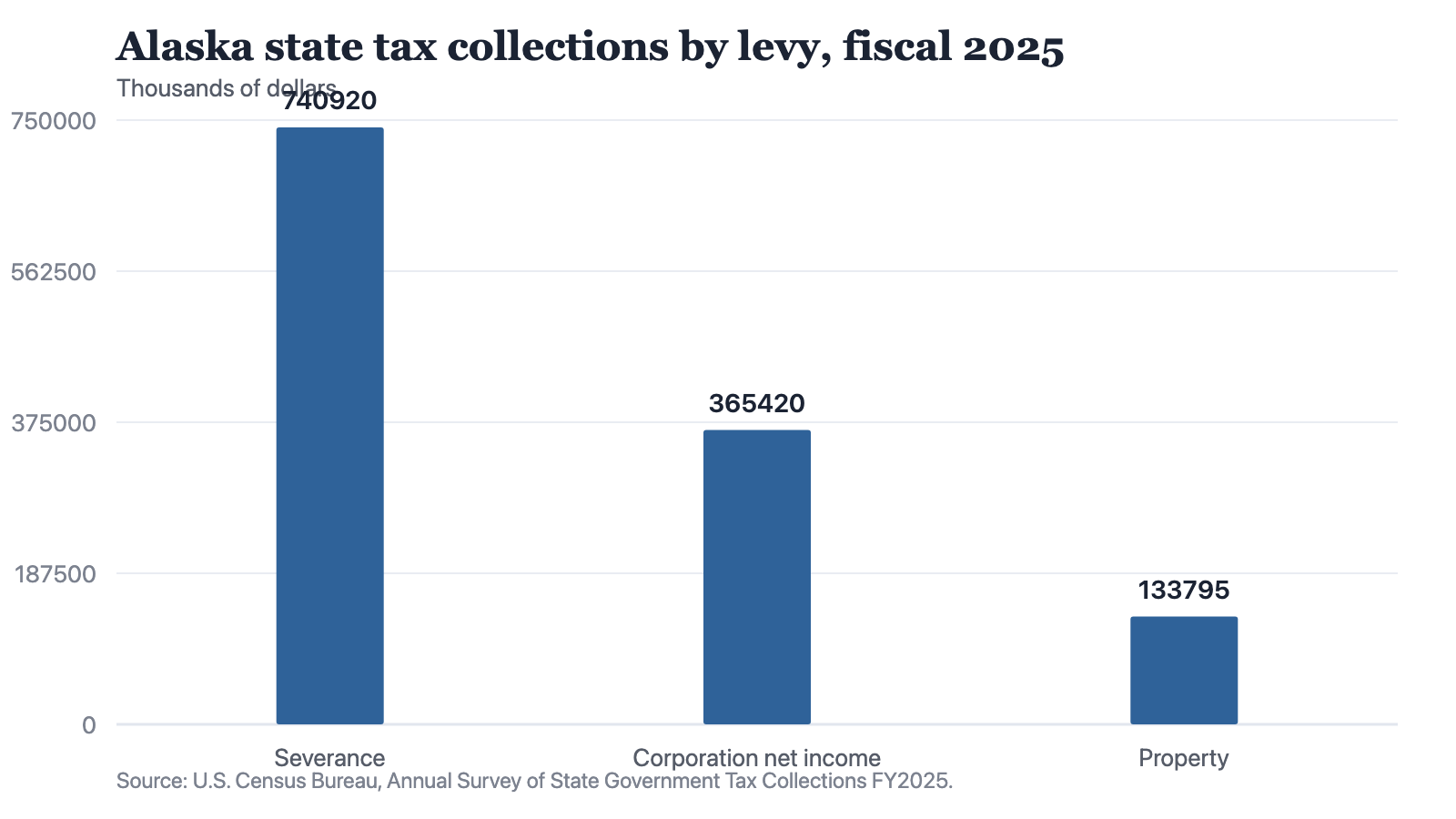
Notes: Alaska levied no individual income tax and no general sales tax in fiscal 2025; the survey records that as a fact about the statute, not as a missing value. The three bars do not sum to total collections of 1.687 billion dollars, which include levies outside the five tracked here. Source: U.S. Census Bureau, Annual Survey of State Government Tax Collections FY2025.
Source: The Cefa Brief
Chart description
A bar chart with three bars, in thousands of dollars. Severance tax is the tallest at 740,920. Corporation net income tax follows at 365,420, a little under half the height of the severance bar. Property tax is the smallest at 133,795. The two smaller bars together come to 499,215, less than the severance bar on its own.
A bar chart with three bars, in thousands of dollars. Severance tax is the tallest at 740,920. Corporation net income tax follows at 365,420, a little under half the height of the severance bar. Property tax is the smallest at 133,795. The two smaller bars together come to 499,215, less than the severance bar on its own.
Alaska shows the fact pattern that tends to produce a permanent fund. In fiscal 2025 its severance tax, levied on the production of oil and other resources, brought in 740.9 million dollars, more than its corporation net income tax and its property tax combined. The same survey records that the state levied no individual income tax and no general sales tax at all. A government funded that way is funded out of a stock of something that will eventually be gone, at a price it does not set, and the case for converting part of the flow into a financial asset while the flow lasts writes itself.
Withdrawal rules and where they are written
The withdrawal rule is where the two vehicles part for good. A reserve fund can usually be drawn on by the finance ministry under conditions the legislature is able to loosen in the same session it needs the money. A wealth fund's rule normally limits spending to income actually earned, or to a set percentage of a multi-year average of market value, which deliberately breaks the link between a good year in markets and a good year for the budget. Where the rule sits matters as much as what it says. A constitutional lock can only be undone by the process that amends a constitution. A statutory one can be undone by a majority in a hurry.
- The deposit trigger: a fixed share of a named revenue stream, or a discretionary transfer voted each year.
- The withdrawal cap: realised income only, a percentage of average market value, or an amount the legislature sets.
- The investment mandate: which asset classes are permitted, and whether domestic assets are among them.
- The governance: who appoints the board, how long they serve, and who is able to remove them.
- The reporting: what is published, how often, and whether holdings are disclosed position by position.
None of this describes a central bank's foreign exchange reserves, which are a third thing again. Reserves back monetary operations and have to be available at short notice, so they are held in liquid, low-risk instruments and are sized against short-term external obligations. A wealth fund accepts illiquidity in exchange for return. Adding the two together flatters a country's buffer, because the part that could be sold tomorrow is smaller than the combined figure suggests.
What a counterparty should ask
When such a fund turns up on the other side of an investment, the mandate is the document that matters. A fund answerable for a commercial return behaves like a financial investor and leaves when the return arrives. A fund with a development or strategic mandate may hold for a generation, may want a board seat, and may accept a lower return for something it is under no obligation to name. Neither is disqualifying. They are different counterparties, and the difference is written down before the negotiation starts.
The test is short. Ask what triggers a deposit. Ask what the fund is permitted to pay out, and to whom. Then ask whether the finance ministry could reach the money in a bad year without changing a law. If the answer to the last question is yes, it is a reserve fund, whatever the plaque on the building says.
About the author
Each author told us that for this piece they hold no interest a reader would think relevant.
Explainers are written and kept up to date by The Cefa Brief’s editors. An Explainer is background CEFA stands behind. It is not one author’s argument, and it is not a CEFA position on what anyone should do. If something here is wrong or out of date, write to applied@thecefa.org.
© 2026 Center for Economics & Foreign Affairs. To republish it, see our republication terms. Republishing
Share
The Cefa Brief · applied.thecefa.org/cefa-brief/what-a-sovereign-wealth-fund-is · Printed from the web edition