
What a municipal bond pays for and who repays it
A municipal bond is a loan from investors to a government. By the end you will know what the money is allowed to buy, which pocket the repayment comes out of, and why two bonds sold by the same city in the same week can rest on completely different promises.
Prepared by
Last reviewed Published 3 minute read

Abbildung: The Cefa Brief
A municipal bond is a loan. A government or a public authority borrows a sum from investors, spends it on something meant to last for decades, and repays the investors over twenty or thirty years out of money it has not yet collected. The word municipal is doing a great deal of work in that sentence. It covers states, counties, cities, school districts, water utilities, airports, toll roads, ports and hospital districts, and on its own it tells a reader almost nothing.
So the first question to ask about a municipal bond is not how large it is. It is who repays, and out of what. Two bonds sold by the same city in the same week can rest on entirely different promises, and the difference is usually stated in a single paragraph near the front of the offering document, under the heading Security.
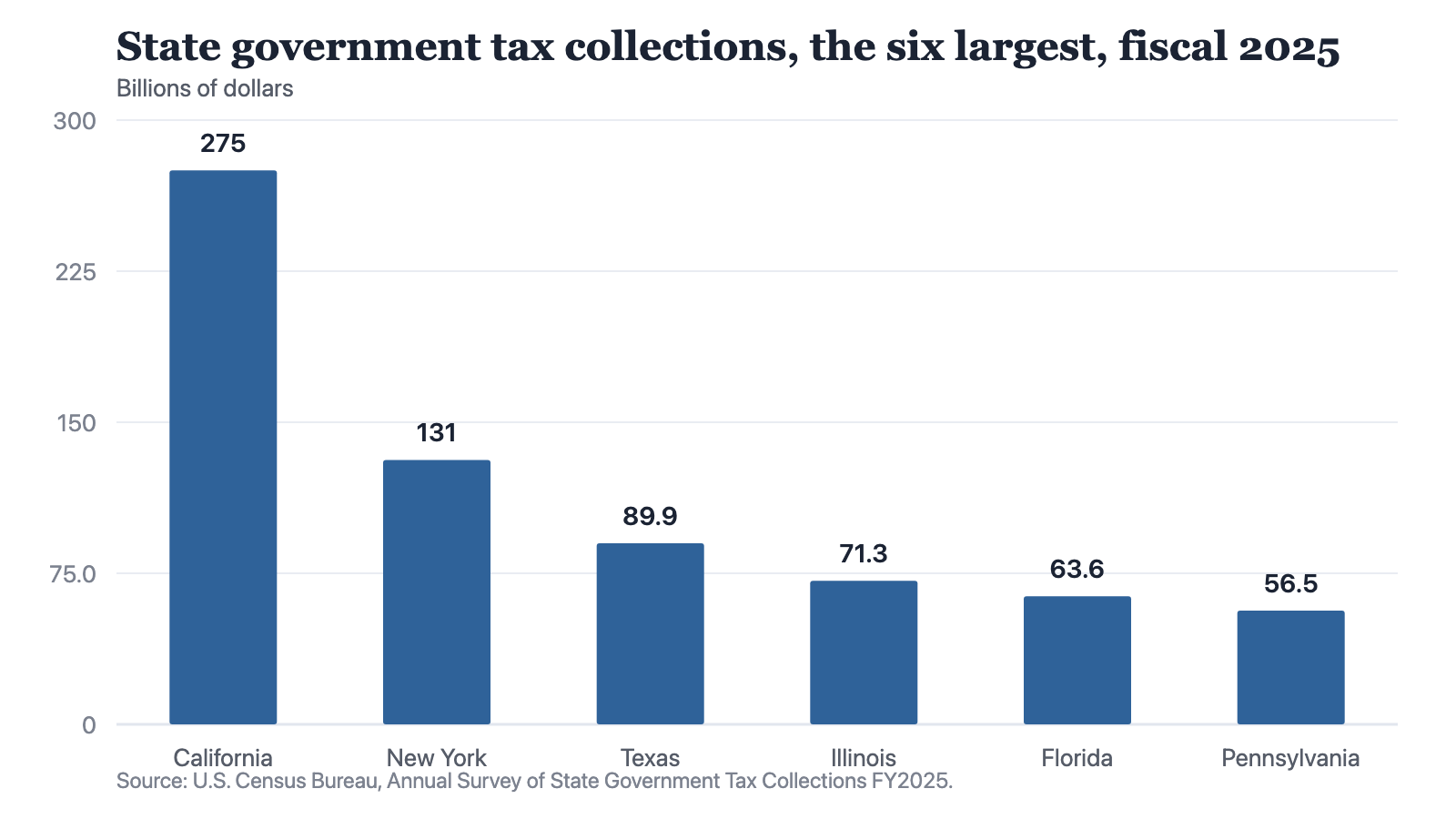
Notes: Source: U.S. Census Bureau, Annual Survey of State Government Tax Collections FY2025. State governments only; county, city, school-district and authority collections are outside this survey.
Source: The Cefa Brief
Chart description
Six vertical bars, ordered from largest to smallest. California is far the tallest at 275.0 billion dollars, more than twice the next bar. New York follows at 131.3 billion, then Texas at 89.9 billion, Illinois at 71.3 billion, Florida at 63.6 billion and Pennsylvania at 56.5 billion. The shape is a steep drop from the first bar to the second and a gentle slope across the remaining four.
Six vertical bars, ordered from largest to smallest. California is far the tallest at 275.0 billion dollars, more than twice the next bar. New York follows at 131.3 billion, then Texas at 89.9 billion, Illinois at 71.3 billion, Florida at 63.6 billion and Pennsylvania at 56.5 billion. The shape is a steep drop from the first bar to the second and a gentle slope across the remaining four.
Two promises hide under one word
A general obligation bond is backed by the taxing power of the government that issued it. In its strongest form the issuer pledges to levy whatever property tax is needed to make the payments, without a ceiling; in weaker forms the tax that backs it is capped by law, which is why the phrase unlimited tax matters in a document that otherwise looks like boilerplate. An investor buying general obligation debt is lending against a tax base: the households, payrolls, sales and property inside a boundary. The chart shows one measured slice of that base. Most municipal debt is issued below the state level by governments whose collections this survey does not reach, but the state figures are the part of the base that is counted the same way in every state.
A revenue bond is backed by a named stream of money and by nothing else. Water charges, landing fees, tolls, dormitory rents, a dedicated share of a sales tax. If that stream falls short, the bondholders cannot reach into the general fund, because the pledge drew a fence and they agreed to stand outside it.
- General obligation: repaid from taxes the issuer already levies, secured by a pledge of its taxing power.
- Revenue: repaid from a defined stream tied to a system or a dedicated tax, secured by a lien on that stream alone.
- Appropriation-backed, sometimes called lease revenue: repaid only if a legislature or council votes the money each year, with no legal obligation to vote it again.
What the money is allowed to buy
Interest on most municipal bonds is exempt from federal income tax, and that exemption comes with conditions on what the proceeds may do. The money funds capital: a school building, a treatment plant, a runway, a rail extension. It does not fund next year's payroll. Rules limit how much of a tax-exempt financed asset can be used by a private business, and a deal that crosses those limits becomes a private activity bond, taxable unless it fits one of the categories Congress has listed. Separate rules stop an issuer borrowing cheaply and parking the proceeds in higher-yielding investments.
Term is chosen to match the asset, not the appetite of the borrower. A government that funds a thirty-year asset with thirty-year debt is asking the people who will use the bridge to help pay for it. A government that funds a five-year asset with thirty-year debt is asking a generation to pay for something that will be gone before the last coupon.
Where the disagreement is
Economists have argued for decades that the federal tax exemption is a clumsy subsidy. The federal government gives up revenue; part of the benefit reaches the issuer as a lower interest rate, and part stays with investors in high tax brackets who would have lent anyway. Public finance officers answer that the exemption is the cheapest reliable way a small water district gets to the capital market at all, and that removing it would raise the cost of exactly the assets both sides say are underbuilt. The disagreement is not about whether the exemption lowers borrowing costs. It is about how much of the forgone federal revenue actually arrives as a lower cost, and who pockets the rest.
Here is the test to carry into the next press release. Find the sentence that names the money. If it names a tax that already exists and a government that already collects it, the claim is on taxpayers. If it names a charge that will only exist once the thing is built and used, the claim is on a forecast. If it names neither, and says only that the legislature intends to appropriate, the claim has to be renewed every single year, and the announcement has told you less than it appears to.
About the author
Each author told us that for this piece they hold no interest a reader would think relevant.
Explainers are written and kept up to date by The Cefa Brief’s editors. An Explainer is background CEFA stands behind. It is not one author’s argument, and it is not a CEFA position on what anyone should do. If something here is wrong or out of date, write to applied@thecefa.org.
© 2025 Center for Economics & Foreign Affairs. To republish it, see our republication terms. Republishing
Share
The Cefa Brief · applied.thecefa.org/cefa-brief/municipal-bonds-who-repays · Printed from the web edition