
What a production subsidy actually buys
Governments underwrite factories in two different ways: by paying toward the building, or by paying for each unit the finished plant makes. By the end you will know which instrument a programme is using, and what each one can and cannot change.
Prepared by
Last reviewed Published 3 minute read

رسم توضيحي: The Cefa Brief
Two firms build the same factory. One receives a payment toward the cost of the building and the equipment inside it. The other receives a payment for every unit the finished plant ships. Both are called subsidies. They are different instruments, they are paid at different moments, and they fail in different ways.
The first is a capital subsidy: a grant, a cost-shared award, or an investment tax credit that covers a share of what it costs to build. It is agreed before construction, paid against milestones an inspector certifies, and it usually carries a clawback if the plant is not finished or not kept running. The second is a production subsidy: a credit or payment per unit of output, claimed after the output exists. Nothing is paid until something has been made.
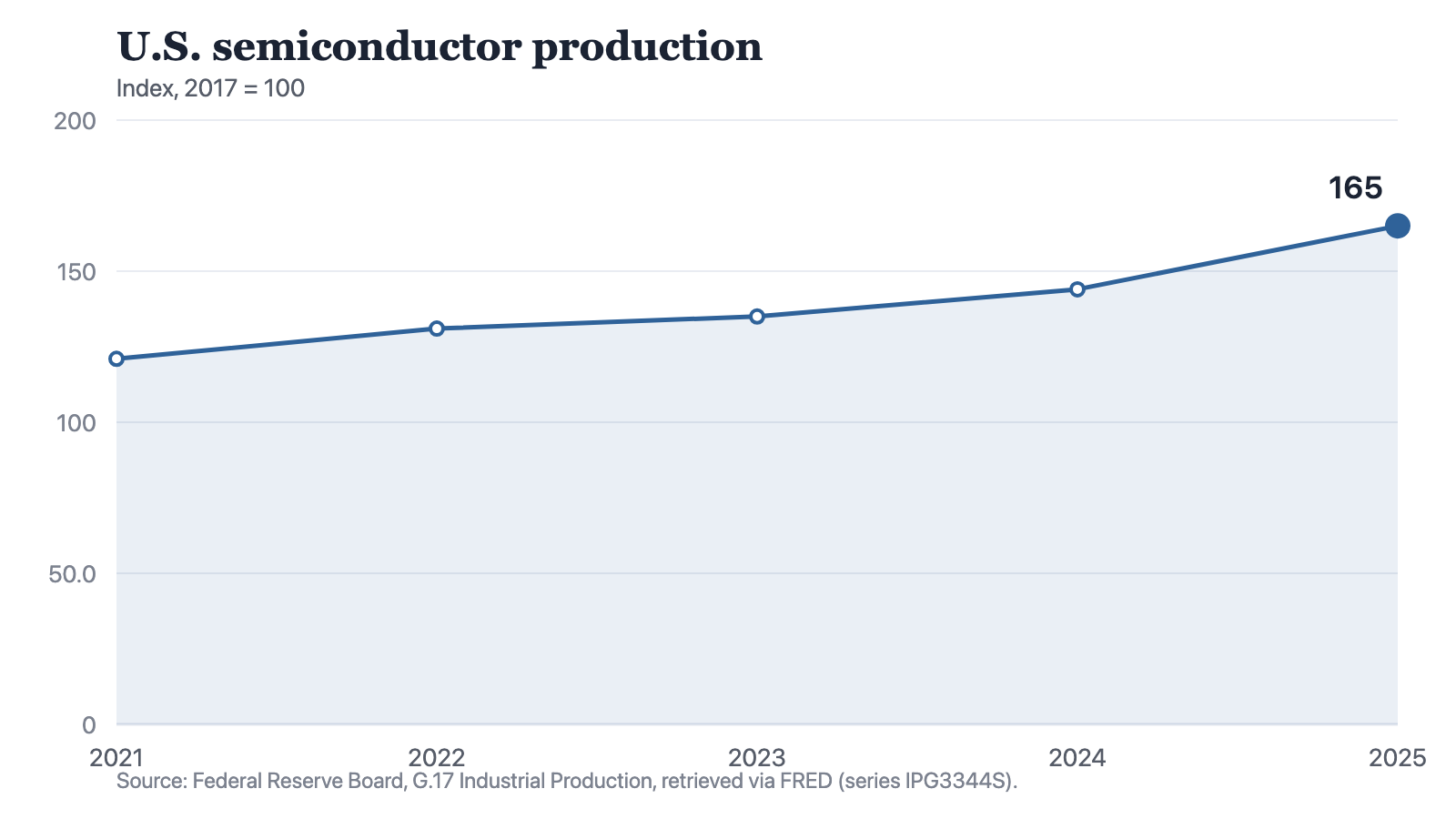
Notes: Source: Federal Reserve Board, G.17 Industrial Production, retrieved via FRED (series IPG3344S). The index tracks physical output. It does not distinguish subsidised output from unsubsidised output.
Source: The Cefa Brief
Chart description
A line chart with five annual points on an index where 2017 equals 100. The index stands at 121 in 2021 and 131 in 2022, rises to 135 in 2023 and 144 in 2024, then climbs more steeply to 165 in 2025. The line rises at every point shown, and the largest single-year step is the last one.
A line chart with five annual points on an index where 2017 equals 100. The index stands at 121 in 2021 and 131 in 2022, rises to 135 in 2023 and 144 in 2024, then climbs more steeply to 165 in 2025. The line rises at every point shown, and the largest single-year step is the last one.
What each instrument changes
A capital subsidy changes the size of the cheque an investor must write at the start. It lowers the up-front capital a project needs and therefore the return that capital has to earn to be worth raising. It does nothing to the cost of running the plant in year seven. A production subsidy does the reverse. It leaves the construction bill untouched and raises the margin on each unit for as long as the credit lasts. That is also why its cost to the Treasury is unknown on the day the law passes: it depends on how much gets made.
This is why the two are usually combined. A capital award gets a plant built in a place where it would otherwise not be built. A production credit keeps the plant running once the ribbon is cut, which is the harder problem. A factory that is built and then idled has consumed the subsidy and delivered nothing.
The instruments also differ in what the government has to know. A capital award requires an agency to choose among projects before any of them exist, which means judging business plans, sites, and management. A production credit requires only that output be verified after the fact. The first puts the state in the position of an investor. The second puts it in the position of a customer who pays on delivery, and it is correspondingly harder to cap.
What to read in the programme text
- The payment trigger: what must physically happen before money leaves the Treasury. A signed agreement is not a payment.
- The eligibility boundary: which firms, which products, and whether a foreign-owned subsidiary building domestically qualifies.
- The cap: whether the programme has a fixed appropriation or is open-ended and demand-driven.
- The clawback: what the government can recover, on what trigger, if the plant closes, moves, or never opens.
- The expiry: the date the credit ends, which sets the horizon an investor is actually underwriting.
Economists disagree about what these instruments buy, and the disagreement is specific. One position holds that a capital award closes a gap that is itself the product of other governments' support, and that once a plant and the suppliers around it exist, they stay. The other holds that much of the award is captured as rent: it lands on projects that would have been built anyway, or it is competed away as states and countries bid against each other for the same plant. Both sides accept the same record of announcements. They part on what would have happened without the money, which is not observable.
A subsidy is a price the public pays for a decision it cannot otherwise compel. The question is always which decision.
The test is the trigger. When a programme is announced with a headline number, find the sentence that says what must exist before a dollar is disbursed. If the answer is a completed application, the number is an intention. If the answer is a certified milestone or a unit shipped, the number is a claim on the Treasury that something has been built, and it can be checked against the thing itself.
About the author
Each author told us that for this piece they hold no interest a reader would think relevant.
Explainers are written and kept up to date by The Cefa Brief’s editors. An Explainer is background CEFA stands behind. It is not one author’s argument, and it is not a CEFA position on what anyone should do. If something here is wrong or out of date, write to applied@thecefa.org.
© 2026 Center for Economics & Foreign Affairs. To republish it, see our republication terms. Republishing
Share
The Cefa Brief · applied.thecefa.org/cefa-brief/what-a-production-subsidy-buys · Printed from the web edition