
What a development finance institution does with public money
Development finance institutions lend, insure and buy stakes in private businesses abroad using capital they are expected to get back. By the end you should be able to tell which instrument an announcement is describing, and what the private market would have done without it.
Prepared by
Last reviewed Published 4 minute read

رسم توضيحي: The Cefa Brief
A development finance institution is a government-owned lender that places public capital into private companies and projects in poorer countries and expects to be repaid. The last clause carries the whole difference between it and an aid agency. Aid is given away. Development finance is placed, priced and, in the ordinary case, recovered.
The names differ from country to country. The United States has the International Development Finance Corporation. Britain has British International Investment, France has Proparco, the Netherlands has FMO. Their charters differ too, in what they may own, where they may lend and how much risk they may carry. The machinery underneath is the same everywhere: a capital base subscribed by a government, a mandate to invest where private lenders will not go unaided, and an obligation to preserve that capital rather than spend it.
Notes: Current dollars, not adjusted for inflation. Source: U.S. Bureau of Economic Analysis, retrieved via FRED (series GDP).
Source: The Cefa Brief
Chart description
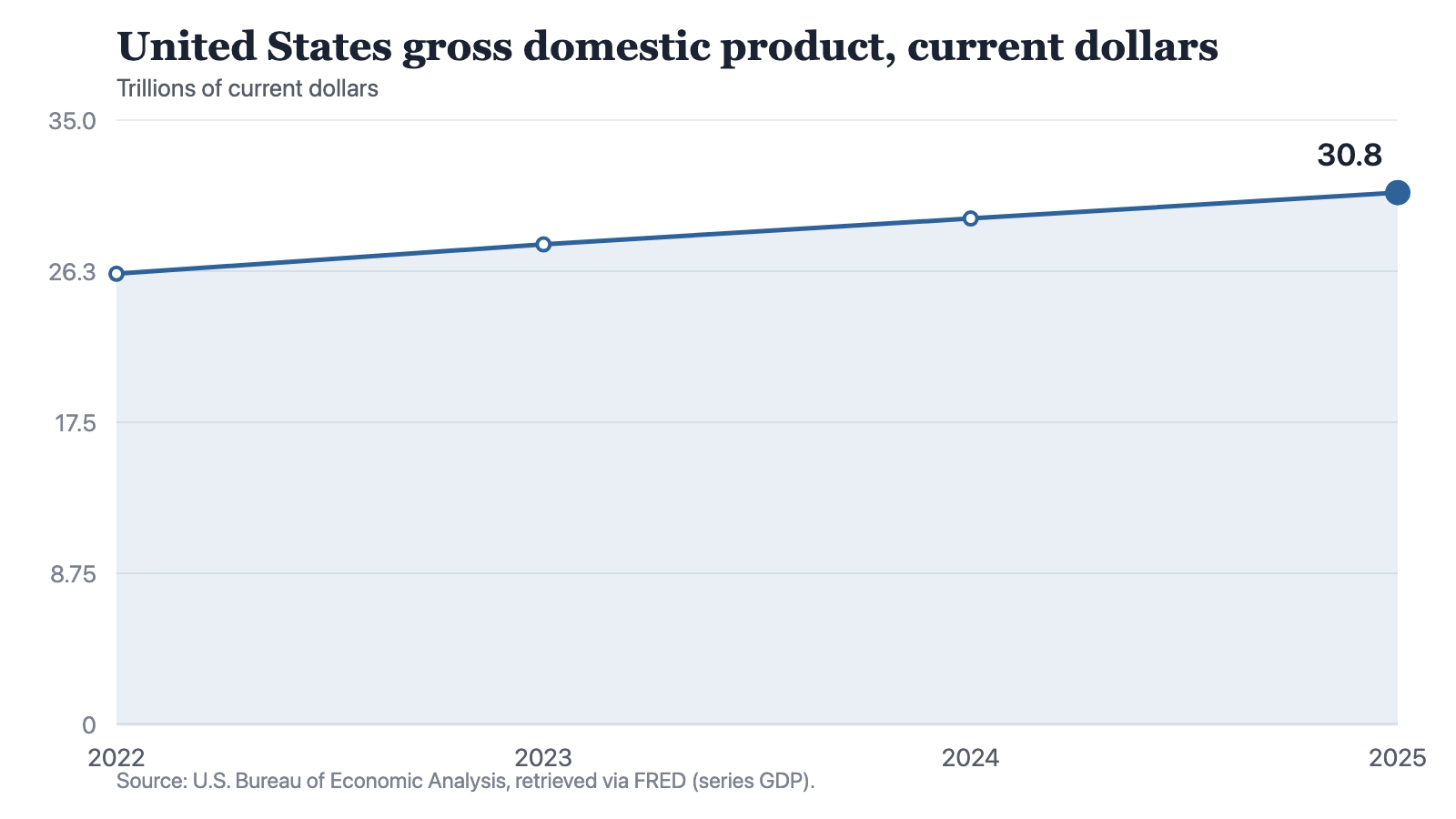
A line chart with four annual points, rising steadily from left to right with no reversals. Gross domestic product in current dollars stands at 26.1 trillion in 2022, 27.8 trillion in 2023, 29.3 trillion in 2024 and 30.8 trillion in 2025. The steps between years are of similar size, so the line reads as a straight climb rather than a curve.
A line chart with four annual points, rising steadily from left to right with no reversals. Gross domestic product in current dollars stands at 26.1 trillion in 2022, 27.8 trillion in 2023, 29.3 trillion in 2024 and 30.8 trillion in 2025. The steps between years are of similar size, so the line reads as a straight climb rather than a curve.
What the institution actually sells
A development finance institution does not hand out money. It writes contracts, and there are four kinds worth being able to tell apart, because each puts public capital at risk in a different way.
- A senior loan. The institution lends directly to a company or a project, often in dollars, usually for longer than a commercial bank will lend, and takes its place in the queue of creditors.
- An equity stake. The institution buys part of the business, carries the full downside and is paid only if the company is eventually sold or listed. Equity is the slowest instrument and the one most likely to lose money.
- A guarantee or political risk insurance. No cash leaves the building. The institution promises to pay a commercial lender if the borrower defaults, or to compensate an investor if a government seizes the asset, blocks a currency transfer or breaks a contract. The bank keeps the loan on its books and the risk moves.
- Project preparation. Staff time and grant money spent turning an idea into something a lender can price: feasibility work, environmental and social assessment, legal structuring. It earns no return of its own. Without it, the other three instruments often have nothing to finance.
Two rules govern every one of those contracts. The first is additionality: the institution is supposed to do only what the private market would not have done at that moment, on those terms. The second is the return requirement. The money is meant to come back so it can be lent again, and so that the sponsoring government is not writing a cheque every year. The rules pull in opposite directions. Additionality pushes toward the hardest countries and the least bankable sectors. The return requirement pulls away from both.
Why a guarantee is the cheapest thing on the menu
The guarantee deserves separate attention because it is the instrument most often misread. When an institution guarantees a loan, the commercial bank's exposure stops being exposure to a company in a country with a weak credit rating and becomes exposure to the guaranteeing government. The bank's capital charge falls. Because the capital charge falls, the bank can lend at a lower rate and for a longer term, which is frequently the thing standing between a project and financial close. The public balance sheet has changed the price of the loan without disbursing anything. The cost is real but deferred: a guarantee called is money paid, and until it is called it sits as a contingent liability that appears nowhere in a headline figure.
A development finance institution is defined less by what it funds than by where it sits between additionality and the requirement to be repaid.
Where specialists disagree
The serious argument is about mobilisation, not about intent. Critics point out that portfolios drift toward middle-income countries and toward sectors commercial banks already like, because those are the deals that can carry the return requirement, and that a dollar placed there may have displaced a private dollar rather than drawn one in. Defenders answer that the counterfactual is unobservable, and that the deals which never happen leave no trace in anybody's data. A second argument is about measurement. Mobilisation ratios count private money in the same transaction, which is not the same as private money that would not otherwise have come. A third is about concessional windows: whether an institution that lends at below-market terms in the hardest places is doing the job properly or quietly turning back into an aid agency with a lending desk. None of these are resolved, and an institution's own reporting cannot resolve them.
When a development finance institution announces a commitment, three questions separate an intervention from an announcement. Which instrument is it, of the four above. Has the money been disbursed, or only approved by a board. And what would a commercial lender have charged, or refused, had the institution not been in the room. The third question is the one that determines whether public capital moved a deal or merely joined one, and it is the question press releases answer least often.
About the author
Each author told us that for this piece they hold no interest a reader would think relevant.
Explainers are written and kept up to date by The Cefa Brief’s editors. An Explainer is background CEFA stands behind. It is not one author’s argument, and it is not a CEFA position on what anyone should do. If something here is wrong or out of date, write to applied@thecefa.org.
© 2025 Center for Economics & Foreign Affairs. To republish it, see our republication terms. Republishing
Share
The Cefa Brief · applied.thecefa.org/cefa-brief/what-a-development-finance-institution-does · Printed from the web edition