
A development institution should give up the senior position and hold the first loss
The United States ran a current account deficit in every year from 2020 to 2025, averaging 147 billion dollars a quarter at the start of that window and 294 at the end, exactly twice as wide. An institution that gives up the senior position will report a smaller book and a worse loss record, and both are the point.
by
Published 5 minute read

رسم توضيحي: The Cefa Brief
A development institution should stop taking the senior position in the transactions it finances. It should sit below the private lenders, in the tranche that is written down first, and it should accept a smaller book and a worse loss record as the price of sitting there. That is my position. A senior claim on contracted revenue is the easiest paper in project finance to place, and a public balance sheet standing in that queue is one more bidder for something that already had them.
Seniority is an order of payment, not a property of the asset. Every financed structure ranks its claims: someone is repaid first, someone waits, and someone absorbs the shortfall when revenue arrives late or small. The project itself does not improve when the order changes. What changes is who holds the risk the project was always going to carry.
Capital does not need help finding the safe end
Start with the direction capital already runs, on figures that are published. The United States ran a deficit on its current account in every year from 2020 to 2025. Stated as the series states it, in billions of dollars at a quarterly average, the six annual points are 147, 214, 243, 233, 300 and 294. Each is the average of that year's four quarterly balances, not a year's total. The 2025 figure is exactly twice the 2020 figure, and the widest reading in the window is 2024 at 300.
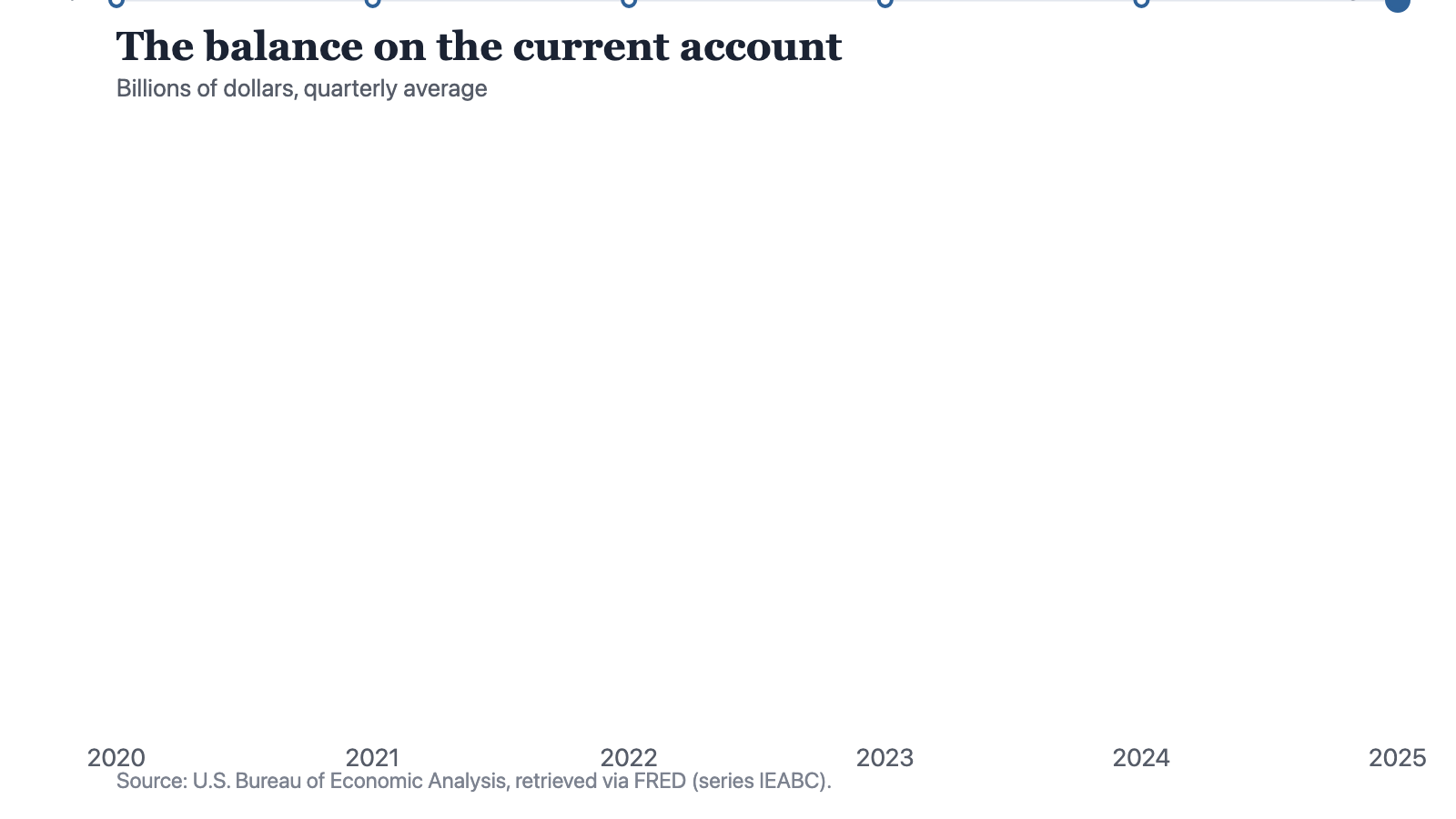
Notes: Billions of dollars at a quarterly average. Every point in the window is a deficit. A whole year's balance is roughly four times the figure shown, and no annual total is computed here.
Source: The Cefa Brief
Chart description
A line chart of the balance on the current account showing deficits of 147 billion dollars in 2020, 214 in 2021, 243 in 2022, 233 in 2023, 300 in 2024 and 294 in 2025. The line lies below zero at every point. It moves away from zero through 2022, recovers slightly in 2023, reaches its lowest point in 2024 and rises a little in 2025.
A line chart of the balance on the current account showing deficits of 147 billion dollars in 2020, 214 in 2021, 243 in 2022, 233 in 2023, 300 in 2024 and 294 in 2025. The line lies below zero at every point. It moves away from zero through 2022, recovers slightly in 2023, reaches its lowest point in 2024 and rises a little in 2025.
A deficit on the current account is matched, in the accounts and before the statistical discrepancy, by a net inflow on the financial side. That is an identity rather than a finding. It establishes that money came in on net across these six years; it does not establish why it came, and six annual averages will not answer that. The direction is the part this argument needs, and the direction has not reversed.
Net exports of goods and services carry the same direction on a different measure, in a unit that is not the same one. That series is stated at a seasonally adjusted annual rate, so each annual point approximates the year itself rather than a month or a quarter, and its six readings are deficits of 619, 849, 938, 786, 898 and 926 billion dollars. The 2025 reading is the second widest of the six, behind 2022. Setting 294 beside 926 without saying that the first is a quarterly average and the second an annual rate produces a comparison that means nothing, and nothing here reconciles the two series or computes the difference between them.
The tranche with the bidders
Now put a development institution into a structure. It is offered the senior secured position on a project with contracted revenue, and that offer is attractive to the institution for exactly the reason it is attractive to everyone else. A claim repaid first, against revenue already under contract, is the part of the structure carrying the least uncertainty, and the part carrying the least uncertainty is the part with the most competition for it.
Competition thins below that line. Somebody has to stand behind the senior lenders and be written down first when the revenue is late, the plant runs under its nameplate, or the offtaker fails. In the places these institutions exist to work, that position often has no bid at all. Transactions in those places do not fail for want of senior money. They fail because nobody will hold the first loss.
A public balance sheet in the senior tranche has bought the part of the deal that had other buyers, and left the part that had none.
What a public balance sheet is for
Four properties separate these institutions from the lenders beside them. They have no depositors who can ask for the money back. They have no redemption cycle, so a bad year does not force a sale. They are not marked to a quarter. And their shareholders can be asked for more, which is what a replenishment is. Those four properties buy nothing in the senior tranche, which clears without them. They are the whole of the case in the junior one, where the holder must be able to be wrong for several years without becoming a forced seller.
What stopping costs
Three things get worse, and they are better stated than managed. Disbursement falls, because the same capital supports a smaller junior book than a senior one. Realised losses rise, and rise by design, since a tranche that never takes a loss was not junior. And the credit rating stops being a background fact and becomes a live question at every replenishment. An institution unwilling to defend a higher loss rate in public should not adopt this position, because under it the loss rate is the product.
The objection with real force is capture. An institution that habitually stands first in line for losses invites sponsors to structure toward the subsidy, and lets the lenders above it earn a senior return on a risk somebody else is holding. That objection is correct on its own terms. The answer is pricing. A junior position should be priced at approval, in writing, against what the senior tranche cleared at, and the price should be published with the commitment. A first-loss piece given away is a transfer. A first-loss piece priced is a position.
One admission is owed, since this page argues about development institutions from two American series. This site holds no figure for any such institution: no balance sheet, no tranche, no loss experience, no replenishment total, and nothing here estimates one. The series do a single job. They establish that the United States ran a current account deficit in every year of the window and a wider one at the end than at the start, and that the matching entry, by the identity, is a net inflow on the financial side. The rest of the argument rests on how a capital structure is ordered, which is not a matter of data at all.
When shareholders are next asked to refund a window, the useful question is not how much but which tranche the money will sit in. Senior money buys a larger portfolio, a cleaner loss record and a report that reads well. It also buys a position the market was willing to fill without it. The other position is smaller, uglier on the page, and the only one that needed shareholders at all.
About the author

Each author told us that for this piece they hold no interest a reader would think relevant.
This commentary carries its author's name because the view in it is the author's own. An editor reviewed it before publication, which is not the same as agreeing with it. It is not a position of the Center for Economics & Foreign Affairs or of Applied America.
© 2026. The author or authors hold the copyright in this commentary; CEFA publishes it with their permission. This edition, its editing and its presentation are © 2026 Center for Economics & Foreign Affairs. To republish it, see our republication terms. Republishing
Share
The Cefa Brief · applied.thecefa.org/cefa-brief/the-queue-was-already-full · Printed from the web edition