
Diffusion rather than invention is the binding step in technological change, and no series in the record counts it
Computer and electronic product output rose 21.1 index points between 2020 and 2025 while manufacturing output as a whole ended 2.7 points below its own 2017 base. Core capital-goods orders, the closest series in the record to the channel by which equipment reaches firms that do not make it, averaged 77 billion dollars a month in 2022 and the same in 2025.
by
Vantage point
The vantage decides what follows, so it should be named first. I am an analyst writing inside The Cefa Brief, working from published statistics and public documents and from nothing else: annual observations of national series redistributed by FRED and retrieved for this site on 19 September 2026, read alongside the agencies' own descriptions of what each series counts. I hold no position in a firm and no brief from any ministry. Nothing below rests on an interview, a private dataset, or a figure that has not been published.
Published 5 minute read

رسم توضيحي: The Cefa Brief
Between 2020 and 2025 the output of American computer and electronic products rose from 105.7 to 126.8 on an index whose 2017 base is 100, a gain of 21.1 points. Manufacturing output as a whole, from the same agency and on the same base, ended the window at 97.3, which is 2.7 points below that base. The first line is a technology being made. Neither line is a technology being used, and the second is where use would have to show up.
Where this is written from
The vantage decides what follows, so it should be named first. I am an analyst writing inside The Cefa Brief, working from published statistics and public documents and from nothing else: annual observations of national series redistributed by FRED and retrieved for this site on 19 September 2026, read alongside the agencies' own descriptions of what each series counts. I hold no position in a firm and no brief from any ministry. Nothing below rests on an interview, a private dataset, or a figure that has not been published.
What that position sees, it sees narrowly. It sees the categories the statistical agencies have chosen to count, at the frequency they publish them, for the country as a whole. It does not see a single installation. Whether a machine was bought and left in its crate, whether a process was rebuilt around it, whether the people who would have to run it were trained or replaced: none of that reaches a national annual series. No agency in these sources publishes an adoption rate. The middle of the story is the part nobody counts, and that absence is not incidental to the argument. It is most of it.
Invention is the step the accounts can see
Research and development inside GDP ran 754 billion dollars in 2020 and 1,081 billion in 2025, each figure at a seasonally adjusted annual rate, so each is already a yearly rate rather than a month's spending. The series rose in every year of the window. Its steps are 85, then 103, then 49, then 38, then 52 billion, which sum to the 327 billion separating the first reading from the last, an increase of 43 percent on the 2020 figure. Research spending is the part of technological change a balance sheet can authorise on its own. It requires the agreement of nobody outside the organisation paying for it.
Production of the technology followed, and it followed inside one part of the economy. The computer and electronic product index runs 105.7, 110.3, 117, 116.6, 118.3 and 126.8 across the six years, with its largest single step, 8.5 points, in the last of them. Semiconductor production, on the same 2017 base, runs 121 in 2021, 131 in 2022, 135 in 2023, 144 in 2024 and 165 in 2025: 44 points across four steps, 21 of them in 2025 alone. Both are indexes. Neither carries a dollar amount, a count of machines, or a buyer.
Making a technology is not the same as using it
Set those lines against the aggregates they sit inside. Manufacturing output runs 93, 97.6, 98, 97.3, 96.4 and 97.3, so the 2025 reading matches the 2023 reading exactly and stays 2.7 points under a base year set in 2017. Industrial production, wider still, runs 95.1, 99.3, 101, 100.8, 100.1 and 101.2, which leaves 2025 just 1.2 points above that base and 0.2 points above 2022. Subtracting manufacturing output from the computer and electronic index, which is admissible because both come from the Federal Reserve Board and share a unit and a base year, gives the distance between them in points of that base: 12.7 in 2020, 12.7 in 2021, 19 in 2022, 19.3 in 2023, 21.9 in 2024 and 29.5 in 2025. The distance more than doubled while the aggregate stood still.
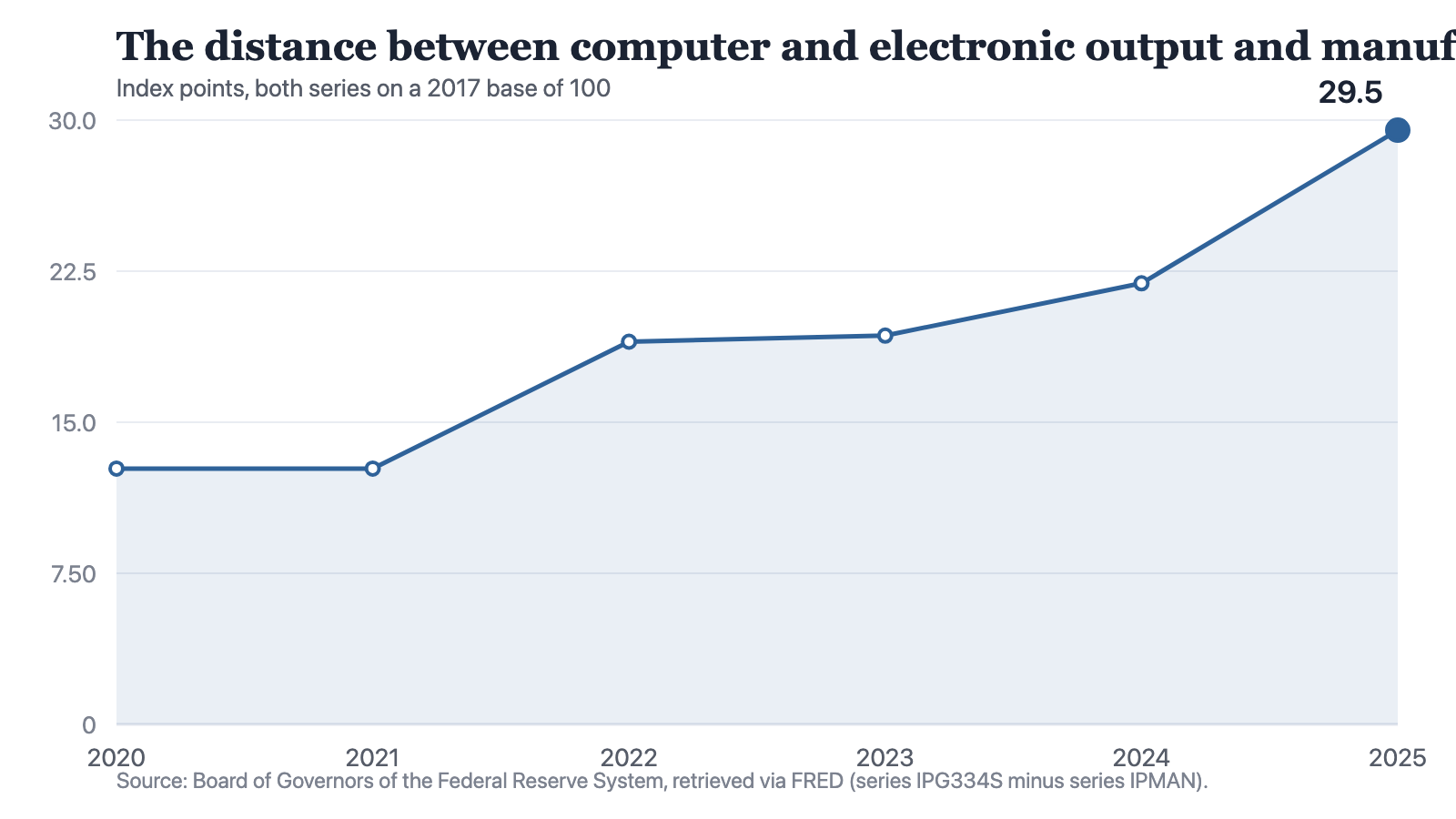
Notes: Computer and electronic product output (series IPG334S) minus manufacturing output (series IPMAN), both published by the Board of Governors of the Federal Reserve System, both indexes on a 2017 base of 100. The six figures are arithmetic on published index values, not a published series. Index points are not dollars, not units of output and not a share; the difference records divergence between two indexes and nothing else.
Source: The Cefa Brief
Chart description
A line chart of the computer and electronic product output index minus the manufacturing output index, in points of their shared 2017 base: 12.7 in 2020, 12.7 in 2021, 19 in 2022, 19.3 in 2023, 21.9 in 2024 and 29.5 in 2025. The line is flat between the first two points, rises 6.3 points into 2022, is almost flat again in 2023, then rises in each of the last two years, with its steepest step of 7.6 points at the end.
A line chart of the computer and electronic product output index minus the manufacturing output index, in points of their shared 2017 base: 12.7 in 2020, 12.7 in 2021, 19 in 2022, 19.3 in 2023, 21.9 in 2024 and 29.5 in 2025. The line is flat between the first two points, rises 6.3 points into 2022, is almost flat again in 2023, then rises in each of the last two years, with its steepest step of 7.6 points at the end.
Diffusion travels in equipment
One route by which a technology reaches the firms that did not invent it is the equipment those firms buy. Core capital-goods orders are the closest series in these sources to that channel, and they have not moved. They run 62, 70, 77, 75, 74 and 77 billion dollars, each point a monthly average, so each is the average month rather than the year's total; The 2022 figure and the 2025 figure are the same number. Across exactly those three years the computer and electronic index rose 9.8 points, from 117 to 126.8. That order book is counted in dollars without adjustment for prices, and the producer price index for all commodities stood at 264.5 in 2022 and 260.3 in 2025; the two are named together so that a reader holds both, and one has not been divided by the other.
Invention can be financed by the people who want it. Diffusion needs the agreement of every firm that would have to change how it works.
The gains arrive late, and late is the finding
Output per hour in the nonfarm business sector, indexed to 2017 equals 100, runs 109.1, 111.4, 109.8, 112.1, 115.4 and 118. The series fell 1.6 points in 2022, then added 2.3, 3.3 and 2.6. Of the 8.9 points it gained across the whole window, 8.2 arrived after the 2022 reading, which is 92 percent of the six-year gain landing in the final three years. That shape is what a slow diffusion looks like from the outside. It is also what a dozen unrelated things look like from the outside, and six annual points cannot tell them apart. The other route a method takes into an economy is not conversion but entry, and new business applications ran 84 thousand a week on average in 2020 and 109 thousand in 2025, each figure a weekly average rather than a year's total.
Why diffusion is the binding step
My position is that diffusion binds because it is the only step requiring the agreement of people who did not choose the technology. A laboratory can be funded by a board that wants one. A line making the technology itself can be funded the same way, and the semiconductor index shows what that looks like when it happens. Everything after that point is somebody else's decision: a machine bought by a firm in a different industry, a shift pattern rewritten, a supervisor retrained, a customer persuaded that the new output is acceptable. Each of those carries its own budget, its own timetable and its own veto. The record here is consistent with that ordering. Research spending rose in every year, the producing sector's index rose 21.1 points, the aggregate it belongs to finished 2.7 points below its base, and the order book that would carry the technology outward read 77 billion dollars a month in 2022 and 77 in 2025.
Be exact about what this does not establish. Six annual observations cannot date a turn inside a year, cannot separate one cause from another, and cannot span the interval between a technology existing and a technology being used. An index on a 2017 base carries no level and no dollars; the dollar series here are nominal; nothing below identifies a mechanism. What the record does is register the order in which traces appear, and a trace is not a cause. The narrower claim survives all of that. The steps a country can finance directly are the steps that show up in its accounts, the step that decides whether any of it matters has no series of its own, and a country that counts what it spends on invention but not what it installs will keep reading the first as evidence of the second.
How to cite
Jag DeSaint, "Diffusion rather than invention is the binding step in technological change, and no series in the record counts it," The Cefa Brief, Applied America, 7 سبتمبر 2026, https://applied.thecefa.org/cefa-brief/the-middle-step-has-no-series.
About the author

Each author told us that for this piece they hold no interest a reader would think relevant.
This Perspectives piece carries its author's name because the view in it is the author's own. An editor reviewed it before publication, which is not the same as agreeing with it. It is not a position of the Center for Economics & Foreign Affairs or of Applied America.
© 2026. The author or authors hold the copyright in this Perspectives piece; CEFA publishes it with their permission. This edition, its editing and its presentation are © 2026 Center for Economics & Foreign Affairs. To republish it, see our republication terms. Republishing
Share
The Cefa Brief · applied.thecefa.org/cefa-brief/the-middle-step-has-no-series · Printed from the web edition