
One industrial line is climbing and the index around it is not
Domestic semiconductor production reached 165 on a 2017 base in 2025, from 121 in 2021. Total industrial production reached 101.2. That gap is the best evidence economic-security policy has in this data, which is exactly why it should be claimed carefully.
by
Published 4 minute read

Ilustración: The Cefa Brief
Almost nothing in the national industrial data moves. That is the first thing to say honestly about the last five years. Industrial production stood at 101 in 2022 and 101.2 in 2025, on an index set to 100 in 2017, having dipped to 100.8 and then 100.1 in between. Six years of argument, legislation and money, and the aggregate index has travelled about a point.
One line inside it did move. Domestic semiconductor production, measured on the same 2017 base, ran 121 in 2021, 131 in 2022, 135 in 2023, 144 in 2024 and 165 in 2025. The final step is the largest in the series by a wide margin. Against a flat industrial index, that is a genuine exception, and I think it should be claimed. My argument is about how much can be claimed, because the version being asserted in public is larger than the series supports, and the gap between the two is where the whole programme becomes vulnerable.
The one line that moves
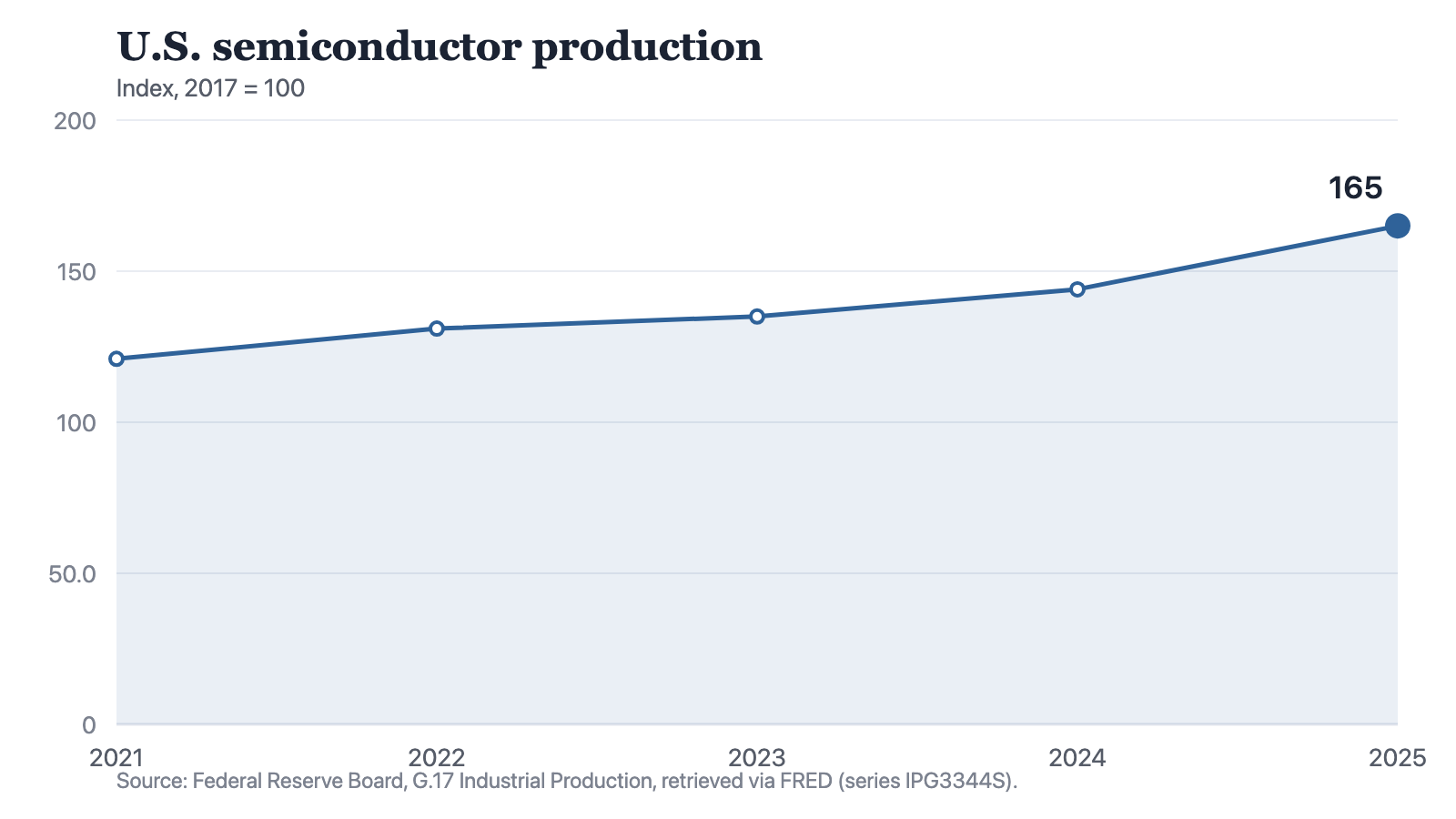
Notes: An index of production relative to 2017. It measures how much the domestic industry made, not its capacity, its technology generation, or which stages of manufacture took place in the country.
Source: The Cefa Brief
Chart description
A line chart of the U.S. semiconductor production index rising from 121 in 2021 to 131 in 2022, 135 in 2023, 144 in 2024 and 165 in 2025. The steepest single-year rise is the last, from 144 to 165.
A line chart of the U.S. semiconductor production index rising from 121 in 2021 to 131 in 2022, 135 in 2023, 144 in 2024 and 165 in 2025. The steepest single-year rise is the last, from 144 to 165.
Set the two series side by side and the comparison is legible because they share a base year. Both ask the same question — how much was made, against 2017 — and give very different answers. The wider industrial base is where it was. This one sector is well clear of where it was, and accelerating in the most recent observation rather than fading.
That is unusual enough to deserve saying plainly, and it is worth noticing what it is not accompanied by. Manufacturing value added has slipped from 10.2 percent of GDP in 2022 to 9.4 percent in 2025, and manufacturing employment has gone from 12.8 million workers in 2022 to 12.6 million in 2025. Whatever is happening in the semiconductor line is not showing up as a broad industrial revival, and anyone who wants to argue that it will has to argue it rather than assume it.
What an index is not
Here is the objection I take most seriously, and it comes in two parts. The first is that a production index is not a security measure. It records output of the domestic semiconductor industry relative to 2017. It does not say which devices, at which technology generation, on which equipment, with which imported inputs, or at which stage of manufacture. A country can raise the total while the specific parts a defence programme or a grid operator depends on are still made in one place on the other side of an ocean. The index would not blink.
The second part is attribution. The series cannot tell you why it rose. Demand did something over this period. Capacity commissioned years earlier came online. Policy did something. The annual index does not decompose into those, and no amount of confidence in the policy makes it decompose. To say that a programme produced this line is to make a causal claim from a series that contains no control and no counterfactual.
Both objections are correct. Neither of them makes the line uninteresting, and that is the distinction I want to hold. It is possible for a fact to be real, unusual and worth acting on, and for the explanation of it to remain open.
The claim worth making
So here is the version I would sign. Domestic semiconductor output is well above its 2017 level and rose faster in 2025 than in any other year of the window, while the industrial index that contains it has barely moved since 2022. That is a documented divergence between one strategically named sector and the rest of the industrial base, and it is the only such divergence visible in this data. It is enough to justify continued attention and enough to justify asking what else is inside it.
What I would not sign is the sentence that usually follows: that the dependency is therefore closing, that supply is more secure, that the policy worked. Those require knowing which devices, at which generation, and with what share of the critical inputs still sourced abroad. None of that is in a production index, and substituting the index for it is the move that loses the argument in front of anyone competent.
This matters more for a programme with good evidence than for one with none. The semiconductor line is the strongest card economic-security policy currently holds in the national data. Overplayed once, in a hearing or a press release, it becomes the example everyone cites for why the claims were inflated, and the real finding goes down with the exaggerated one.
The honest thing is also the durable thing. Publish the index, name the base year, say what it measures and what it does not, and let the divergence from the aggregate stand on its own. It is a good enough fact to survive being described accurately, which is more than most facts in this argument can manage.
About the author

Each author told us that for this piece they hold no interest a reader would think relevant.
This commentary carries its author's name because the view in it is the author's own. An editor reviewed it before publication, which is not the same as agreeing with it. It is not a position of the Center for Economics & Foreign Affairs or of Applied America.
© 2025. The author or authors hold the copyright in this commentary; CEFA publishes it with their permission. This edition, its editing and its presentation are © 2025 Center for Economics & Foreign Affairs. To republish it, see our republication terms. Republishing
Share
The Cefa Brief · applied.thecefa.org/cefa-brief/the-semiconductor-exception · Printed from the web edition