
What gross domestic product counts, and what it leaves out
Gross domestic product counts production inside a border that reaches a final buyer. Knowing which dollars it is counted in, and which work it never sees, changes what the figure can be used for.
Prepared by
Last reviewed Published 3 minute read

Abbildung: The Cefa Brief
Gross domestic product measures the market value of the goods and services produced inside a country's borders during a set period and sold to a final buyer. It is a flow, not a stock. It reports what was made between January and December. It says nothing about what the country owns at the end of it.
Final is the load-bearing word. A mill sells a steel coil to a stamping plant, the stamping plant sells a door panel to a carmaker, and the carmaker sells a car. Only the car enters the total. Counting the coil, the panel and the car would count the same steel three times over. Statisticians reach the same figure from the other direction by adding up value added at each stage, which is a firm's sales less the cost of the inputs it bought in. That is why a sector's contribution to the economy is quoted as value added rather than as revenue.
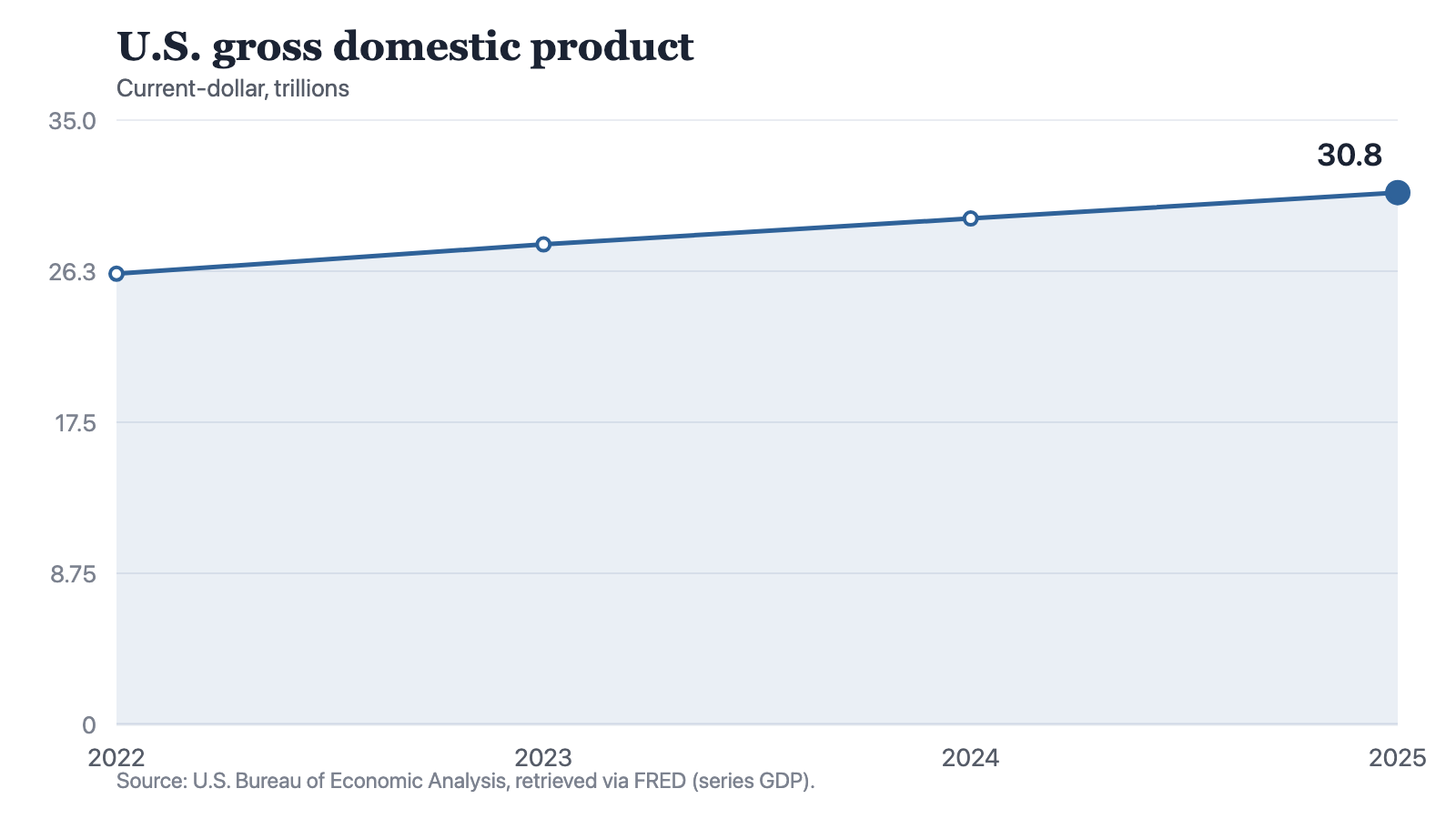
Notes: Source: U.S. Bureau of Economic Analysis, retrieved via FRED (series GDP). Current-dollar figures carry no adjustment for price change.
Source: The Cefa Brief
Chart description
A four-point line running left to right across the years 2022 to 2025. It starts at 26.1 trillion dollars in 2022 and rises at every step: 27.8 trillion in 2023, 29.3 trillion in 2024, 30.8 trillion in 2025. The steps are close to even, so the line reads as nearly straight rather than curving, and it never falls. Because each point is stated in the prices of its own year, the climb combines a change in how much was produced with a change in what it cost.
A four-point line running left to right across the years 2022 to 2025. It starts at 26.1 trillion dollars in 2022 and rises at every step: 27.8 trillion in 2023, 29.3 trillion in 2024, 30.8 trillion in 2025. The steps are close to even, so the line reads as nearly straight rather than curving, and it never falls. Because each point is stated in the prices of its own year, the climb combines a change in how much was produced with a change in what it cost.
The dollars in this series are not the same dollars
The series above is current-dollar gross domestic product, often called nominal. Each year is measured in that year's prices. When the line rises, two quite different things could have happened. The country produced more. Or it produced the same and paid more. The series cannot separate them, and neither can anyone reading it.
That is what the real series is for. Real gross domestic product holds prices fixed at a base year and lets only quantities move, and the gap between the two versions is the price change, published as the GDP deflator. An argument about whether the economy grew needs the real series. An argument about the size of a debt or a defence budget relative to the economy needs the current-dollar one, because debts and budgets are written in current dollars too.
Domestic means located here, not owned here
Gross domestic product counts production inside the border whoever owns the plant. A foreign-owned assembly line in Ohio counts. An American-owned plant in Monterrey does not. Gross national product applies the opposite rule and follows ownership rather than location. The distinction has teeth in industrial policy. An incentive that draws a foreign firm to build here raises domestic product, while the profits that firm earns are income to somebody abroad.
The production boundary
Gross domestic product counts transactions, so work that happens outside a market is invisible to it. A parent minding a child at home does not register. Pay a nursery to mind the same child and the total rises, though no more care has been given. The same boundary keeps out the costs that production imposes on the future: timber cut shows up as output, and the missing forest shows up nowhere. Wear on existing plant and equipment is not subtracted either, which is what the word gross announces. Subtract it and the measure becomes net domestic product, which is smaller and harder to estimate.
None of this is an error that better arithmetic would correct. The boundary was drawn deliberately, when the national accounts were built to answer a wartime question about productive capacity, and economists have argued ever since about whether to move it. One camp would adjust the headline figure for unpaid household work and for the depletion of natural assets, on the ground that a measure governments steer by should reflect what is actually gained and lost. Another holds that a production measure should stay a production measure, and that welfare belongs in separate satellite accounts kept alongside it. The disagreement is about what a single headline number should be asked to do, not about the arithmetic underneath it.
Gross domestic product answers one question well. It says how much was produced for sale inside these borders. It was never built to answer the others.
So there is a test for any figure quoted as a share of gross domestic product, whether it is debt, defence or research. Check that the numerator and the denominator are counted in the same dollars, because a real numerator over a current-dollar denominator will drift for no reason but prices. Then, when someone says the economy grew, ask which series they read. If it was the one above, they have not yet said whether the country made more or paid more.
About the author
Each author told us that for this piece they hold no interest a reader would think relevant.
Explainers are written and kept up to date by The Cefa Brief’s editors. An Explainer is background CEFA stands behind. It is not one author’s argument, and it is not a CEFA position on what anyone should do. If something here is wrong or out of date, write to applied@thecefa.org.
© 2026 Center for Economics & Foreign Affairs. To republish it, see our republication terms. Republishing
Share
The Cefa Brief · applied.thecefa.org/cefa-brief/what-gdp-counts · Printed from the web edition