
What a domestic content rule actually requires
A Buy American clause is an origin test written into a contract, not a ban on foreign goods. By the end you will know how the test is computed, who has to prove it, and what a waiver reveals.
Prepared by
Last reviewed Published 3 minute read

Abbildung: The Cefa Brief
A domestic content rule is a clause in a contract or a grant agreement. It does not forbid anyone from buying a foreign product. It conditions the government's money on where the thing was made, and it reaches exactly as far as that money goes and no further.
Three versions of the clause do most of the work. One applies to what federal agencies buy directly for their own use. One applies to what recipients of federal infrastructure funds buy with those funds, which reaches states, transit agencies and utilities that are not federal buyers at all. The third sits inside tax credits, where meeting a content threshold raises the credit rather than qualifying a purchase. Three different instruments, one test of origin.
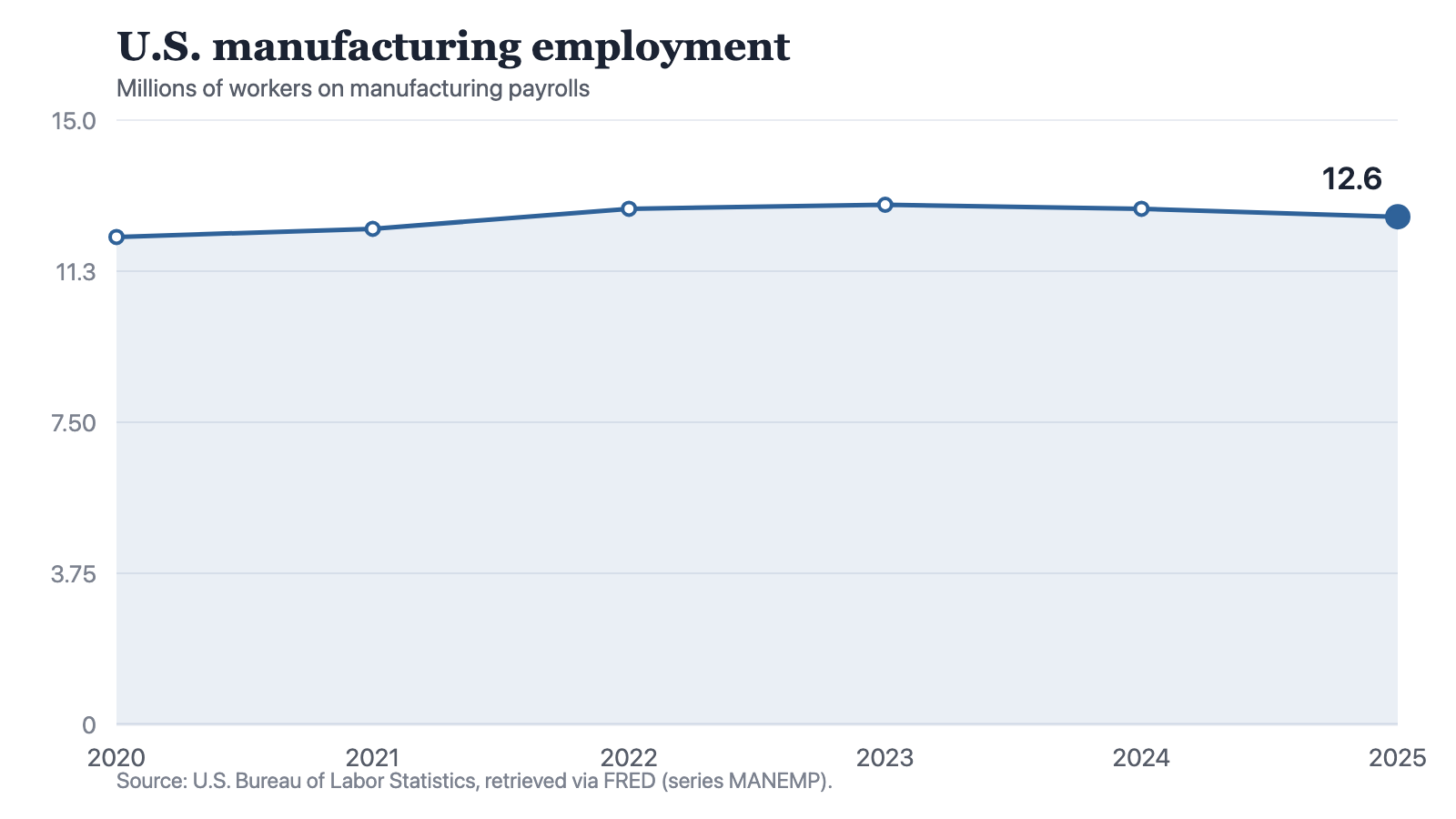
Notes: Source: U.S. Bureau of Labor Statistics, retrieved via FRED (series MANEMP). The series counts manufacturing payroll jobs across the economy. It does not isolate work performed under federally funded contracts.
Source: The Cefa Brief
Chart description
A line chart with six annual points, in millions of workers. Employment stands at 12.1 million in 2020, 12.3 million in 2021, 12.8 million in 2022 and 12.9 million in 2023, then eases to 12.8 million in 2024 and 12.6 million in 2025. The shape is a climb across the first four points and a shallow decline across the last two.
A line chart with six annual points, in millions of workers. Employment stands at 12.1 million in 2020, 12.3 million in 2021, 12.8 million in 2022 and 12.9 million in 2023, then eases to 12.8 million in 2024 and 12.6 million in 2025. The shape is a climb across the first four points and a shallow decline across the last two.
How the origin test is computed
The test applies to a product, not to a company. For manufactured goods, the usual method takes the cost of the components that go into the end product and asks what share of that cost is domestic. Cost, not value added: a component counts at what it cost, wherever the profit on it eventually lands. For iron and steel the test is different and physical. The metal must be melted and poured domestically, and every stage of manufacture from the melt onward must happen here, which is a supply-chain requirement rather than an accounting one. Construction materials are governed by their own definitions again, which is why two clauses in the same project can reach different answers about the same building.
Proof is documentary. The contractor certifies compliance, and that certification flows down to subcontractors and suppliers who certify in turn. Nobody inspects a casting to find out where it was poured. A false certification is a false claim against the government, which is where the enforcement risk sits, and it sits with the firm that signed rather than the agency that bought.
Waivers are part of the instrument
A rule with no exit would stop projects wherever no domestic supplier exists, so every version of the clause carries waiver authority. The buyer requests a waiver, the agency grants or refuses it, and for infrastructure funds the proposed waiver is published for public comment before it takes effect. The grounds are narrow and named.
- Nonavailability: the item is not produced domestically in sufficient and reasonably available quantity, or not to a satisfactory quality.
- Unreasonable cost: applying the rule would raise the cost of the project beyond the margin the regulation allows.
- Public interest: the agency finds that applying the rule to this purchase would defeat the purpose of the programme.
The published waiver file is the most informative document a content rule produces. It is a running list, written by the buyers themselves and in their own interest, of the things the country does not currently make.
Specialists disagree about the second-order effect, not the first. That a scarce domestic source raises the price of a given purchase is not much contested. The argument is about what the premium buys. One view holds that a standing, credible requirement gives a supplier the demand certainty it needs to invest, and that the premium is the cost of creating a supplier that did not previously exist. The other holds that public purchasing is too small and too lumpy to sustain an industry, so the premium buys delay and a waiver rather than capacity. Which view fits depends on the product, and both sides read the same waiver record for evidence.
A content rule cannot conjure a supplier. It can only make the absence of one visible and expensive.
The test to apply is scope. When a rule is announced, ask which product the percentage is measured against, who has to sign the certificate, and whether a waiver has already been published for the item in question. If the answer to the last is yes, the rule is documenting a gap rather than closing it, and the interesting question moves to who is being asked to fill it.
About the author
Each author told us that for this piece they hold no interest a reader would think relevant.
Explainers are written and kept up to date by The Cefa Brief’s editors. An Explainer is background CEFA stands behind. It is not one author’s argument, and it is not a CEFA position on what anyone should do. If something here is wrong or out of date, write to applied@thecefa.org.
© 2025 Center for Economics & Foreign Affairs. To republish it, see our republication terms. Republishing
Share
Related
- Perspektive
Productive capacity names a quantity that no series on this site reports
Of the fifty-eight annual series in the file behind this site, one carries the word capacity in its title, and it reports a percentage of capacity rather than an amount of it. What stands in are four measures of four different things, and they moved in different directions over the same three years.
- Perspektive
Industrial strategy is a decade-long commitment made by institutions that are not built to hold one
Spending on manufacturing plant rose from a yearly rate of 75 billion dollars in 2020 to 244 in 2024, lifting the factory share of all nonresidential building from 8.8 percent to 18.8. Manufacturing employment reached its high for these six years in 2023 and is lower now, which is what it looks like when a country can order buildings faster than the institutions to run them.

The Cefa Brief · applied.thecefa.org/cefa-brief/domestic-content-rules · Printed from the web edition