
What makes an industrial site shovel ready
Site readiness is a list of specific permissions and physical connections, not a mood. By the end you will know what a certified site has actually cleared, what it has not, and which constraint usually decides the timetable.
Prepared by
Last reviewed Published 3 minute read

رسم توضيحي: The Cefa Brief
A site is called shovel ready when the work that has to happen before a shovel moves is already done. That work is legal and physical, and almost none of it is visible from the road. Clear title. Zoning that permits the use. A completed environmental review. Water, sewer, gas and electric capacity brought to the property line in quantities the tenant will actually draw. A road that can take the trucks and, for many industrial users, a rail connection. Soil tests that tell an engineer what the foundations will cost.
Most states, and many utilities and railroads, run certification programmes that inspect a site against a checklist of that kind and publish the ones that pass. Certification is useful because it converts a developer’s due diligence into a public record. It is not a permit, and it does not freeze anything. A certified site can still need an air permit, a wetlands determination, a rezoning for a taller building, or a new interconnection study if the tenant’s load turns out larger than the one the utility assumed.
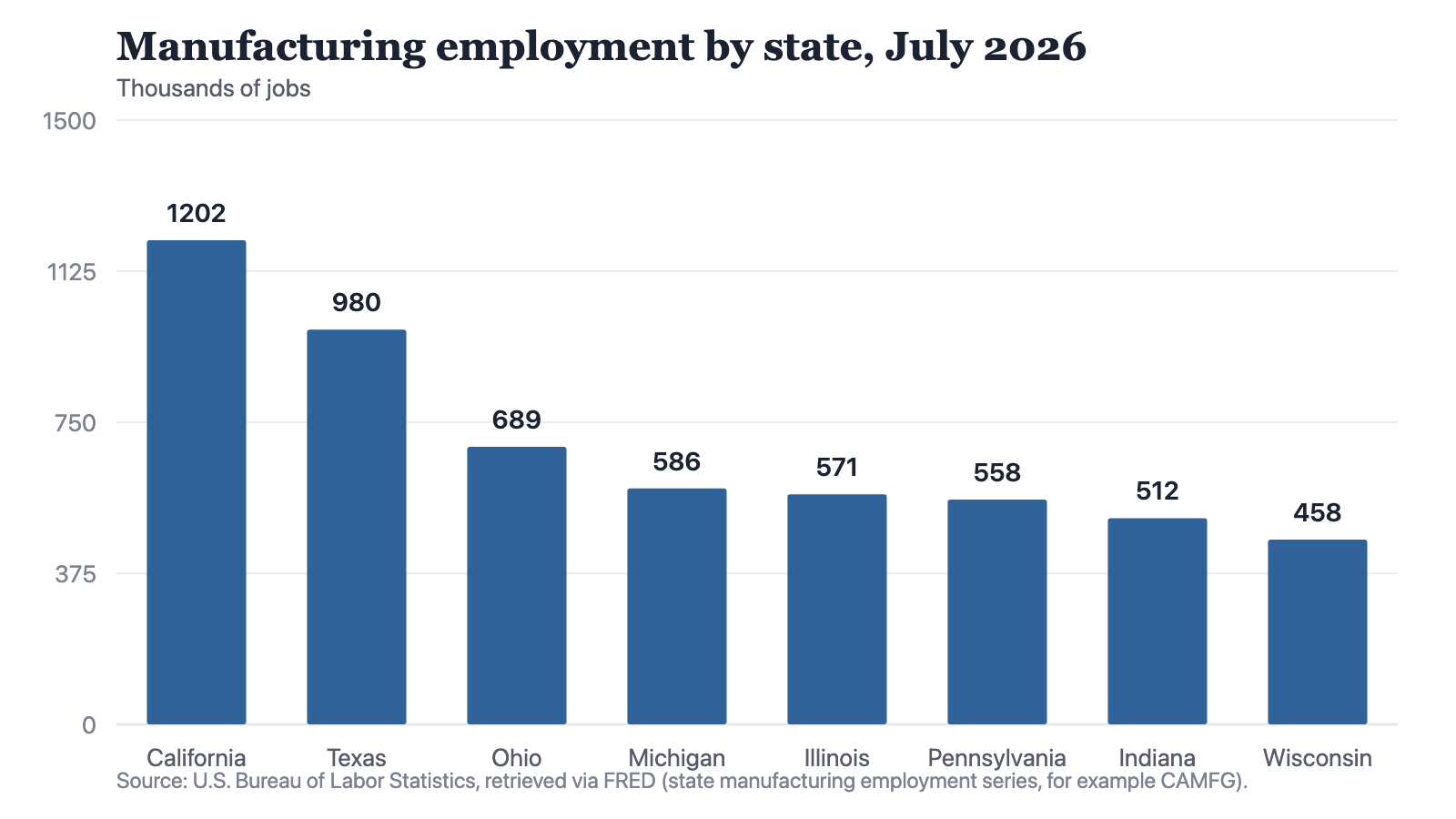
Notes: U.S. Bureau of Labor Statistics, retrieved via FRED (state manufacturing employment series). Thousands of jobs on payrolls in July 2026. There is no public count of ready sites; this measures demand for industrial land, not supply of it.
Source: The Cefa Brief
Chart description
Eight bars of manufacturing employment in thousands of jobs for July 2026. California is tallest at 1,201.9, with Texas second at 979.7, so the first two bars stand well clear of the rest. The remaining six form a gently descending cluster: Ohio at 688.7, Michigan at 585.5, Illinois at 571, Pennsylvania at 558.1, Indiana at 512 and Wisconsin at 458.4. The gap between California and Ohio is larger than the gap between Ohio and Wisconsin, so the chart shows two very large manufacturing states and then a broad industrial midwest and north-east band of similar size. The series counts people on payrolls, not plants, acres or prepared sites.
Eight bars of manufacturing employment in thousands of jobs for July 2026. California is tallest at 1,201.9, with Texas second at 979.7, so the first two bars stand well clear of the rest. The remaining six form a gently descending cluster: Ohio at 688.7, Michigan at 585.5, Illinois at 571, Pennsylvania at 558.1, Indiana at 512 and Wisconsin at 458.4. The gap between California and Ohio is larger than the gap between Ohio and Wisconsin, so the chart shows two very large manufacturing states and then a broad industrial midwest and north-east band of similar size. The series counts people on payrolls, not plants, acres or prepared sites.
The list behind the phrase
Sites are prepared for a customer, and the customers are concentrated: manufacturing payrolls sit heavily in a handful of states, which is where site programmes compete hardest. Readiness is graded, and the grades matter more than the label. A serious site file separates what is done from what is merely believed to be achievable, and the difference is written in dates and names.
- Control: an option or a deed in the hands of the party offering the site, not a handshake with a landowner who has not signed.
- Entitlement: the zoning in force today permits the use and the building envelope, without a variance.
- Environmental: the assessments are complete and any remediation is either finished or covered by an enforceable agreement.
- Utilities: electric, water, gas and wastewater capacity confirmed in writing by the provider at a stated volume, with the date of the study.
- Access: road geometry, bridge weights and, where relevant, the rail spur agreement are settled.
- Geotechnical: borings done, so the cost of foundations is a number rather than a range.
The constraint that usually decides the date
Land is rarely the binding constraint. Power and water usually are. A large manufacturing or data-centre load has to be studied by the utility, queued, and often paid for through upgrades to substations or transmission that the site owner does not control. Wastewater capacity behaves the same way, because a treatment plant expansion is a municipal capital project with approvals of its own. This is why two sites with identical acreage and identical certificates can be years apart in practice, and why the honest question to ask a site developer is when the interconnection study was done and what load it assumed.
Land is rarely the binding constraint. Power and water usually are.
Where practitioners disagree
There is a real argument about how far a public authority should go before a tenant exists. One position is that speed is the product: grading a pad, extending a main and finishing the permits in advance is the only way a community competes for projects that choose a site in months. The other is that this converts a competitive process into a public bet, because the works are paid for whether or not anyone comes, and the sites that sit empty tend to be the ones whose readiness was assumed rather than engineered. Both sides accept the same evidence about timetables. They weigh the cost of an empty prepared site against the cost of losing projects differently.
When a site is offered to you as shovel ready, ask for three dates: the date of the utility capacity letter, the date of the environmental report, and the expiry of the zoning approval. A readiness claim with no dates on it is a brochure. One with dates tells you exactly how much of the work is done and how much of it has gone stale.
About the author
Each author told us that for this piece they hold no interest a reader would think relevant.
Explainers are written and kept up to date by The Cefa Brief’s editors. An Explainer is background CEFA stands behind. It is not one author’s argument, and it is not a CEFA position on what anyone should do. If something here is wrong or out of date, write to applied@thecefa.org.
© 2026 Center for Economics & Foreign Affairs. To republish it, see our republication terms. Republishing
Share
The Cefa Brief · applied.thecefa.org/cefa-brief/shovel-ready-site · Printed from the web edition