
What a cost overrun is measured against
An overrun is a comparison, and the figure it is compared with usually goes unstated. By the end you will know which baselines are in use, and why the same project can be on budget and over budget at once.
Prepared by
Last reviewed Published 3 minute read

Abbildung: The Cefa Brief
An overrun is a subtraction: final cost minus a baseline. The final cost is usually the easy half. The baseline is where the argument lives, because a project accumulates several of them over its life and any one can be presented as the real one.
Four candidates are in common use, and they are rarely the same number. There is the figure first said out loud in public, often before a design exists. There is the estimate in the business case on which the decision to proceed was taken. There is the price at contract award, which is the first number a counterparty has actually agreed to. And there is the latest approved budget, which may have been revised more than once. A project can sit comfortably inside the last of these and far outside the first, and both statements can be made in good faith on the same day.
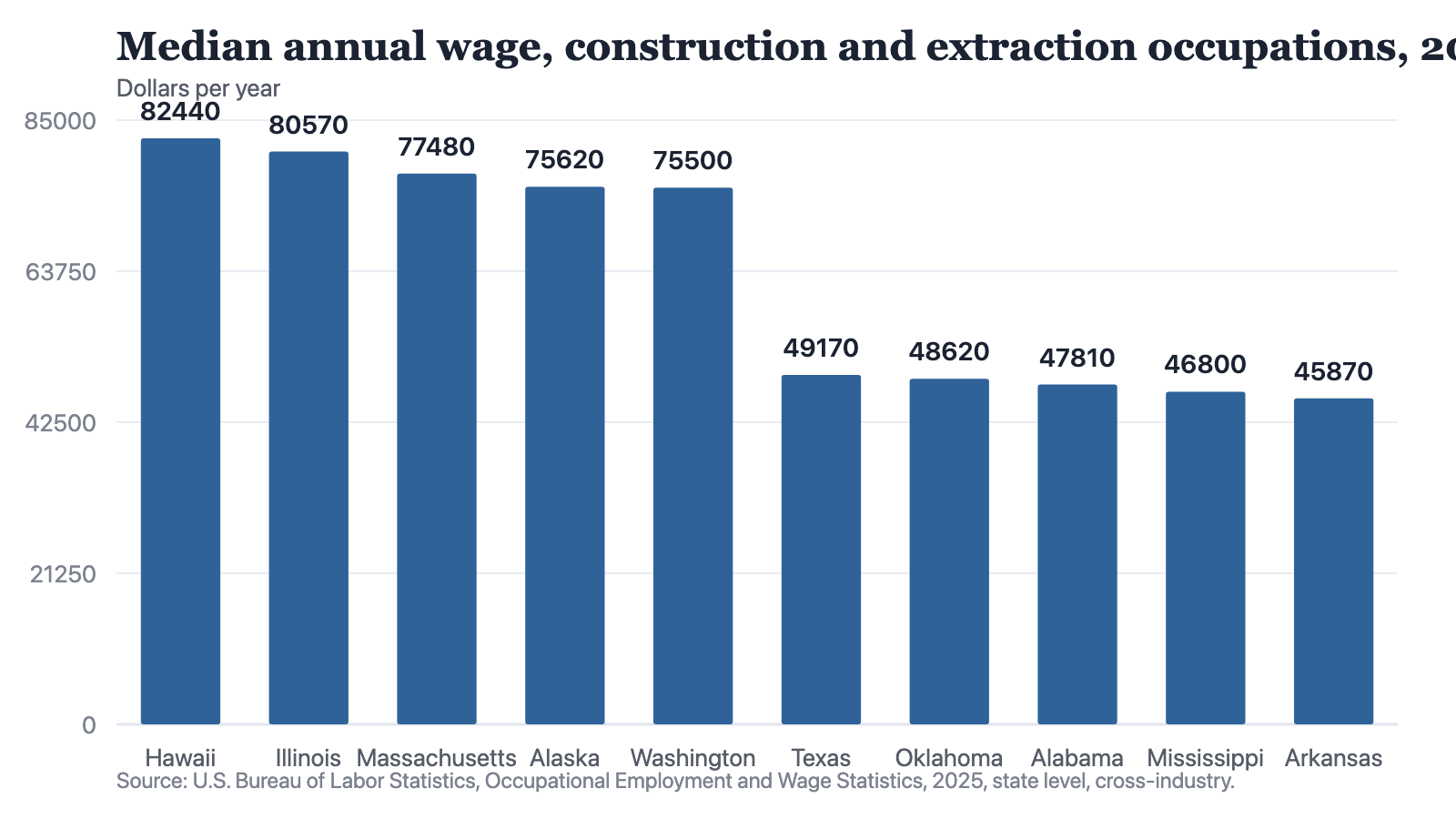
Notes: Five highest and five lowest of fifty-one jurisdictions; the middle forty-one are not shown.
Source: The Cefa Brief
Chart description
Ten bars in descending order, with a clear break in the middle where the omitted jurisdictions would sit. The five tallest are close in height to one another: Hawaii at 82,440 dollars, Illinois at 80,570, Massachusetts at 77,480, Alaska at 75,620 and Washington at 75,500. The five shortest are likewise tightly grouped near the bottom of the range: Texas at 49,170, Oklahoma at 48,620, Alabama at 47,810, Mississippi at 46,800 and Arkansas at 45,870. The gap between the two groups is wide enough that no bar in the lower group comes close to the height of any bar in the upper one.
Ten bars in descending order, with a clear break in the middle where the omitted jurisdictions would sit. The five tallest are close in height to one another: Hawaii at 82,440 dollars, Illinois at 80,570, Massachusetts at 77,480, Alaska at 75,620 and Washington at 75,500. The five shortest are likewise tightly grouped near the bottom of the range: Texas at 49,170, Oklahoma at 48,620, Alabama at 47,810, Mississippi at 46,800 and Arkansas at 45,870. The gap between the two groups is wide enough that no bar in the lower group comes close to the height of any bar in the upper one.
Why baselines move
Rebaselining is a legitimate practice and also the most common way an overrun disappears. When scope genuinely changes — a station added, a standard tightened, a route altered — the old estimate is measuring a different project, and comparing against it tells you nothing useful. When funding is deferred and the work stretches over more years, the same work costs more in cash terms and a revised baseline records that honestly. The difficulty is that the paperwork for a principled rebaseline and a convenient one looks identical. The only defence is a preserved record of what the scope was at each baseline, which is why the projects that report overruns most credibly are the ones that publish the scope alongside the number.
- The announcement figure: quoted early, usually before design, and usually without contingency in it.
- The approval estimate: the number in the business case on which the decision to proceed rested.
- The award price: the first figure a counterparty has signed for, and the first that is legally meaningful.
- The current approved budget: the baseline after any revisions, and the one most institutions actually report against.
Cash, real terms, and where the work is
Two figures stated in different years' money are not comparable, and a great many published overruns compare them anyway. An estimate made in one year's dollars, set against an outturn paid in later dollars, will show a gap even where the project performed exactly as planned. The opposite error is just as common: deflating an outturn by a general price index when construction input prices moved differently from consumer prices, which they frequently do.
Place is the other half of it. The chart shows the labour price of one occupational group across jurisdictions, and the distance between the ends is not a rounding difference. An estimate built on national averages is therefore already wrong on the day it is written, in a direction that depends on where the work will be done. A project priced for one labour market and executed in another begins with an error that has nothing to do with how well it is managed, and that error will be reported later as an overrun.
The live disagreement in this field is about why the errors run in one direction. One school, associated with reference-class forecasting, holds that bottom-up estimating is systematically optimistic and that the reliable correction is to compare a project against the recorded distribution of outcomes from similar completed projects, setting its own detail aside. Another holds that the problem is not cognitive but institutional: sponsors know the early figure is low and publish it anyway, because a truthful figure would not have been approved. The first diagnosis calls for better method. The second calls for different incentives. They are not mutually exclusive, and they imply quite different reforms.
When a percentage is quoted at you, three questions settle what it means. Which of the four baselines is the denominator. Whether both figures are stated in the same year's money. And whether the scope at the end is the scope that was priced at the start. An overrun quoted without those three is not a measurement. It is a position in an argument.
About the author
Each author told us that for this piece they hold no interest a reader would think relevant.
Explainers are written and kept up to date by The Cefa Brief’s editors. An Explainer is background CEFA stands behind. It is not one author’s argument, and it is not a CEFA position on what anyone should do. If something here is wrong or out of date, write to applied@thecefa.org.
© 2025 Center for Economics & Foreign Affairs. To republish it, see our republication terms. Republishing
Share
The Cefa Brief · applied.thecefa.org/cefa-brief/what-a-cost-overrun-is-measured-against · Printed from the web edition