
The bigger GDP number answers a different question
The United States publishes two gross domestic product totals and they are diverging by design. Industrial programmes are almost always defended with the larger one, which is the only one that cannot tell you whether more is being made.
by
Published 4 minute read

Abbildung: The Cefa Brief
The United States publishes two gross domestic product totals, and in 2025 they stood at 30.8 trillion and 23.85 trillion. Neither is an error and neither is an estimate of the other. One counts output at the prices it actually fetched; the other counts the same output at a fixed 2017 price basis. They are different instruments built for different questions, and the country has quietly settled into a habit of using the first to answer the second.
My position is that anyone defending an industrial programme with the current-dollar total is making an argument that cannot be checked. Industrial policy is a claim about things: plants, volumes, tonnes, units, capability that exists where it did not. The only one of these two series that speaks about things is the chained-dollar one. The larger number is the one people reach for, and it is the one that has been stripped of exactly the information the argument requires.
What each series is holding constant
The current-dollar total reads 26.1 trillion in 2022, 27.8 in 2023, 29.3 in 2024 and 30.8 in 2025. The chained-dollar total reads 22.08, 22.72, 23.36 and 23.85 across the same four years. Both are rising and neither falls, so no one is hiding a downturn. What separates them is what each holds still. The first lets prices move and measures the resulting money. The second freezes prices at a 2017 basis and measures what is left, which is volume.
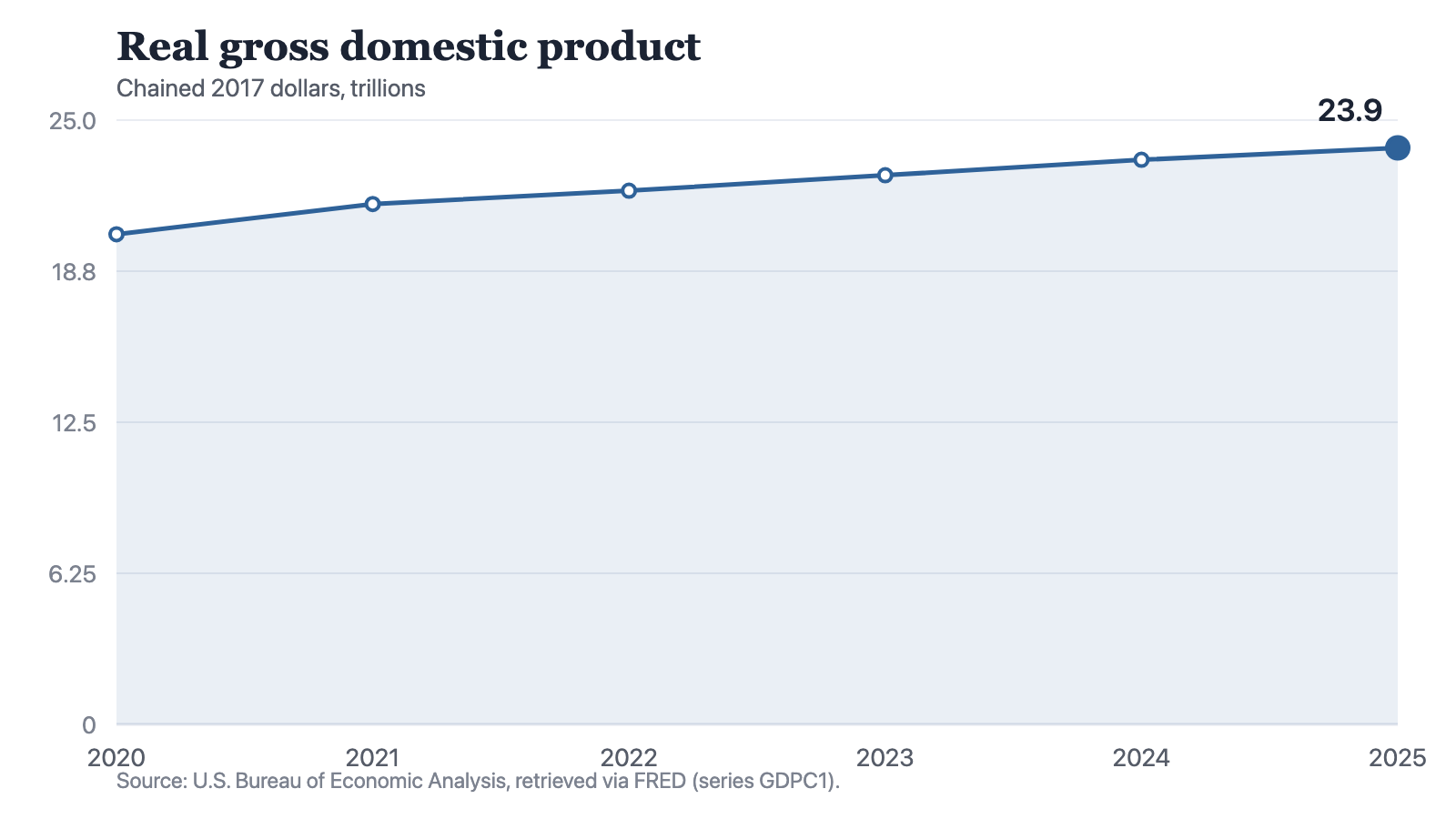
Notes: Stated in chained 2017 dollars. This series is not comparable in level to the current-dollar total, which is measured in the prices of each year.
Source: The Cefa Brief
Chart description
A line chart of real gross domestic product in chained 2017 dollars rising from 20.28 trillion in 2020 to 21.53 in 2021, 22.08 in 2022, 22.72 in 2023, 23.36 in 2024 and 23.85 in 2025. The line rises in every year, with the largest step between 2020 and 2021.
A line chart of real gross domestic product in chained 2017 dollars rising from 20.28 trillion in 2020 to 21.53 in 2021, 22.08 in 2022, 22.72 in 2023, 23.36 in 2024 and 23.85 in 2025. The line rises in every year, with the largest step between 2020 and 2021.
Because the two are stated in different units, they cannot be subtracted, and I am not going to subtract them. What can be said is how much each added over the four years both cover. The current-dollar total added 4.7 trillion of current dollars. The chained-dollar total added 1.77 trillion of 2017 dollars. Two numbers, two units, one underlying economy. That is not a discrepancy to be reconciled. It is the design working as intended.
The chained series also carries two earlier observations, and they are worth having. Real output stood at 20.28 trillion in 2020 and 21.53 in 2021, a step of 1.25 that no later year comes close to. The annual increments after it run 0.55, 0.64, 0.64 and 0.49. The most recent is the smallest in the whole window, and the shape of that sequence, a rebound followed by four steadier and slightly narrowing steps, is a fact about volume that the current-dollar series simply does not contain.
The objection from the people who sign the cheques
The strongest objection is that current dollars are the real world and constant dollars are the abstraction. Wages are paid in current dollars. Tax is assessed in them. Debt is denominated in them, and the ratio of debt to output that every finance ministry watches is built from the current-dollar total, not the chained one. A constant 2017 dollar is a statistical construction that no supplier has ever invoiced in. On that view, insisting on the real series is preferring a model to the economy.
That is correct wherever the question is financial, and I would not use a chained-dollar figure to discuss debt capacity or a tax base. The construction has genuine costs too: chaining means the units shift as the weights are revised, which makes the series less intuitive than its critics are usually given credit for noticing. If someone wants to argue that real GDP is harder to interpret than it looks, they are right.
But the objection defends the current-dollar series against uses nobody is contesting. Nothing in it rescues the specific move I am objecting to, which is citing a nominal total as evidence that a country is producing more. That inference requires knowing whether the extra dollars bought extra output or the same output at higher prices, and it is precisely that knowledge the current-dollar series was built to discard. Using it for that purpose is not a defensible simplification. It is asking a question of an instrument that has been designed not to answer it.
Why the habit persists
The reason the larger number wins is not that anyone is confused. It is that it is larger, it is more recent to the ear, and it moves faster: 4.7 trillion of headline growth is a better sentence than 1.77 trillion of chained growth, and every communications office in the country knows it. Nominal totals also cross a decade's worth of milestones sooner, and milestones are the currency of political reporting. The incentive runs entirely one way, which is why the correction has to be a standard rather than an appeal to good faith.
The standard is not demanding. When a programme's success is stated in dollars of output, ask which dollars. If the answer is current dollars, the claim being made is about money and should be phrased that way. If the claim is about capability, about volume, about things being produced in this country that were not before, then the chained series is the one that has been built to carry it, and the fact that it produces a smaller and slower-moving number is not a flaw in the measurement. It is the measurement doing its job.
About the author

Each author told us that for this piece they hold no interest a reader would think relevant.
This commentary carries its author's name because the view in it is the author's own. An editor reviewed it before publication, which is not the same as agreeing with it. It is not a position of the Center for Economics & Foreign Affairs or of Applied America.
© 2025. The author or authors hold the copyright in this commentary; CEFA publishes it with their permission. This edition, its editing and its presentation are © 2025 Center for Economics & Foreign Affairs. To republish it, see our republication terms. Republishing
Share
The Cefa Brief · applied.thecefa.org/cefa-brief/the-bigger-gdp-number · Printed from the web edition