
ErklärstückStates & Communities
How a balanced-budget rule shapes what a state can offer
Almost every state has to close its books inside a single fiscal year. By the end you will know why that rule pushes economic development toward tax credits and away from cash, and what that swap costs.
Prepared by
Last reviewed Published 3 minute read

Abbildung: The Cefa Brief
A state’s budget runs on a clock. In most states the fiscal year begins on 1 July and ends on 30 June, three months out of step with the federal year, which starts on 1 October. Inside that window the state must match what it spends to what it takes in. The rules that force the match vary: in some states the governor must propose a balanced budget, in others the legislature must enact one, and in the strictest the state may not carry a deficit from one year into the next. What they share is a deadline.
Receipts do not respect the deadline. Income and corporate taxes move with profits and capital gains. Sales taxes move with consumption. Severance taxes move with the price of oil, gas and coal, which is set in markets no legislature controls. A state whose revenue is concentrated in one of those lines can see a gap open months after the budget was signed.
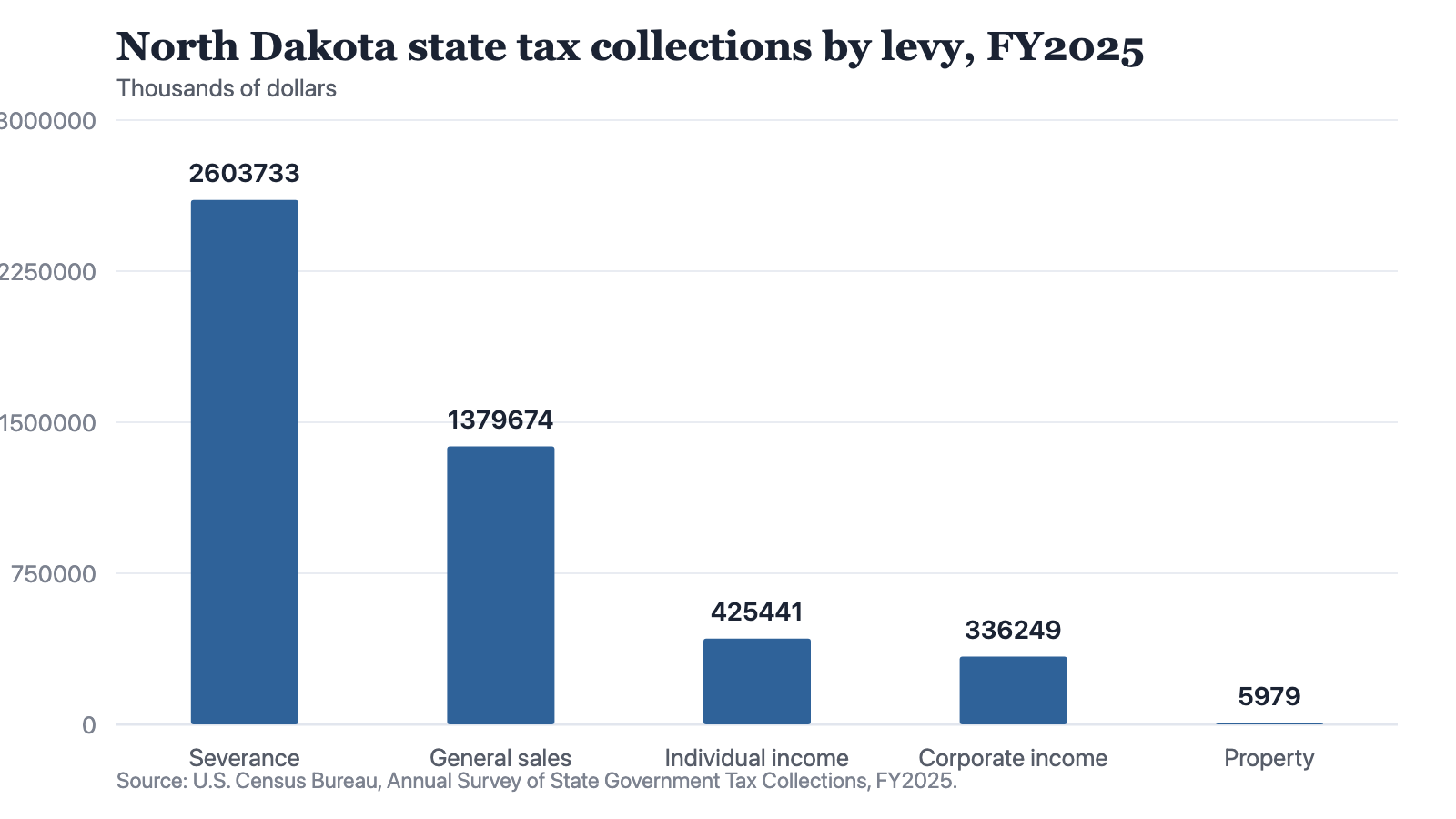
Notes: U.S. Census Bureau, Annual Survey of State Government Tax Collections, FY2025. Thousands of dollars. The five itemised levies do not sum to total tax collections of 5,517,006, because other taxes are not broken out.
Source: The Cefa Brief
Chart description
Five bars, falling steeply from left to right, showing North Dakota’s state tax collections in fiscal 2025 in thousands of dollars. Severance tax is the tallest at 2,603,733, nearly twice the second bar, general sales at 1,379,674. Individual income tax follows at 425,441 and corporate income tax at 336,249, roughly a sixth and roughly an eighth of the severance bar respectively. Property tax is 5,979, so small against the others that the bar is barely visible at this scale. The shape shows a revenue base whose largest single line is tied to commodity prices rather than to wages or retail sales.
Five bars, falling steeply from left to right, showing North Dakota’s state tax collections in fiscal 2025 in thousands of dollars. Severance tax is the tallest at 2,603,733, nearly twice the second bar, general sales at 1,379,674. Individual income tax follows at 425,441 and corporate income tax at 336,249, roughly a sixth and roughly an eighth of the severance bar respectively. Property tax is 5,979, so small against the others that the bar is barely visible at this scale. The shape shows a revenue base whose largest single line is tied to commodity prices rather than to wages or retail sales.
Why the rule reaches economic development
An appropriation is cash, and cash leaves the treasury inside the year it is voted. A grant to build a road to a new plant, or to train the workers who will staff it, competes in that year against schools, Medicaid and prisons, all of which have to fit under the same ceiling. A tax credit does not work that way. It reduces a liability the company has not yet incurred, in a year that is not yet being balanced, and in many states it never appears as spending at all.
An appropriation costs money this year. A credit costs money in a year nobody is balancing yet.
That asymmetry explains a great deal about how American incentives are built. Investment and jobs credits, payroll rebates, property tax abatements granted by a local body, sales tax exemptions on construction materials and equipment: all of them shift the cost into future years, and several of them shift it onto a different level of government. The forms differ in law, but the fiscal logic is the same, and it is set by the clock rather than by any theory of what works.
What the rule does not do
A balanced-budget rule does not stop a state borrowing. Capital budgets are commonly outside it, so debt-financed construction continues while operating accounts are cut. It does not stop a state from making long promises, either: a credit with a ten-year term is a claim on ten future budgets, and pensions are longer still. What it does is make the operating budget the place where adjustment happens, which is why revenue shortfalls show up as hiring freezes, deferred maintenance and pulled programme money rather than as a deficit.
- Ask which fiscal year the money actually leaves the treasury, and whether the answer is an appropriation or a credit against a future liability.
- Ask whether the credit is refundable or transferable, because either feature turns it into cash for a company with no tax to offset.
- Ask whether a cap exists on the total the state can award in a year, and whether unused room carries forward.
- Ask who recovers the money if the jobs do not appear, and whether that clawback has ever been used.
Where the argument is genuine
Economists disagree about the effect of these rules on the business cycle. One camp holds that strict rules force states to cut in downturns, deepening the local slump at the moment demand is weakest, and that rainy-day funds are the intended remedy but are rarely large enough. Another holds that the discipline is what keeps state borrowing costs low and prevents the slow accumulation of unfunded promises. The dispute is about timing and credibility, not about arithmetic.
The next time a state announces an incentive package, look for the year in which the treasury is worse off. If that year is inside the budget being debated, the legislature is trading it against something visible. If it is not, the decision has been moved to a session that has not happened yet, and the people who will have to balance it were not in the room.
About the author
Each author told us that for this piece they hold no interest a reader would think relevant.
Explainers are written and kept up to date by The Cefa Brief’s editors. An Explainer is background CEFA stands behind. It is not one author’s argument, and it is not a CEFA position on what anyone should do. If something here is wrong or out of date, write to applied@thecefa.org.
© 2026 Center for Economics & Foreign Affairs. To republish it, see our republication terms. Republishing
Share
The Cefa Brief · applied.thecefa.org/cefa-brief/state-balanced-budget-rules · Printed from the web edition