
Industrial policy is being judged by the wrong labour number
The unemployment rate says how many job-seekers found work. It says nothing about how many people are looking. For a programme meant to draw people back into work, that is the only question that matters.
by
Published 2 minute read

Abbildung: The Cefa Brief
Every industrial programme of the last five years has been defended with the unemployment rate. It is the wrong number, and the habit of reaching for it is doing real damage to how these programmes are judged.
The unemployment rate is a ratio with the labour force on the bottom. The labour force counts people who are working or actively looking. Someone who stops looking leaves the denominator, and the rate falls. A programme can therefore preside over a falling unemployment rate while the number of people attached to work goes nowhere.
What the participation rate asks instead
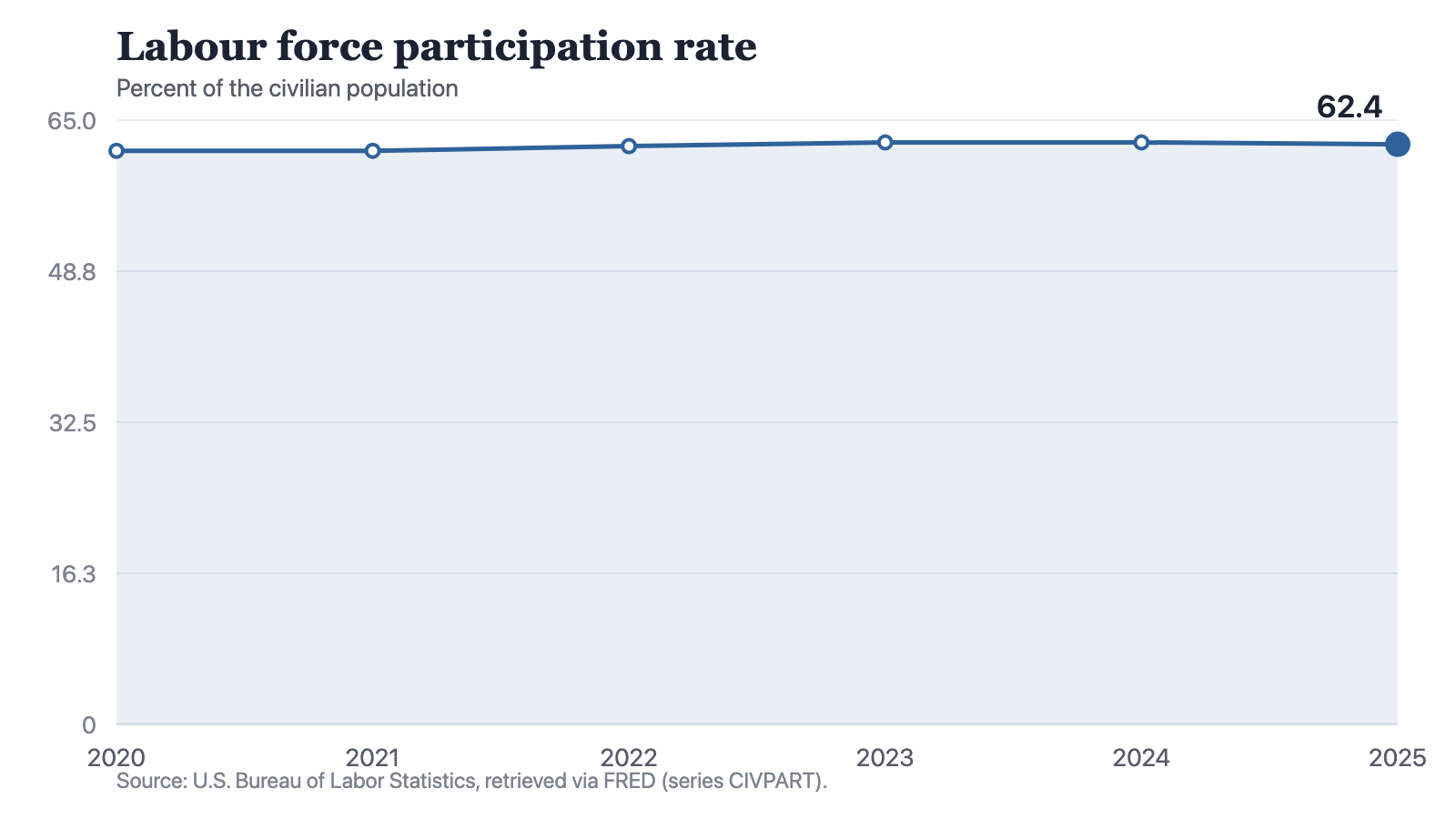
Notes: Annual averages. The measure counts everyone aged 16 and over and is not adjusted here for the ageing of the population, which lowers it independently of any policy.
Source: The Cefa Brief
Chart description
A line chart with a zero baseline showing participation at 61.7 percent in 2020 and 2021, rising to 62.2 in 2022 and 62.6 in 2023 and 2024, then easing to 62.4 in 2025. The line is close to flat across the period.
A line chart with a zero baseline showing participation at 61.7 percent in 2020 and 2021, rising to 62.2 in 2022 and 62.6 in 2023 and 2024, then easing to 62.4 in 2025. The line is close to flat across the period.
Participation asks a different question: of everyone who could be attached to work, how many are? It has no denominator that shrinks when people give up. If a programme pulls someone off the sidelines, participation registers it. If it does not, participation says so.
That is the claim industrial policy actually makes. The case for building things in a place is not that the people already looking for work will find it slightly faster. It is that work will exist where it did not, and that people who had stopped looking will look again.
The strongest objection
The obvious reply is that participation is dominated by demography. The population is ageing, and retirement pulls the rate down whatever policy does. That objection is correct and it is the reason participation is rarely quoted. A flat line can hide a real gain that demography is masking.
It is not, however, a reason to go back to the unemployment rate. It is a reason to hold participation to the same standard as any other measure: compare it against what demography alone would have produced, by age band, and read the difference. That is harder than quoting a headline, which is precisely why the headline keeps winning.
What to ask of the next announcement
When a programme is defended with a labour figure, ask which one. If it is the unemployment rate, ask what happened to participation in the same place over the same period. If the answer is that nobody measured it, the claim being made is smaller than it sounds.
The test is not whether the rate fell. It is whether more people are attached to work than were before, and whether the programme is the reason. Those are answerable questions. The unemployment rate simply does not answer them.
About the author

Each author told us that for this piece they hold no interest a reader would think relevant.
This commentary carries its author's name because the view in it is the author's own. An editor reviewed it before publication, which is not the same as agreeing with it. It is not a position of the Center for Economics & Foreign Affairs or of Applied America.
© 2025. The author or authors hold the copyright in this commentary; CEFA publishes it with their permission. This edition, its editing and its presentation are © 2025 Center for Economics & Foreign Affairs. To republish it, see our republication terms. Republishing
Share
The Cefa Brief · applied.thecefa.org/cefa-brief/participation-not-unemployment · Printed from the web edition