
РазъяснениеStates & Communities
How a tax-increment financing district works
A TIF district pays for public works out of the tax growth those works are meant to cause. By the end you will know what the district captures, who gives it up, and what the argument between supporters and critics is actually about.
Prepared by
Last reviewed Published 3 minute read

Иллюстрация: The Cefa Brief
Tax-increment financing is a way for a local government to pay for public works out of the tax growth those works are meant to produce. A city draws a boundary on a map. It records what the property inside the boundary is assessed at in that year, and that figure becomes the base. Every taxing body inside the district goes on collecting its ordinary rate on the base. Tax on any assessed value above the base, the increment, is diverted into a fund the district controls.
The fund pays for the things that were supposed to cause the increment: land assembly, demolition, streets, water and sewer extensions, a parking structure, site remediation, sometimes a share of a private developer’s costs. A district can spend as the increment arrives, or it can issue bonds against the increment it expects and spend the money at the start. The second is normal for large projects, and it is where the risk sits, because the debt is sold before anyone knows whether the increment will appear.
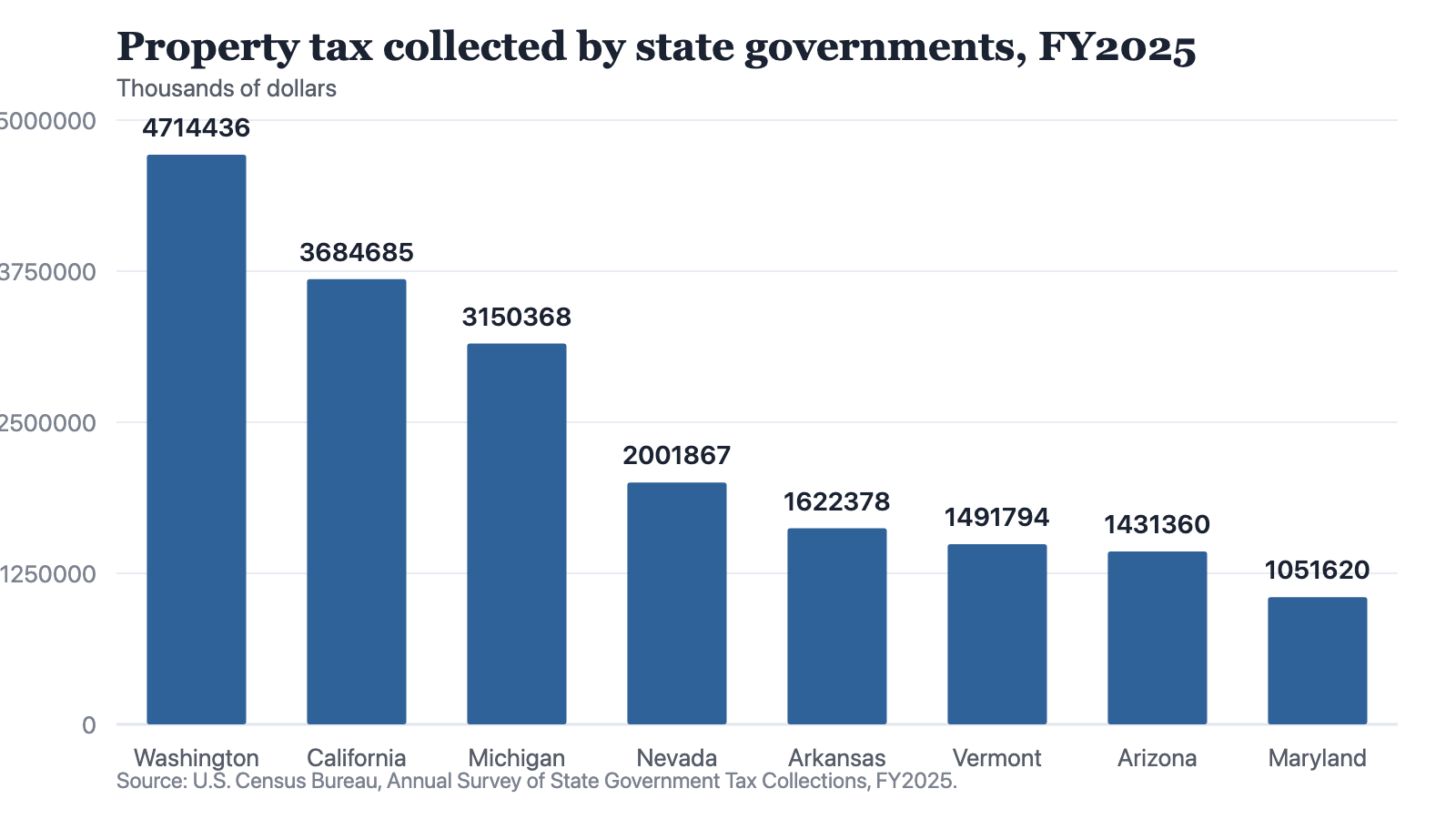
Notes: U.S. Census Bureau, Annual Survey of State Government Tax Collections, FY2025. Thousands of dollars. Local property tax collections are not in this survey.
Source: The Cefa Brief
Chart description
Eight descending bars showing property tax collected by state governments in fiscal 2025, in thousands of dollars. Washington is the tallest at 4,714,436, followed by California at 3,684,685 and Michigan at 3,150,368. The middle of the range holds Nevada at 2,001,867, Arkansas at 1,622,378, Vermont at 1,491,794 and Arizona at 1,431,360. Maryland is the shortest bar at 1,051,620, less than a quarter of Washington’s. The chart shows only the states that collect a property tax centrally; in the same survey, fourteen of the 51 jurisdictions record no state property tax item whatsoever, because the levy there belongs entirely to local government.
Eight descending bars showing property tax collected by state governments in fiscal 2025, in thousands of dollars. Washington is the tallest at 4,714,436, followed by California at 3,684,685 and Michigan at 3,150,368. The middle of the range holds Nevada at 2,001,867, Arkansas at 1,622,378, Vermont at 1,491,794 and Arizona at 1,431,360. Maryland is the shortest bar at 1,051,620, less than a quarter of Washington’s. The chart shows only the states that collect a property tax centrally; in the same survey, fourteen of the 51 jurisdictions record no state property tax item whatsoever, because the levy there belongs entirely to local government.
What the district captures
The increment is a property tax increment, and in the United States the property tax is overwhelmingly a local instrument. Counties, municipalities, school districts and special districts set rates against assessed value. The chart shows the narrow and very uneven slice that state governments collect themselves, and in fourteen of the jurisdictions surveyed that slice does not exist. The consequence for TIF is direct. States write the statute that authorises districts, and then almost none of the money runs through state accounts. What a district captures is local revenue, forgone by local bodies, recorded in local reports.
- The local government designates a boundary, usually after a statutory finding about the condition of the area.
- The assessed value inside the boundary in that year is recorded as the base.
- Existing taxing bodies keep receiving their ordinary tax on the base for the life of the district.
- Tax on assessed value above the base is diverted into the district’s fund.
- The district spends that fund directly, or pledges it to service bonds issued against it.
- At the end of the statutory term the district closes and the whole assessed value returns to the ordinary rolls.
Where the disagreement sits
Nearly every TIF statute requires a but-for finding: that the development would not occur but for the assistance. The finding is a judgement about a world that did not happen, and it is the centre of the dispute. Supporters hold that distressed sites carry costs, contamination, fragmented title, missing utilities, which no private balance sheet will absorb, and that the increment is the only revenue a city can pledge without raising a rate. Critics hold that increments often capture growth the market would have delivered anyway, so the district converts ordinary revenue into a subsidy and records the result as success.
The finding that development would not have happened otherwise is a judgement, not a measurement.
The second argument is about who was asked. A municipal council designates the district, but the diverted increment comes from every body that levies on the same parcels, and school districts are usually the largest of them. Some states require those bodies to consent, or hold schools harmless through the state aid formula. Others do not. Terms are set by statute and can run long enough that a district outlives the officials who created it, which is why extensions and expansions draw more scrutiny than the original designation.
How to read a district’s own report
A district publishes its numbers, usually once a year, and three lines decide whether it is working: the base year value, the current assessed value inside the boundary, and the debt service owed this year. Take the growth between the first two and set it beside the growth in assessed value outside the boundary in the same county over the same years. If the inside and the outside grew at about the same rate, the district is capturing the market rather than creating it, and the debt in the third line is being paid by the school district down the road.
About the author
Each author told us that for this piece they hold no interest a reader would think relevant.
Explainers are written and kept up to date by The Cefa Brief’s editors. An Explainer is background CEFA stands behind. It is not one author’s argument, and it is not a CEFA position on what anyone should do. If something here is wrong or out of date, write to applied@thecefa.org.
© 2026 Center for Economics & Foreign Affairs. To republish it, see our republication terms. Republishing
Share
The Cefa Brief · applied.thecefa.org/cefa-brief/tax-increment-financing · Printed from the web edition