
What refining capacity is, and why it is the bottleneck
Refining is the step between a raw material and a usable one. By the end you will know why it is harder to replace than a mine, why it clusters in a few places, and what a country that cannot refine actually lacks.
Prepared by
Last reviewed Published 3 minute read

Ilustração: The Cefa Brief
Refining is the step that turns something dug up into something a factory can use. Crude oil becomes petrol, diesel and the feedstocks for plastics. Bauxite becomes alumina and then aluminium. Lithium concentrate becomes lithium hydroxide. In each case the raw material and the usable material are chemically different substances, and the plant that converts one into the other is a large, specific and very expensive piece of capital.
Public argument usually treats the mine as the hard part. It is generally the other way round. A deposit is where geology left it, and finding more is a question of exploration budgets and luck. A refinery can in principle be built anywhere, which is precisely why its location is a decision somebody made rather than a fact about the world, and precisely why it can be lost.
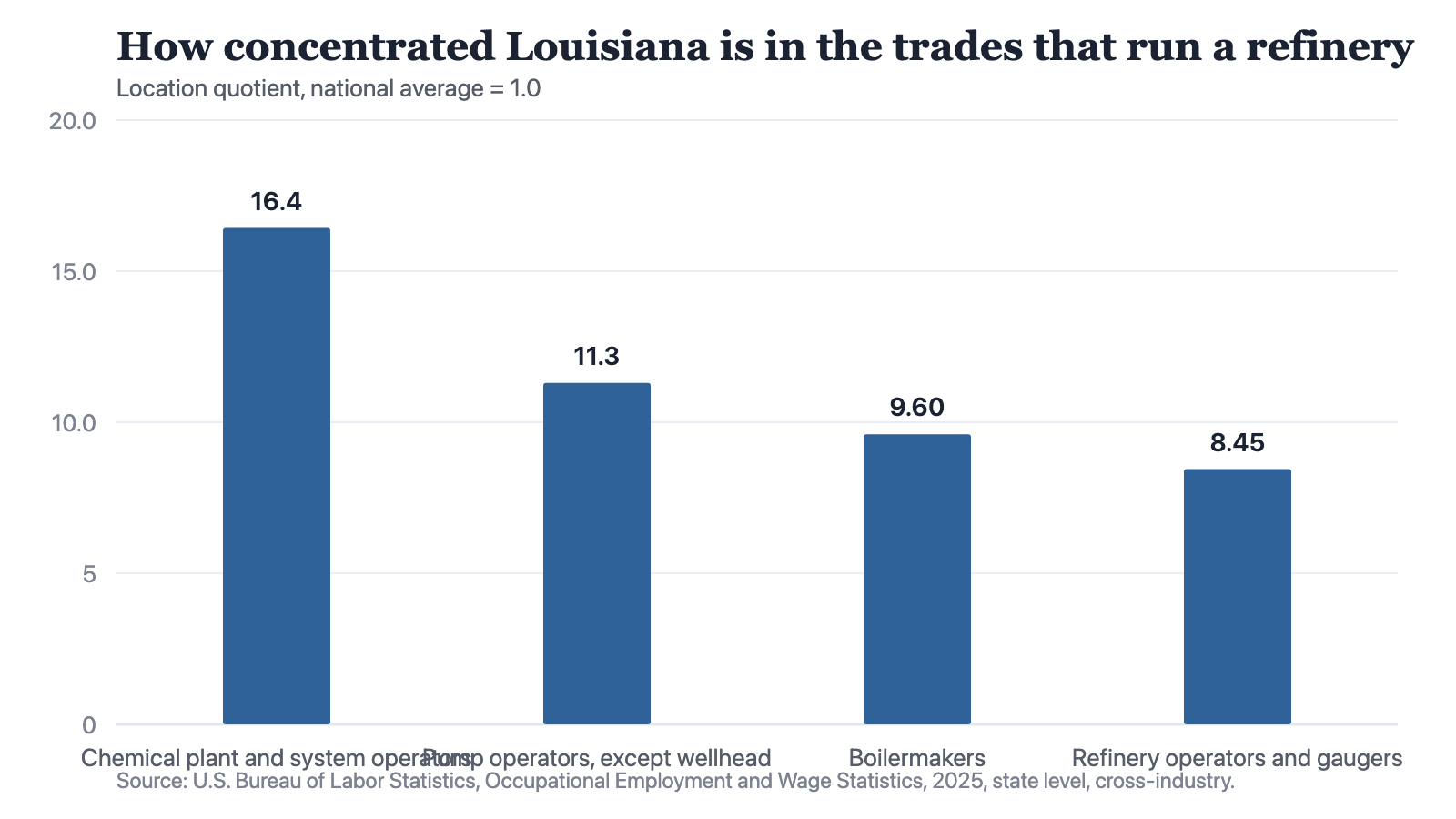
Notes: Location quotient: the state's share of these jobs divided by the national share. Occupations employing fewer than 1,000 people in the state are not shown. Bar labels are shortened to fit. Their full Bureau of Labor Statistics titles are: Petroleum Pump System Operators, Refinery Operators, and Gaugers; Pump Operators, Except Wellhead Pumpers; Derrick Operators, Oil and Gas; Roustabouts, Oil and Gas. A shortened label covers exactly the occupation its full title names, no more and no less.
Source: The Cefa Brief
Chart description
Four bars, all far to the right of the national average of 1.0. Chemical plant and system operators is the longest at 16.43. Pump operators, except wellhead pumpers, follows at 11.3, then boilermakers at 9.6, then refinery operators and gaugers at 8.45. The bars step down evenly rather than falling away, so roughly half the length of the longest bar still remains at the shortest. The picture is of a whole group of occupations sitting many times above their national share together, not one unusual job in an otherwise ordinary labour market.
Four bars, all far to the right of the national average of 1.0. Chemical plant and system operators is the longest at 16.43. Pump operators, except wellhead pumpers, follows at 11.3, then boilermakers at 9.6, then refinery operators and gaugers at 8.45. The bars step down evenly rather than falling away, so roughly half the length of the longest bar still remains at the shortest. The picture is of a whole group of occupations sitting many times above their national share together, not one unusual job in an otherwise ordinary labour market.
What a refinery actually is
A refinery is a chemical process plant configured for a particular input. Crude oils differ in density and in sulphur content, and a plant built to run light sweet crude cannot simply switch to heavy sour crude: the units that would strip the sulphur and crack the heavy fractions are either there or they are not, and adding them is a capital project of its own. The same is true of mineral processing. A plant built to separate one ore body's chemistry is not a general purpose machine. The configuration is chosen at construction and is expensive to revisit, which is the first reason capacity is sticky.
Why the capacity does not move
- Capital. The plant is built once, over several years, and repaid over decades. The money is sunk the moment it is spent, so the economics of an existing plant and a proposed one are never comparable.
- Siting. Processing needs air and water permits, industrial power, and a position next to the transport that brings feed in and takes product out. Few sites clear all four, and the ones that do already have plants on them.
- Labour. Operators, boilermakers and instrument technicians are trained largely by working in plants, and they cluster where plants already are. That is what the chart shows: not one scarce occupation but a connected trade base.
- Continuous operation. Many process plants are designed never to stop. Shutting one down is a controlled and costly procedure and restarting it is worse, so a plant closed for commercial reasons is rarely reopened.
This is where dependence shows up, and it is why a resource endowment can be misleading. A country can own the deposit, ship the concentrate out, and buy the finished material back at whatever the seller charges. On paper it holds the resource. In practice it holds an excavation and an invoice. The leverage sits with whoever operates the conversion step, because that step has the fewest alternatives, the longest replacement time, and the least visibility in any figure for production.
Ore is not a supply chain. The conversion step is.
Analysts disagree about how far a government should go to hold this step at home. One argument treats conversion capacity as a strategic asset of the same kind as a shipyard: it takes years to build, it cannot be improvised in a crisis, and it is worth carrying through the price troughs at public expense. The competing argument is that refining is a thin margin commodity business, that subsidy locks capital into plants no private owner would run, and that security is better bought through diversified contracts with several producing countries than through domestic plants that have to be paid for in the good years as well as the bad. Both sides agree the conversion step is the chokepoint. They disagree about whether owning it is worth what owning it costs.
The useful question to put to any announcement about securing a material is where in the chain the money lands. A new mine, a new separation plant and a new component factory are three different projects with three different timelines. Only one of them removes a dependence on somebody else's chemistry. If the announcement counts tonnes of ore and does not name the plant that will process them, the dependence has not moved.
About the author
Each author told us that for this piece they hold no interest a reader would think relevant.
Explainers are written and kept up to date by The Cefa Brief’s editors. An Explainer is background CEFA stands behind. It is not one author’s argument, and it is not a CEFA position on what anyone should do. If something here is wrong or out of date, write to applied@thecefa.org.
© 2026 Center for Economics & Foreign Affairs. To republish it, see our republication terms. Republishing
Share
The Cefa Brief · applied.thecefa.org/cefa-brief/what-refining-capacity-is · Printed from the web edition