
ExplicativoInternational Partners
What makes a loan concessional
Concessional finance is lending on terms better than the market would offer, measured by a calculation called the grant element. By the end you should know which four terms make a loan concessional, who absorbs the cost, and why the same loan can be scored two different ways.
Prepared by
Last reviewed Published 3 minute read

Ilustração: The Cefa Brief
Concessional finance is money lent on terms the borrower could not have obtained from the market. That is the entire definition. Everything after it, including the grant element and the arguments about discount rates, is machinery for measuring how much better the terms are.
The terms usually move in four directions at once. The interest rate is below what a commercial lender would charge a borrower of that credit standing. The maturity is longer, sometimes long enough that the loan outlives the government that signed it. There is a grace period during which interest may be owed but principal is not. And in some facilities the loan is written in the borrower's own currency, so that a devaluation does not quietly enlarge the debt. Any one of these is a subsidy. Together they can make an asset financeable that no commercial structure would have carried.
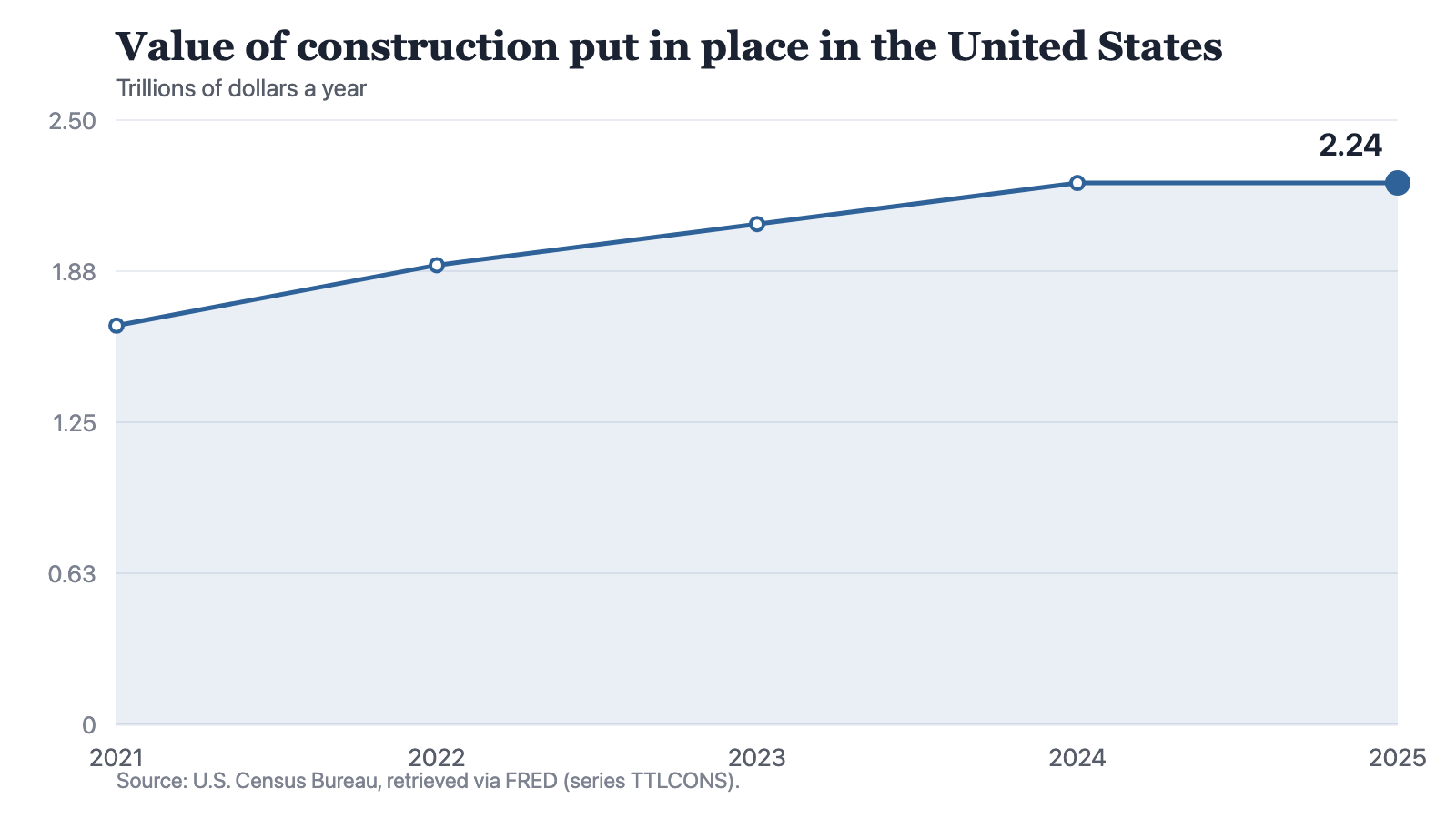
Notes: Annual value put in place, all construction. Source: U.S. Census Bureau, retrieved via FRED (series TTLCONS).
Source: The Cefa Brief
Chart description
A line chart with five annual points. The line rises through the first four years, from 1.65 trillion dollars in 2021 to 1.9 trillion in 2022, 2.07 trillion in 2023 and 2.24 trillion in 2024, then runs flat into 2025 at 2.24 trillion. The shape is a climb that levels off at the right-hand end rather than turning down.
A line chart with five annual points. The line rises through the first four years, from 1.65 trillion dollars in 2021 to 1.9 trillion in 2022, 2.07 trillion in 2023 and 2.24 trillion in 2024, then runs flat into 2025 at 2.24 trillion. The shape is a climb that levels off at the right-hand end rather than turning down.
The grant element, and why it is an estimate
Institutions compress those four terms into one number, the grant element. The method is simple to state. Take the schedule of payments the borrower has promised, discount each one back to what it is worth today, add them up, and compare the total with the face value of the loan. The shortfall is the part the lender has effectively given away. The result depends entirely on the discount rate chosen for that calculation, and the choice of discount rate is a policy decision made by a committee, not a fact observed in a market. Change it, and the same loan, with identical terms, becomes more or less concessional on paper. This is why two institutions can describe the same facility differently and both be reporting honestly.
Somebody absorbs the shortfall. In practice there are three payers, and which one is carrying the cost tells you a great deal about how durable the facility is.
- The sponsoring government's taxpayers, through a budget appropriation that covers the expected cost of lending below market. This is the most visible route and the most exposed to a change of government.
- The lending institution's own earnings, when a bank lends at hard terms to middle-income borrowers and uses the margin to support a soft window for the poorest ones. The subsidy is cross-financed inside one balance sheet.
- Donors, who contribute grant money to a pooled fund that is then lent out on soft terms and replenished periodically. This is the usual structure of the concessional arms of the multilateral development banks.
Concessional is not free
A concessional loan is still a loan. It is recorded as debt, it is serviced out of the budget, and if it is denominated in a foreign currency it must be serviced out of export earnings or reserves. A long grace period moves the burden rather than removing it, and it moves it onto a later administration, which is one reason debt sustainability analyses look at the whole profile of repayments rather than the interest rate alone. A country can accumulate a great deal of concessional debt and still arrive at a point where servicing it crowds out the schools the borrowing was meant to build.
Concessional describes the terms of an obligation. It does not make the obligation anything other than an obligation.
The argument about grants
Specialists disagree, in public and at length, about where the line between a grant and a soft loan should fall. One side argues that for the poorest and most debt-distressed countries, lending on any terms adds to a stock of obligations that will eventually have to be written down, and that a grant is the honest instrument. The other side argues that a loan imposes a discipline a grant does not, that the repayment flow keeps the fund alive for the next borrower, and that grants are politically harder to sustain year after year. A second disagreement runs through the measurement itself: when market interest rates rise, the discount rate used to score concessionality may not move with them, so a loan can be scored as generous when the borrower is in fact paying close to what a private lender would have asked. Both arguments are live, and neither is settled by better data alone.
When a figure for concessional support is announced, four questions turn the word back into terms. What is the interest rate. When does the first principal payment fall due. When does the last one. In which currency is it owed. A fifth question is for the careful reader: which discount rate produced the grant element being claimed. Without the fifth, concessional is a statement of intent rather than a description of the contract.
About the author
Each author told us that for this piece they hold no interest a reader would think relevant.
Explainers are written and kept up to date by The Cefa Brief’s editors. An Explainer is background CEFA stands behind. It is not one author’s argument, and it is not a CEFA position on what anyone should do. If something here is wrong or out of date, write to applied@thecefa.org.
© 2025 Center for Economics & Foreign Affairs. To republish it, see our republication terms. Republishing
Share
The Cefa Brief · applied.thecefa.org/cefa-brief/what-makes-a-loan-concessional · Printed from the web edition