
Crude has fallen back below its 2021 price and the all-commodities index has not
West Texas Intermediate averaged 95 dollars a barrel in 2022 and 65 in 2025, three dollars below its 2021 reading and thirty below the peak. The producer price index for all commodities peaked in the same year, sits 1.6 per cent below that peak, and rose 2.2 per cent in the year crude fell 15.6 per cent.
by
Published 3 minute read

Ilustração: The Cefa Brief
West Texas Intermediate averaged 65 dollars a barrel in 2025. That is three dollars below the 2021 reading of 68 and thirty dollars below the 2022 peak of 95. Only 2020, at 39 dollars, is lower in the six years this series holds.
The six annual readings are 39 dollars in 2020, 68 in 2021, 95 in 2022, 78 in 2023, 77 in 2024 and 65 in 2025. Each is the average of that year's daily quotations rather than a price on any particular day.
Three falls, of three different sizes
The climb took two years and 56 dollars: 29 dollars into 2021, then 27 more into 2022. At 95 dollars the 2022 average is more than twice the 2020 average of 39. Nothing else in the window moves at that speed.
Then three consecutive falls, of 17 dollars, one dollar and 12 dollars. The middle one is the smallest move this file can record short of none, because the price is stored rounded to whole dollars. Read on their own, 78 and 77 look like a floor. The 2025 reading is what breaks that reading.
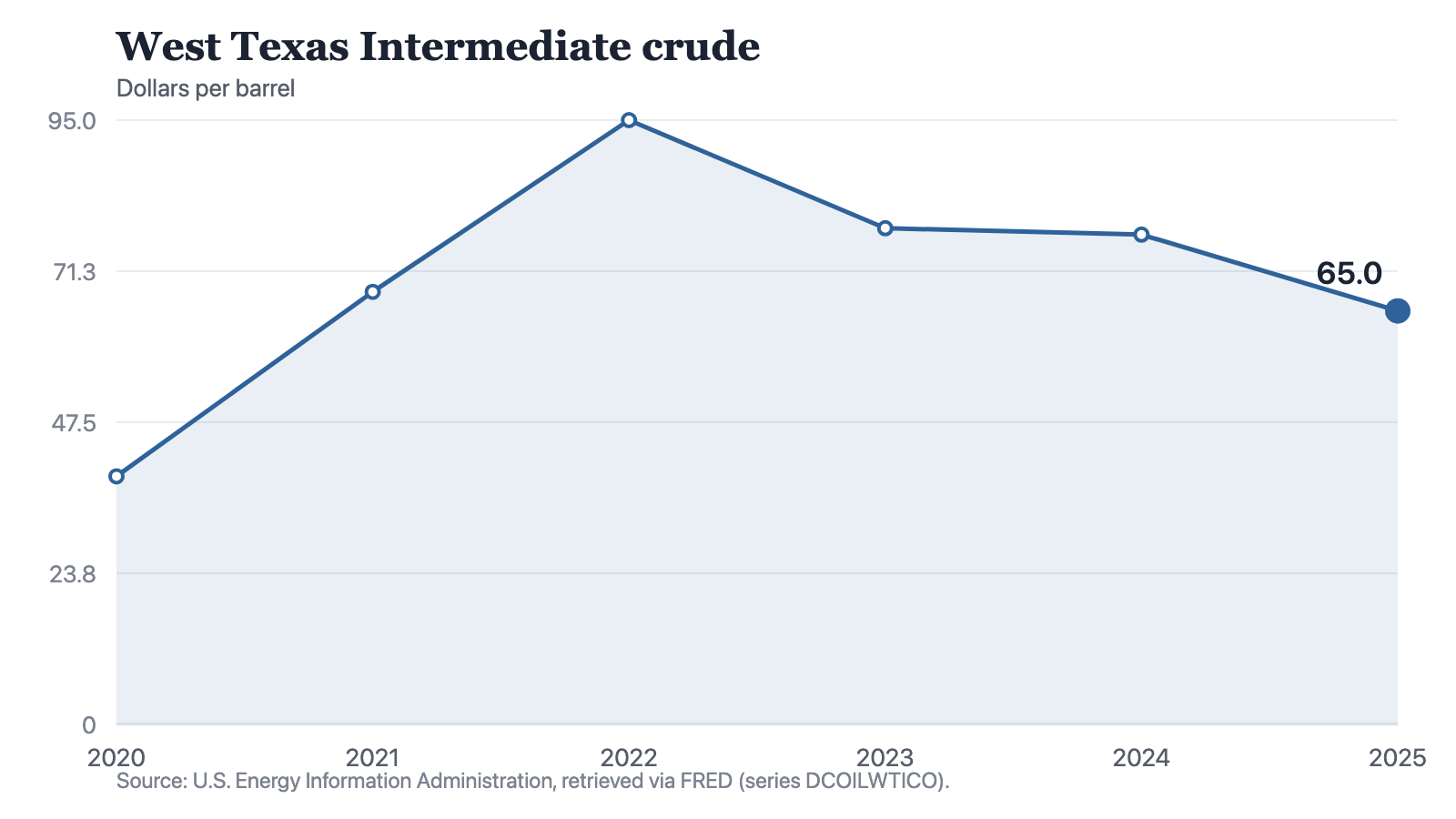
Notes: Annual observations. Each point is the average of that year's daily quotations, not a price on any given day, and the values are stored rounded to whole dollars.
Source: The Cefa Brief
Chart description
A line chart showing the West Texas Intermediate crude price at 39 dollars a barrel in 2020, 68 in 2021, 95 in 2022, 78 in 2023, 77 in 2024 and 65 in 2025. The line rises steeply across the first two steps to its high point of 95 in 2022, falls 17 dollars to 2023, moves one dollar to 2024, and then falls a further 12 dollars to 65, which is below the 2021 point and above the 2020 point.
A line chart showing the West Texas Intermediate crude price at 39 dollars a barrel in 2020, 68 in 2021, 95 in 2022, 78 in 2023, 77 in 2024 and 65 in 2025. The line rises steeply across the first two steps to its high point of 95 in 2022, falls 17 dollars to 2023, moves one dollar to 2024, and then falls a further 12 dollars to 65, which is below the 2021 point and above the 2020 point.
Taken together the three falls come to 30 dollars, which is 31.6 per cent of the 2022 peak. The level is still 26 dollars above where the window opened in 2020, so this is a retreat from a high rather than a return to the start. Both statements describe the same line.
The index did not follow
Crude is an input to a great many prices, and the broadest producer price series on this site did not move with it. The producer price index for all commodities, on a 1982 base of 100, runs 194.4, 227.3, 264.5, 255.7, 254.6 and 260.3 across the same six years. It peaked in 2022, the year crude peaked. It is now 4.2 points, or 1.6 per cent, below that peak, against 31.6 per cent for the barrel.
In 2025 the two series moved in opposite directions. Crude fell 12 dollars, 15.6 per cent of its 2024 average. The all-commodities index rose 5.7 points, 2.2 per cent of its 2024 reading, and at 260.3 stands 33 points above its own 2021 figure. The barrel is back below 2021. The index the barrel feeds into is not.
I have not decomposed that index, and this site does not carry its weights. What share of all-commodities producer prices is energy, and how long a change in the barrel takes to reach the rest, are questions these two series cannot settle. They come from separate agencies. Nothing here divides one by the other, and no figure in this piece is a real, that is price-adjusted, oil price.
A barrel below its 2021 price is a fact about crude. It is not, on this evidence, a fact about what anything else costs.
What the series counts
Two limits sit on the measure itself. It is one benchmark grade quoted in dollars a barrel, not the price of every barrel bought and sold, and not what a refiner, a haulier or a household pays for fuel. Because each annual point averages a year of daily quotations, the within-year range is gone: a year that swung hard and a year that sat still can print the same number.
That bears directly on the flat pair in the middle. The 2023 and 2024 averages differ by a dollar, which says the two years came out close on average and says nothing about the path either of them took.
The defensible sentence is a short one. Crude averaged 95 dollars a barrel in 2022 and 65 in 2025, a fall of 30 dollars that leaves it below 2021 and above 2020, while the broadest producer price index held here is within 1.6 per cent of its own 2022 peak. What the second fact owes to the first is not in these numbers, and I would rather stop at them.
Method and data
The figures are annual observations of the West Texas Intermediate crude price, series DCOILWTICO, published by the U.S. Energy Information Administration, redistributed by FRED and retrieved for this site on 19 September 2026. The underlying series is a daily quotation and the fetcher asks FRED for annual points with averaging, so each year shown here is the average of that year's daily quotations and not a price on any particular day, not a year-end price and not a total of anything. The values are stored rounded to whole dollars, so a one-dollar step is the smallest move the series can register short of none. It is one benchmark grade quoted in dollars a barrel: it is not the price of every barrel traded, not a wellhead average, not a retail fuel price, and it carries no volume.
The producer price index for all commodities, series PPIACO, published by the U.S. Bureau of Labor Statistics and retrieved via FRED on the same date, is quoted here for contrast only. It is an index on a 1982 base of 100, so its movements are index points, not dollars. It is not used to deflate the oil price, no figure in this piece is a price-adjusted or real oil price, and the weights inside that index are not carried by this site.
How to cite
Jag DeSaint, "Crude has fallen back below its 2021 price and the all-commodities index has not," The Cefa Brief, Applied America, 4 de maio de 2026, https://applied.thecefa.org/cefa-brief/the-barrel-gave-back-the-climb.
About the author

Each author told us that for this piece they hold no interest a reader would think relevant.
This Insights piece carries its author's name because the view in it is the author's own. An editor reviewed it before publication, which is not the same as agreeing with it. It is not a position of the Center for Economics & Foreign Affairs or of Applied America.
© 2026. The author or authors hold the copyright in this Insights piece; CEFA publishes it with their permission. This edition, its editing and its presentation are © 2026 Center for Economics & Foreign Affairs. To republish it, see our republication terms. Republishing
Share
The Cefa Brief · applied.thecefa.org/cefa-brief/the-barrel-gave-back-the-climb · Printed from the web edition