
Average hourly earnings rose in every year of the window, and the price level rose by slightly more
Private-sector pay went from 29.36 dollars an hour in 2020 to 36.44 in 2025, a gain of 7.08 dollars with no down year. Restated at 2020 prices using the consumer price index, the 2025 figure is 29.30 dollars, about six cents below where the series started.
by
Published 2 minute read

Ilustração: The Cefa Brief
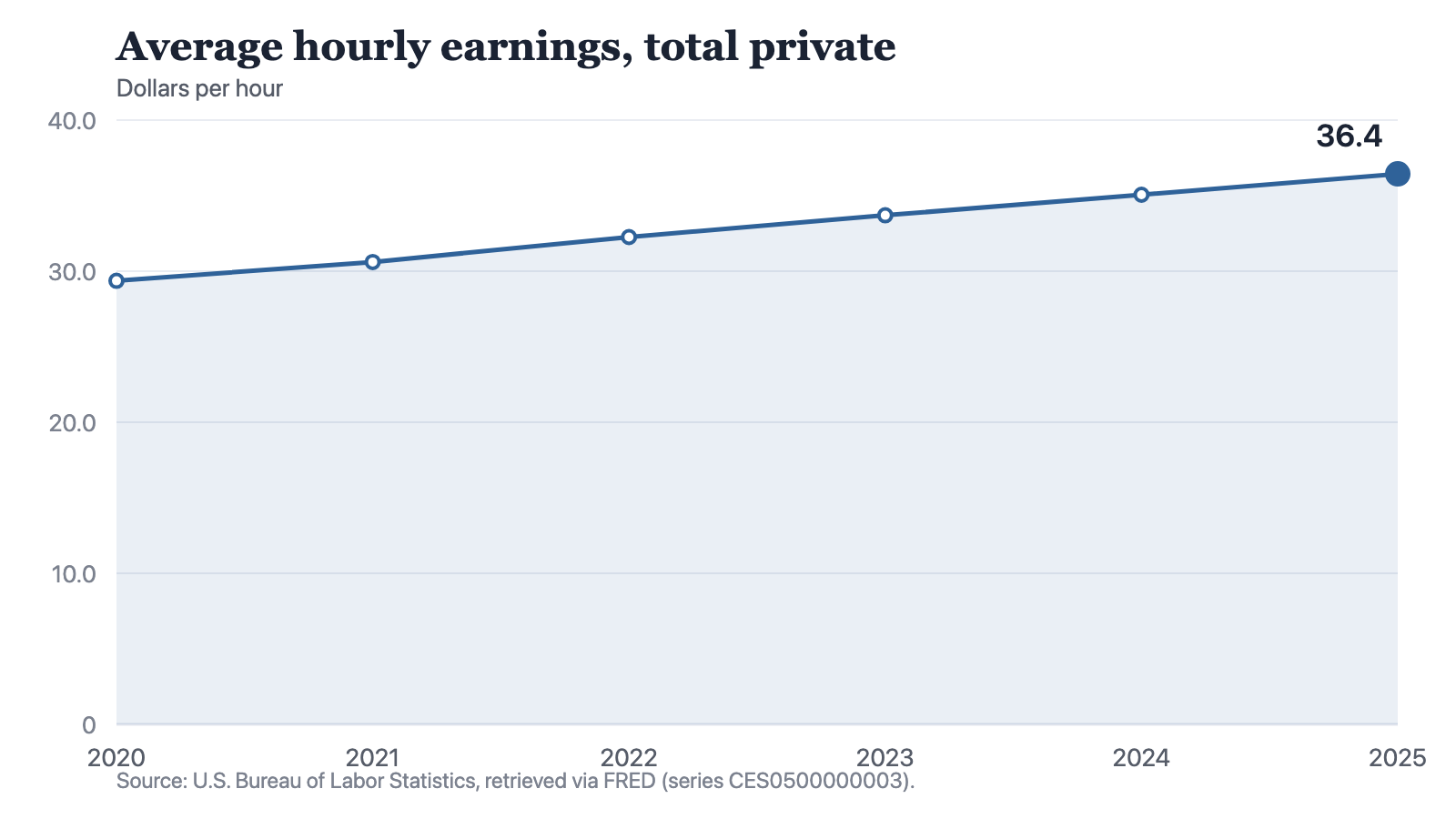
Average hourly earnings in the private sector rose in every year of the available window. The figure went from 29.36 dollars an hour in 2020 to 36.44 in 2025, a gain of 7.08 dollars. No reading in the series is lower than the one before it.
The six readings are 29.36 dollars an hour in 2020, 30.61 in 2021, 32.26 in 2022, 33.70 in 2023, 35.06 in 2024 and 36.44 in 2025. Each is the average of that year's monthly readings.
The annual steps are 1.25 dollars, then 1.65, then 1.44, then 1.36, then 1.38. The largest is the step into 2022. The three that follow are each smaller than it, and the last of them, 1.38 dollars into 2025, is two cents larger than the 1.36 before it. In dollar terms the series slowed after 2022 and has not resumed its earlier pace.
Notes: Annual observations. Each point is the annual observation as the source publishes it.
Source: The Cefa Brief
Chart description
A line chart of average hourly earnings in total private employment: 29.36 dollars an hour in 2020, 30.61 in 2021, 32.26 in 2022, 33.70 in 2023, 35.06 in 2024 and 36.44 in 2025. The line rises at every step, most steeply between 2021 and 2022, and it is drawn in dollars without adjustment for prices.
A line chart of average hourly earnings in total private employment: 29.36 dollars an hour in 2020, 30.61 in 2021, 32.26 in 2022, 33.70 in 2023, 35.06 in 2024 and 36.44 in 2025. The line rises at every step, most steeply between 2021 and 2022, and it is drawn in dollars without adjustment for prices.
The same six years at 2020 prices
The consumer price index for all urban consumers, on a 1982-84 base of 100, reads 258.9 in 2020, 271 in 2021, 292.6 in 2022, 304.7 in 2023, 313.7 in 2024 and 322 in 2025. Dividing each year's pay by that year's index and multiplying by the 2020 index restates the whole series at 2020 prices. It gives 29.36 dollars in 2020, 29.24 in 2021, 28.54 in 2022, 28.63 in 2023, 28.94 in 2024 and 29.30 in 2025. The arithmetic for the last of those is 36.44 multiplied by 258.9 and divided by 322.
Across the whole window pay rose 24.11 per cent and the index rose 24.37 per cent. The order matters more than the totals. Prices rose faster than pay in 2021 and in 2022. Pay rose faster than prices in 2023, in 2024 and in 2025. The restated line falls for two years, bottoms at 28.54 dollars in 2022, then climbs for three years without regaining its starting point. It ends about six cents below it.
What the series does not measure
Three limits sit inside the pay figure. It is an average rather than a median, so it moves when the mix of jobs changes and not only when anyone is paid more. It covers total private employment, which leaves government jobs outside it. And it is an hourly rate, so it says nothing about how many hours were worked, or what a week or a year came to.
One point about the arithmetic. Dividing one series by another was done here, not retrieved. No price-adjusted earnings series was fetched, and the six restated dollar amounts exist only in this piece. Anyone checking them should check the division, not look for them in the source.
What would change the answer is a different deflator or a different pay measure. A price index weighted differently, or a median in place of an average, would move all six restated figures. The gap at the end of the window is about 0.2 per cent of the 2020 figure, which is small enough that either substitution could reverse its sign. The finding that survives both is the narrower one: pay in dollars rose every year, and the rise was close enough to the rise in prices that whether workers ended ahead depends on which index is used to ask.
Method and data
The figures are annual observations of average hourly earnings of all employees in total private employment, series CES0500000003, published by the U.S. Bureau of Labor Statistics, redistributed by FRED and retrieved for this site on 19 September 2026. The unit is dollars per hour, and each annual point is the average of that year's monthly readings rather than a year-end figure or an annual total. Three things the series does not measure. It is an average rather than a median, so it moves when the composition of employment changes and not only when pay changes. It covers total private employment, so government jobs sit outside it. And it is an hourly rate, so it carries no information about hours worked, weekly earnings or annual earnings. The consumer price index cited alongside it, series CPIAUCSL, is a separate series from the same agency, also an average of the year's monthly readings, on a 1982-84 base of 100. The restated dollar figures in this piece are arithmetic performed here on those two series: no combined or price-adjusted earnings series was retrieved, and the restated amounts are not a published statistic.
How to cite
Jag DeSaint, "Average hourly earnings rose in every year of the window, and the price level rose by slightly more," The Cefa Brief, Applied America, 16 de janeiro de 2026, https://applied.thecefa.org/cefa-brief/seven-dollars-and-eight-cents.
About the author

Each author told us that for this piece they hold no interest a reader would think relevant.
This Insights piece carries its author's name because the view in it is the author's own. An editor reviewed it before publication, which is not the same as agreeing with it. It is not a position of the Center for Economics & Foreign Affairs or of Applied America.
© 2026. The author or authors hold the copyright in this Insights piece; CEFA publishes it with their permission. This edition, its editing and its presentation are © 2026 Center for Economics & Foreign Affairs. To republish it, see our republication terms. Republishing
Share
The Cefa Brief · applied.thecefa.org/cefa-brief/seven-dollars-and-eight-cents · Printed from the web edition