
The ten-year Treasury has done more to infrastructure than any permit reform
In 2020 a thirty-year asset was discounted against a long rate of 0.89 percent. In 2025 the same asset is discounted against 4.29. No procedural reform on the table is worth as much as that one line, and almost nobody appraising a project talks about it.
by
Published 4 minute read

Ilustração: The Cefa Brief
The permitting debate has absorbed more institutional attention over the past five years than any other constraint on building things in the United States. I think that attention has been misallocated. Between 2020 and 2025 the single number that most changed what an American infrastructure asset is worth was not written by any legislature, agency or court. It was the ten-year Treasury yield, and it went from 0.89 percent to 4.29.
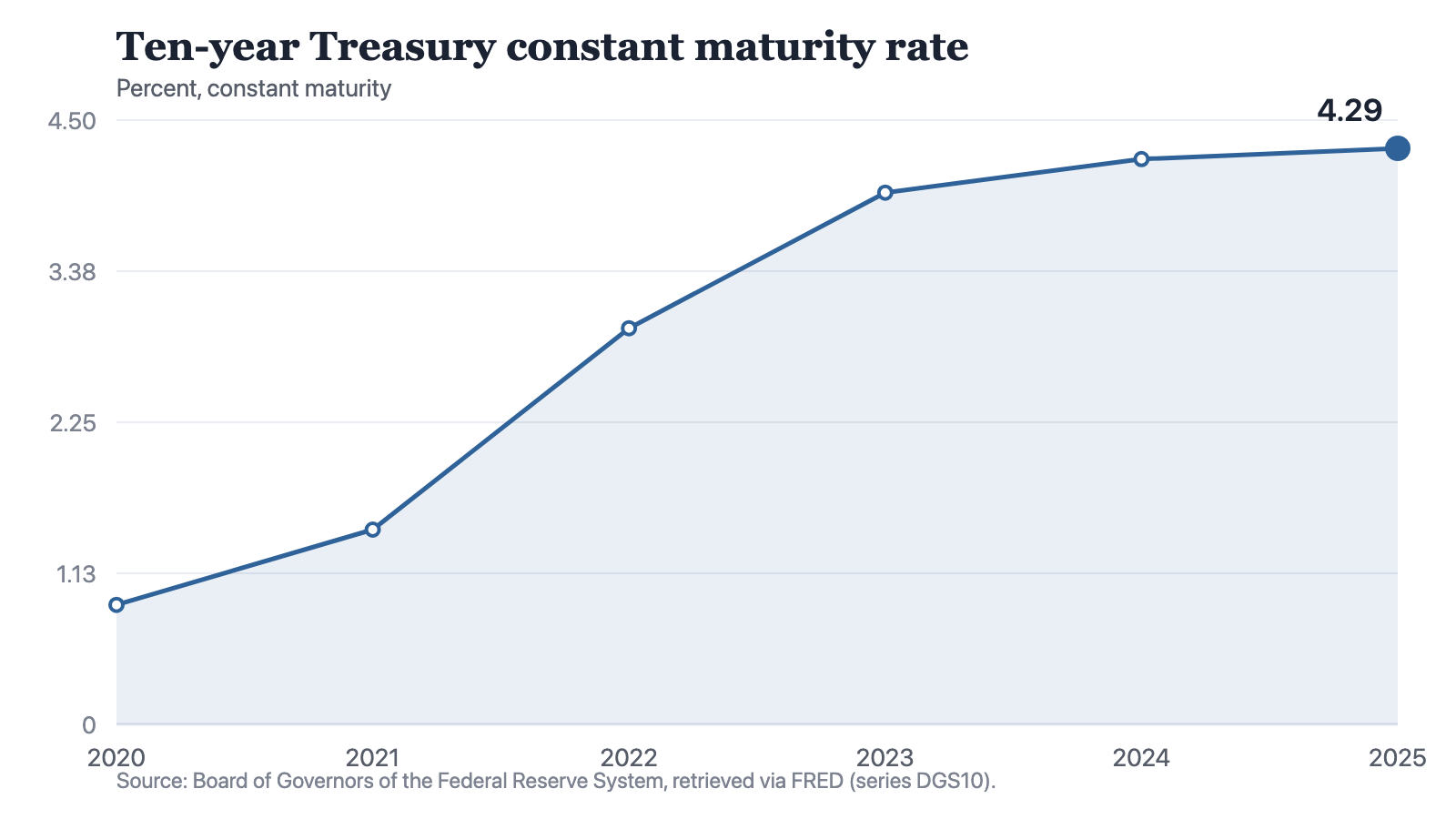
The path in between is 1.45 percent in 2021, 2.95 in 2022, 3.96 in 2023 and 4.21 in 2024. There is no year in this window in which the long end fell. A sponsor who began appraising a project at the start of the window and reached a decision at the end of it was working, without changing a single assumption about the asset, in a different financial world.
What the long end does to a thirty-year asset
Notes: A market yield on a government security, not a borrowing cost available to any project. It is the reference rate against which long-dated dollar obligations are priced.
Source: The Cefa Brief
Chart description
A line chart of the annual average ten-year Treasury constant maturity rate. It begins at 0.89 percent in 2020, rises to 1.45 in 2021, 2.95 in 2022 and 3.96 in 2023, then flattens at 4.21 in 2024 and 4.29 in 2025. The line rises in every year of the window.
A line chart of the annual average ten-year Treasury constant maturity rate. It begins at 0.89 percent in 2020, rises to 1.45 in 2021, 2.95 in 2022 and 3.96 in 2023, then flattens at 4.21 in 2024 and 4.29 in 2025. The line rises in every year of the window.
A road, a transmission line, a port berth and a water system share one financial property: most of what they earn arrives late. The revenue schedule is heavily weighted to years fifteen through thirty, while almost all of the cost lands in years one through five. That shape is what makes these assets useful to a public authority and what makes them fragile to a change in the discount rate. Discount the same receipts at 4.29 percent instead of 0.89 and the far years all but vanish from today's value. Nothing about the asset has changed. The concrete is the same, the traffic is the same, the offtake is the same, the useful life is the same. What changed is the price of waiting.
Nothing about the asset has changed. What changed is the price of waiting.
It is worth being precise about which rate did this, because the two are routinely conflated. The federal funds effective rate averaged 5.14 percent in 2024 and 4.21 percent in 2025. It came down. Over the same two years the ten-year went from 4.21 to 4.29. It went up. Anyone waiting for the long end to follow the policy rate down has, in these figures, been waiting for something that has not yet happened.
Where this argument is weakest
The strongest objection is that a nominal yield is not a discount rate. What a real asset earns is a real return, and part of the move from 0.89 to 4.29 is compensation for a price level that rose sharply. The consumer price index stood at 258.9 in 2020 and 322 in 2025. Deflate the long rate by anything like that and the increase in the real cost of capital is smaller than the headline suggests. That objection is correct on its own terms and I would not dismiss it.
It does not, however, get the sponsor off the hook, because the obligations are nominal. A thirty-year bond coupon is a nominal payment. An availability payment schedule is nominal unless someone negotiated indexation and priced it. A fixed-price construction contract is nominal. The real rate tells you what the asset earns in purchasing power; the nominal rate tells you what the borrower actually has to hand over each year, and it is the second number that decides whether the project reaches financial close.
The second objection is narrower and better. A sponsor who reached close in 2021 fixed a cost of capital then and is unaffected by everything since. That is true, and it is the point. The 2021 cohort is not a template. It is a vintage. Projects that closed into a 1.45 percent long rate are being used as evidence that a pipeline works, when what they demonstrate is that a pipeline worked once, at a price of money that has not been available since.
What follows for the pipeline
If this is right, three things follow for anyone appraising a long-dated American project today.
- State the discount rate on the first page, next to the capital cost, and say which year's rate it is. A project memorandum that hides it three annexes deep is hiding the largest single input.
- Date every comparable. A deal that closed in 2021 and a deal closing now are not comparable transactions, and presenting them in the same table without the vintage is a misrepresentation even when every figure in it is accurate.
- Test the schedule, not just the total. Two projects with identical net present values at 0.89 percent can differ enormously at 4.29, because the one with the later revenue loses more. The shape of the receipts is now a first-order design decision.
One thing I will not claim. Federal debt outstanding rose from $28.7 trillion in 2021 to $37.1 trillion in 2025, and it is tempting to draw a line from that to the stubbornness of the long end. These files cannot support that line. They record two stocks and a yield; they do not establish what moved which, and a brief that prints the correlation as an explanation would be doing exactly what I am objecting to.
The narrow case is simply that the cost of capital deserves the standing in the conversation that procedure currently occupies. Permitting reform is worth doing and its benefits are real. But a reform that saves two years on a consent is competing, for the same project, against a discount rate that has more than quadrupled. Both belong in the appraisal. Only one of them is in the speeches.
About the author

Each author told us that for this piece they hold no interest a reader would think relevant.
This commentary carries its author's name because the view in it is the author's own. An editor reviewed it before publication, which is not the same as agreeing with it. It is not a position of the Center for Economics & Foreign Affairs or of Applied America.
© 2025. The author or authors hold the copyright in this commentary; CEFA publishes it with their permission. This edition, its editing and its presentation are © 2025 Center for Economics & Foreign Affairs. To republish it, see our republication terms. Republishing
Share
The Cefa Brief · applied.thecefa.org/cefa-brief/long-end-sets-the-terms · Printed from the web edition