
New orders for durable goods fell once in five years, then jumped
Orders dipped by 4.9 billion dollars a month in 2024 and rose by 23.4 billion in 2025, the largest single-year gain in the window. The series counts dollars, not machines.
by
Published 3 minute read

Ilustração: The Cefa Brief
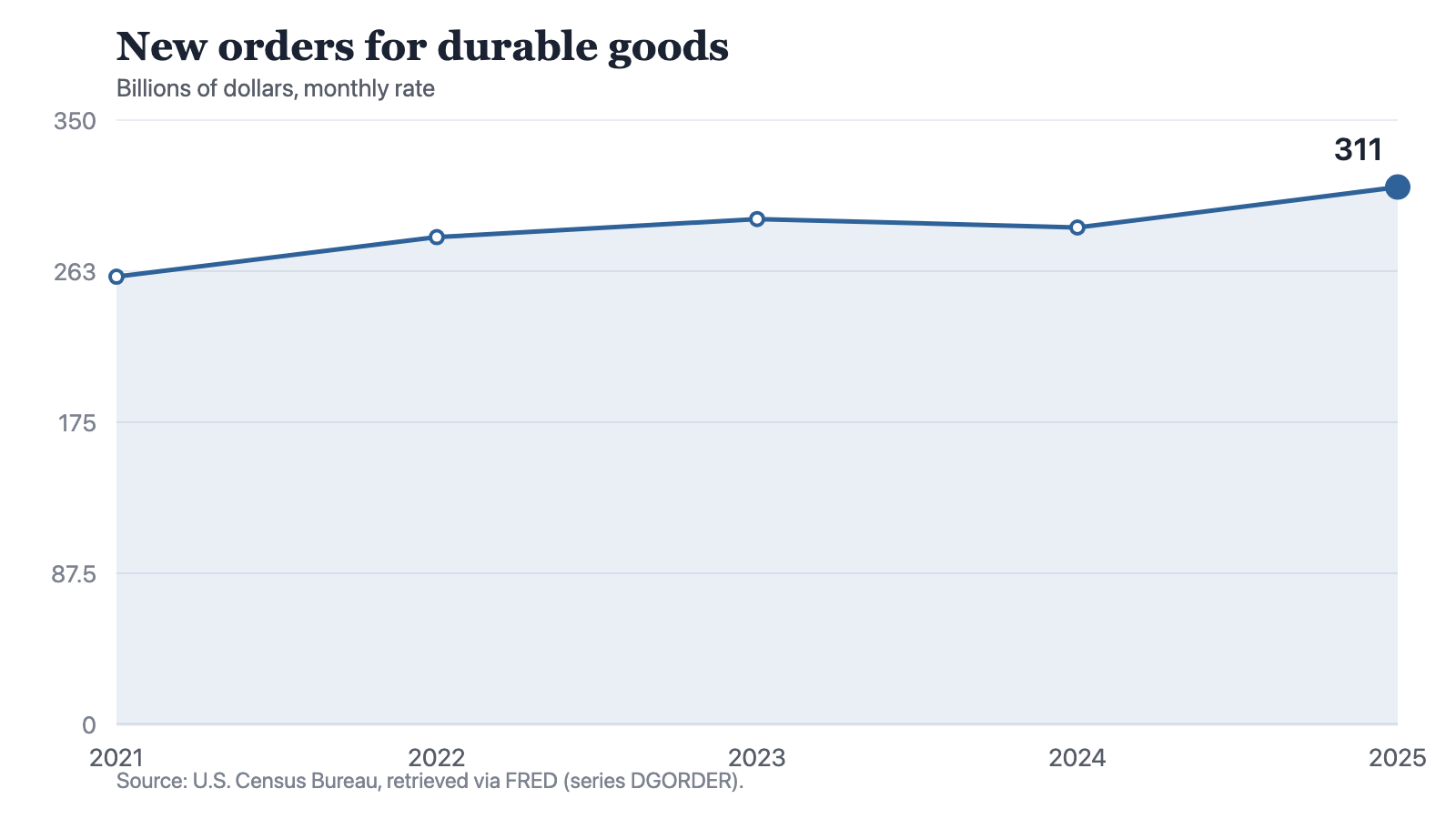
New orders for durable goods have fallen once in the last five annual readings. The fall came in 2024, from 292.7 billion dollars a month to 287.8, and it was worth 4.9 billion. The following year the series added 23.4 billion, the largest single-year gain in the window.
The five readings are 259.3 billion dollars a month in 2021, 282.2 in 2022, 292.7 in 2023, 287.8 in 2024 and 311.2 in 2025. Across the window the monthly rate rose by 51.9 billion, an addition larger than any single-year move the series records.
The dip is smaller than it reads
A single down year in a series like this draws more attention than it deserves. The 2024 fall took orders back to a level between the 2022 and 2023 readings, and it was recovered in full the next year with 18.5 billion to spare. Had the 2024 point not been published, a reader comparing 2023 with 2025 would have seen a rising line and suspected no interruption at all.
Notes: Annual observations. Orders are commitments, not shipments, and the series is stated in dollars without adjustment for prices.
Source: The Cefa Brief
Chart description
A line chart showing orders at 259.3 billion dollars a month in 2021, rising to 282.2 in 2022 and 292.7 in 2023, easing to 287.8 in 2024, and reaching the highest point of the series at 311.2 in 2025.
A line chart showing orders at 259.3 billion dollars a month in 2021, rising to 282.2 in 2022 and 292.7 in 2023, easing to 287.8 in 2024, and reaching the highest point of the series at 311.2 in 2025.
The 2025 gain is the largest in the window, but only just. It is 23.4 billion against the 22.9 billion added between 2021 and 2022. The two are close enough that calling 2025 a record year is technically true and practically a coin toss between two similar moves four years apart. The honest description of the five years is a rising line with one soft patch in it, and the soft patch did not last.
The order book is measured in dollars
This is the constraint on every reading above. Orders are counted in dollars, not units, so the series rises when buyers order more things and also when the same things cost more. Over the same five years the producer price index for all commodities went from 227.3 in 2021 to 260.3 in 2025, on a 1982 base of 100. Those are two separate series from two agencies, and setting them side by side is not a deflation. It is a warning against reading the first as volume.
The warning applies with particular force to the year everyone will want to quote. 2025 is the highest reading the series has in this window, and it is a dollar figure produced in a period when the price index for commodities was also rising. Nothing on this page separates the two effects, and I would treat any confident statement that American factories took orders for more equipment in 2025 as a claim that needs a volume measure behind it.
An order book that grows in dollars has not necessarily grown in machines.
What an order is, and what five points are
New orders are commitments, not deliveries. The series records demand placed before anything has been delivered, which is what makes it useful and what makes it provisional. A measure that runs ahead of production also runs ahead of the chance to be wrong about it, and the gap between an order and a delivery is precisely where a downturn shows up first.
There are also only five points here, and they are annual. They cannot show when inside 2024 the orders softened, or whether the 2025 strength was spread across the year or concentrated in part of it. A series this short carries no view of what a normal year looks like, because it has no reading from before 2021 to compare against.
For anyone reading this as evidence that industrial policy is working, the caution is the same as for the output series. Orders are a demand measure. They say buyers committed more dollars in 2025 than in any earlier year of this window. They do not say what the goods are, or whether every order survives to delivery.
The shape of five years here is one soft year inside a rising line, with part of the rise priced rather than produced. That is a milder story than either a slump or a boom, and it is the one these numbers support.
Method and data
The figures are annual observations of new orders for durable goods, series DGORDER, published by the U.S. Census Bureau, redistributed by FRED and retrieved for this site on 19 September 2026. They are stated in billions of dollars at a monthly rate, so each point is a monthly figure and not an annual total. Orders are commitments placed, not shipments, output or revenue, and the series is not adjusted for prices. The producer price index quoted in the text is a separate series from a separate agency; it is named for context only, and nothing here divides one series by the other or produces a real orders figure.
How to cite
Jag DeSaint, "New orders for durable goods fell once in five years, then jumped," The Cefa Brief, Applied America, 11 de junho de 2026, https://applied.thecefa.org/cefa-brief/durable-orders-one-fall-one-jump.
About the author
Each author told us that for this piece they hold no interest a reader would think relevant.
This Insights piece carries its author's name because the view in it is the author's own. An editor reviewed it before publication, which is not the same as agreeing with it. It is not a position of the Center for Economics & Foreign Affairs or of Applied America.
© 2026. The author or authors hold the copyright in this Insights piece; CEFA publishes it with their permission. This edition, its editing and its presentation are © 2026 Center for Economics & Foreign Affairs. To republish it, see our republication terms. Republishing
Share
The Cefa Brief · applied.thecefa.org/cefa-brief/durable-orders-one-fall-one-jump · Printed from the web edition