
What makes an apprenticeship registered
Registration is a legal status granted by the Department of Labor or a recognised state agency, not a verdict on the quality of the training. By the end you will know what the sponsor has to promise, what the apprentice is owed, and what the credential is worth away from the firm that issued the work.
Prepared by
Last reviewed Published 3 minute read

Illustration: The Cefa Brief
In ordinary speech an apprenticeship is any arrangement in which someone learns a trade while doing it. In federal law the word is narrower. A registered apprenticeship is a programme accepted onto a register kept by the Department of Labor's Office of Apprenticeship, or by a state apprenticeship agency the Department recognises for the purpose. Registration is a status with conditions attached, and the conditions are the whole of the meaning.
The first condition is the one most often missed. An apprentice is an employee from the first day, on a payroll, paid for the hours worked. A scheme in which the learner pays tuition, or works unpaid in exchange for experience, is not an apprenticeship in this sense whatever it is called in the brochure.
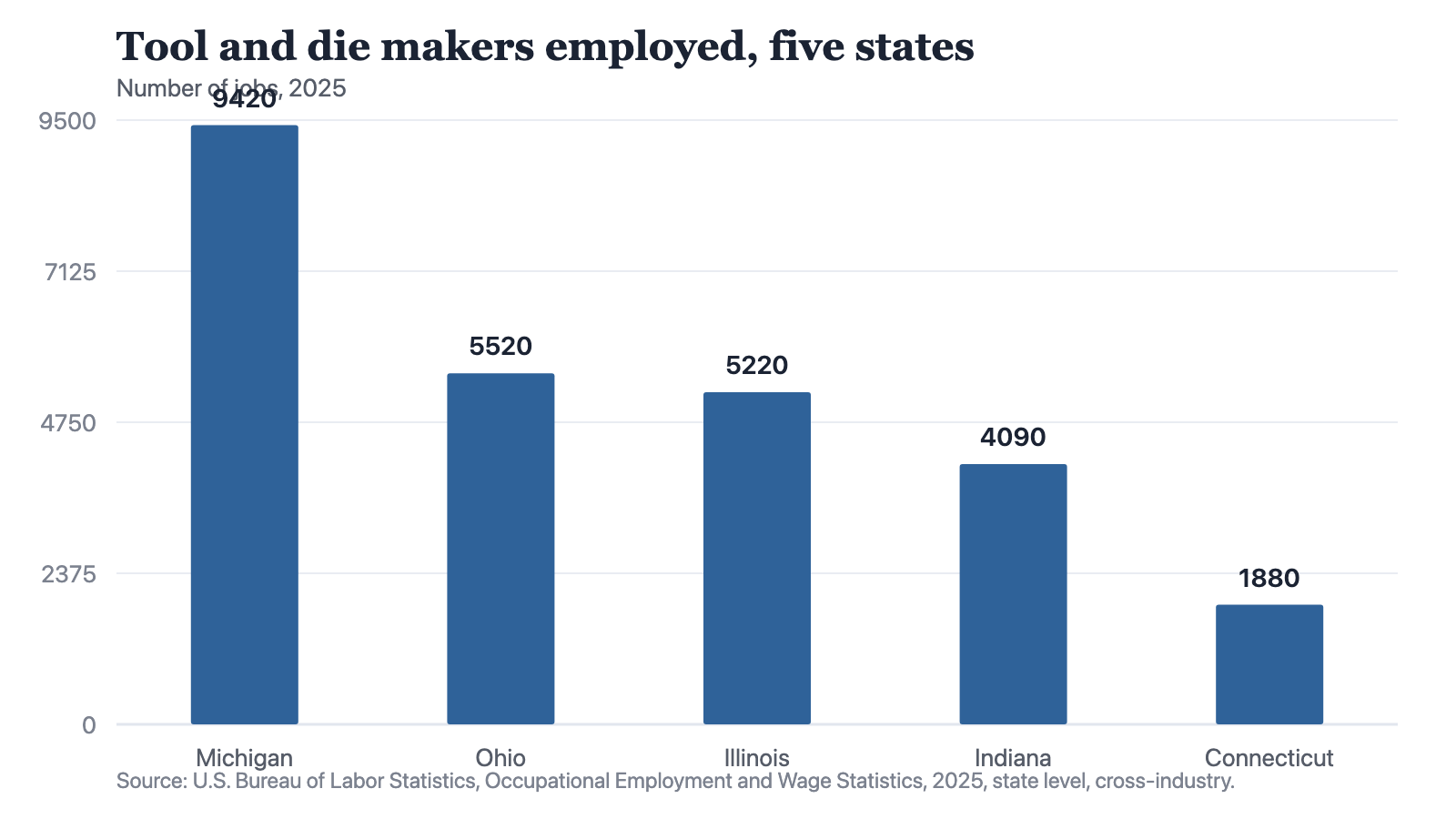
Notes: Source: U.S. Bureau of Labor Statistics, Occupational Employment and Wage Statistics, 2025, state level, cross-industry. Five states in which the occupation takes a larger share of local jobs than of national jobs. These are jobs, not apprentices; no federal wage survey counts apprentices separately.
Source: The Cefa Brief
Chart description
Five bars, ordered from longest to shortest. Michigan stands well clear at the top with 9,420 jobs, more than half again as long as the next bar. Ohio and Illinois follow at almost identical lengths, 5,520 and 5,220. Indiana is shorter at 4,090. Connecticut closes the chart at 1,880, about a fifth of Michigan's bar. The shape is one tall bar, a paired middle, and a long tail down to a short one: a trade clustered in the industrial Midwest with an older outpost in New England.
Five bars, ordered from longest to shortest. Michigan stands well clear at the top with 9,420 jobs, more than half again as long as the next bar. Ohio and Illinois follow at almost identical lengths, 5,520 and 5,220. Indiana is shorter at 4,090. Connecticut closes the chart at 1,880, about a fifth of Michigan's bar. The shape is one tall bar, a paired middle, and a long tail down to a short one: a trade clustered in the industrial Midwest with an older outpost in New England.
What the sponsor promises
- A written schedule of the work processes the apprentice will learn, and the supervision under which they will learn them.
- A progressive wage schedule, in which pay rises at defined points as competencies are demonstrated and ends at the journeyworker rate for the occupation.
- Related technical instruction alongside the job, usually in a classroom or online, with a minimum amount required for each year of the programme.
- An apprenticeship agreement signed by the apprentice and the sponsor and filed with the registering agency.
- Equal opportunity obligations in recruitment, selection and treatment, enforced by that same agency.
The sponsor need not be a single employer. It can be an employer association, a joint committee of a union and the firms that bargain with it, a community college working with several manufacturers, or an intermediary that holds the programme and places apprentices with member firms. Who the sponsor is determines who carries the cost of the classroom instruction, and who keeps the programme alive when one employer's order book empties in the middle of a cohort.
What the apprentice gets that a course does not give
Two things. Wages throughout, which is why apprenticeship reaches people who cannot stop earning in order to study. And, at the end, a credential issued under the national system rather than by the employer: portable, recognised by other firms in the trade in other states, and not revocable by the company that did the training. That portability is the design, not a side effect. It is also why employers have to be persuaded into the system, because the worker they paid to train can leave with the certificate in hand.
The occupations are specific, and the chart shows one of them. Tool and die makers build and maintain the dies, jigs and fixtures that let a factory produce the same part repeatedly to a tolerance. The work has been learned through apprenticeship for as long as there have been registers to record it, and the employment is concentrated: in each of the five states shown the trade takes a larger share of local jobs than it does of the country's. A state deciding whether to fund a programme is deciding about a labour market of that size, not about an abstraction.
Registration is a promise about the wage ladder, the instruction and the credential. It is not a judgement about the quality of the teaching.
Where the disagreement is
There is a live argument about how far the register should reach. One side holds that the registered framework is exactly what separates apprenticeship from ordinary on-the-job training: the wage schedule, the required instruction and the portable credential are enforceable promises, and a looser standard would let firms relabel entry-level work as training. The other holds that registration is slow and unfamiliar to employers outside construction and manufacturing, that occupations in healthcare, information technology and advanced services have grown faster than the register has followed them, and that a lighter form of recognition would widen the model to workers who never see it now. Both sides are looking at the same fact, which is that the registered system remains concentrated in the trades it began with.
A test you can apply. When a programme is described as an apprenticeship, ask three questions. Is the learner on a payroll from the first day? Does the pay rise on a written schedule tied to demonstrated skill, ending at the journeyworker rate for the trade? And does the credential at the end come from the registering agency rather than from the employer? Three yeses describe a registered apprenticeship. Two describe a training scheme, which may be a good one, and which should be argued for on its own terms rather than on the strength of the older word.
About the author
Each author told us that for this piece they hold no interest a reader would think relevant.
Explainers are written and kept up to date by The Cefa Brief’s editors. An Explainer is background CEFA stands behind. It is not one author’s argument, and it is not a CEFA position on what anyone should do. If something here is wrong or out of date, write to applied@thecefa.org.
© 2026 Center for Economics & Foreign Affairs. To republish it, see our republication terms. Republishing
Share
The Cefa Brief · applied.thecefa.org/cefa-brief/what-makes-an-apprenticeship-registered · Printed from the web edition