
What financial close means on an infrastructure project
Financial close is a single date on which every financing document signs and the lenders' money becomes a binding commitment. By the end you will know what has to be true on that day, how it differs from the announcements that come before it, and why it is the only one worth believing.
Prepared by
Last reviewed Published 3 minute read

Illustration: The Cefa Brief
Financial close is a date, not a phase. It is the day on which every financing document is signed, every condition the lenders set has been met or formally waived, and the commitment to advance money stops being conditional. Before that day, a project is a set of intentions held together by exclusivity agreements. After it, the money exists, the interest clock has started, and walking away costs real money.
This matters because the announcements that come earlier sound almost identical and mean much less. A preferred bidder has been selected: a government has picked whom it wants to negotiate with. Contracts have been signed, sometimes called commercial close: the deal's terms are agreed, but the financing behind them may still be conditional. Only at financial close is the money committed, and only after it does anyone break ground.
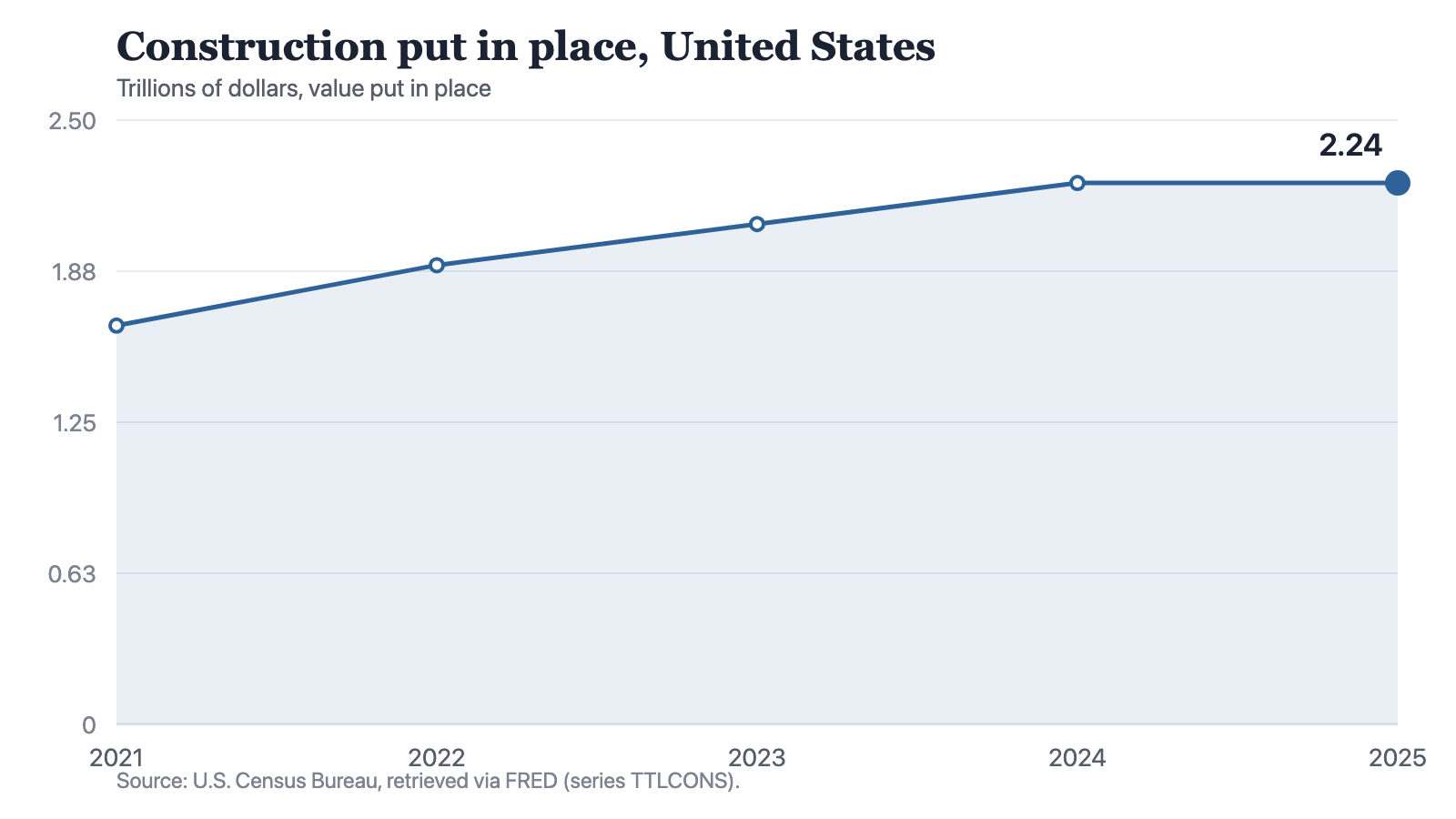
Notes: Source: U.S. Census Bureau, retrieved via FRED (series TTLCONS). All sectors, public and private. The series does not identify project-financed work or the date any financing closed.
Source: The Cefa Brief
Chart description
A line rising over five annual points and then flattening. It begins at 1.65 trillion dollars in 2021, climbs steeply to 1.9 trillion in 2022 and 2.07 trillion in 2023, reaches 2.24 trillion in 2024, and holds at exactly 2.24 trillion in 2025. The shape is three years of steady ascent followed by a flat final segment.
A line rising over five annual points and then flattening. It begins at 1.65 trillion dollars in 2021, climbs steeply to 1.9 trillion in 2022 and 2.07 trillion in 2023, reaches 2.24 trillion in 2024, and holds at exactly 2.24 trillion in 2025. The shape is three years of steady ascent followed by a flat final segment.
What has to be true on the day
The list of conditions precedent is the substance of the months of work before close. Each item exists because a lender refused to advance money without it, and each has defeated a project at some point. They are signed or delivered in a sequence choreographed to the hour, because none of them is meant to take effect unless all of them do.
- A construction contract signed with a contractor who has accepted a fixed price and a completion date, backed by security for failing either.
- Equity commitments in binding form, so the sponsors cannot walk once the debt is drawn.
- The permits and consents the works require, or a defined path to them that the lenders will accept.
- Site rights: ownership, leases, easements and the rights of way the route actually crosses.
- Insurance placed, and the lenders named on the policies.
- Interest rate exposure hedged or fixed, so the cost of the debt cannot move after the price is set.
- Legal opinions that the borrower exists, may borrow, and has granted security that will hold.
Two of these carry more weight than the rest. The construction contract converts an estimate into somebody else's problem, which is what lets lenders size the debt against a cost they believe. The hedge does the same for interest. Until both are locked, the two largest numbers in the model are still moving, and a financing cannot close against numbers that move.
Why the date is the one worth reporting
Financing commitments, contractor prices and hedge quotes all carry validity windows. Let the date slip and the pieces have to be repriced, usually upward, and occasionally a project that was viable in March is not viable in September for no reason connected to the project itself. This is why parties will sit in a room until three in the morning to close on a Thursday rather than a Monday, and why the first drawdown is normally made on the same day it closes.
Every dollar of work in the chart followed a moment like this, whether the financier was a bank syndicate, a bond issue, a government appropriation or a developer's own balance sheet. The series counts work as it is performed, which is to say it counts the consequences of decisions committed to months or years earlier. That lag is the reason a construction figure is a poor guide to what is being agreed now.
Where the disagreement is
The years of development that precede close are expensive, and the expense is argued about. One view holds that this is where bad projects die cheaply, and that lenders forced to put their own money at risk conduct a scrutiny no public review board matches. The other holds that the cost and the length of the process screen out good projects too, particularly smaller ones, because only a bidder able to spend heavily on a bid it may lose can play at all, and the winner's costs are paid by the public in the end regardless. Both sides are describing the same filter and disagreeing about what it filters.
So apply the three-word test to the next infrastructure announcement. If it says selected, nothing is committed and the project can still evaporate quietly. If it says signed, the terms are agreed but the money may not be. If it says reached financial close, the money is committed, the price is fixed, and it is now reasonable to expect machinery on the site. Anything that avoids all three words is telling you about an intention.
About the author
Each author told us that for this piece they hold no interest a reader would think relevant.
Explainers are written and kept up to date by The Cefa Brief’s editors. An Explainer is background CEFA stands behind. It is not one author’s argument, and it is not a CEFA position on what anyone should do. If something here is wrong or out of date, write to applied@thecefa.org.
© 2026 Center for Economics & Foreign Affairs. To republish it, see our republication terms. Republishing
Share
The Cefa Brief · applied.thecefa.org/cefa-brief/what-financial-close-means · Printed from the web edition