
ExplainerInternational Partners
What a government means when it says de-risking
De-risking is the attempt to remove one supplier's leverage over an economy without ending the trade. By the end you should know which instruments governments use, why dependence is so hard to measure, and why rising domestic output does not settle the question.
Prepared by
Last reviewed Published 3 minute read

Illustration: The Cefa Brief
De-risking is one word doing two jobs. In banking it has long meant something narrow and unhappy: a correspondent bank closing whole categories of accounts, or withdrawing from a whole country, because the cost of proving each customer is clean exceeds the profit in serving them. In trade and industrial policy it means something else, and that is the sense governments now use. It is the attempt to reduce an economy's exposure to a single foreign supplier of something it considers critical, while continuing to trade with that supplier. This Explainer is about the second meaning.
The word was chosen deliberately, as an alternative to decoupling. Decoupling describes ending a commercial relationship. De-risking describes keeping it while removing the other party's ability to impose costs by withholding. The claim is about leverage, not about volume, and that distinction is what makes the policy hard to assess: a country can go on buying the same quantity of a good and still have changed its position, if it now has somewhere else to buy it from.
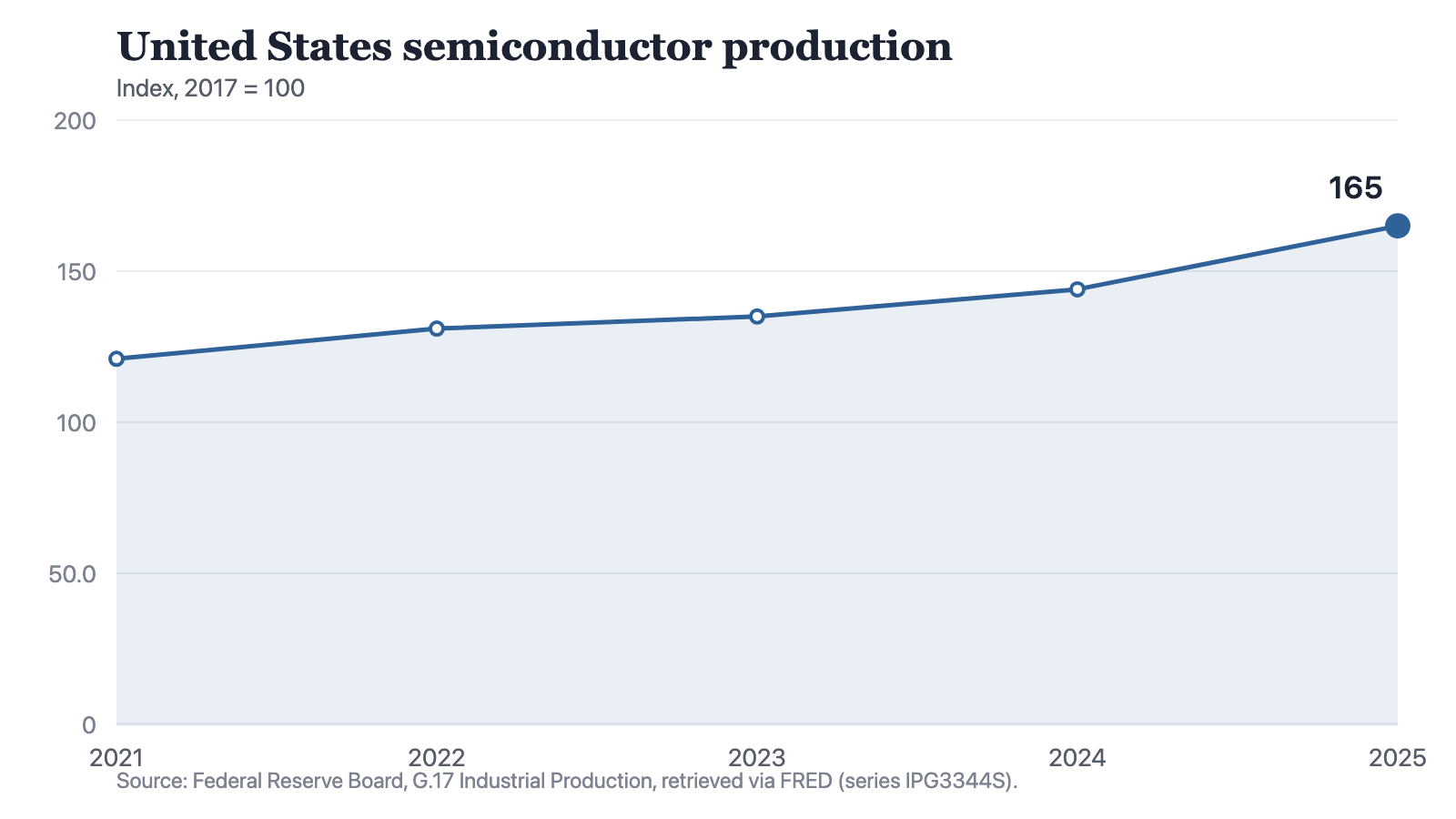
Notes: Index, 2017 = 100. Source: Federal Reserve Board, G.17 Industrial Production, retrieved via FRED (series IPG3344S).
Source: The Cefa Brief
Chart description
A line chart with five annual points, rising throughout. The index stands at 121 in 2021, 131 in 2022, 135 in 2023, 144 in 2024 and 165 in 2025. The increase from 2022 to 2023 is the smallest of the four steps and the increase from 2024 to 2025 is by far the largest, so the line flattens in the middle and then turns sharply upward at the right-hand end. With 2017 set to 100, the final reading means output is well above where it stood in the base year.
A line chart with five annual points, rising throughout. The index stands at 121 in 2021, 131 in 2022, 135 in 2023, 144 in 2024 and 165 in 2025. The increase from 2022 to 2023 is the smallest of the four steps and the increase from 2024 to 2025 is by far the largest, so the line flattens in the middle and then turns sharply upward at the right-hand end. With 2017 set to 100, the final reading means output is well above where it stood in the base year.
The instruments a government reaches for
De-risking is not a single policy. It is a label applied after the fact to a group of instruments that were often built for other reasons, and they are worth separating because they act at different points and cost different amounts.
- Subsidies, grants and tax credits for domestic production capacity, which address supply by building an alternative source at home.
- Export controls, which restrict what may be sold to a specific destination, and which address the other side of the relationship: not what we depend on, but what depends on us.
- Investment screening, inbound and increasingly outbound, which governs who may own a facility or fund a technology rather than who may buy the output.
- Stockpiles and strategic reserves, which do not reduce dependence at all but buy time to respond to an interruption.
- Procurement rules and domestic content requirements, which use the government's own purchasing to create demand an alternative supplier can build against.
- Agreements with partner countries, including minerals partnerships and offtake arrangements, which move the dependency rather than ending it, on the theory that a dependency on a treaty ally is a different kind of risk.
Notice that only the first and the last actually change where things come from. The others buy time, restrict the counterparty, or change who owns the asset. A government announcing a de-risking programme is frequently doing the second kind while describing the first.
Output is not the same as independence
The hardest part of the subject is measurement, and it is hard for a structural reason: the dependency is almost never at the stage anyone is looking at. A finished product assembled domestically can be built from imported subassemblies, which are built from imported components, which are built from a refined material that comes from one country and is processed in another. Trade statistics record the last place a good was shipped from, not the origin of the input that would actually stop the line. A firm that has dutifully found a second supplier may discover that both of its suppliers buy from the same refinery. This is why domestic production can rise year after year while the binding constraint sits exactly where it always sat, one or two stages further up.
Domestic output can rise while the dependence stays precisely where it was, one stage further upstream.
Where the argument runs
Specialists disagree on four points, and the disagreements are real rather than rhetorical. The first is whether de-risking is distinguishable from decoupling in practice, or whether it is the same policy described in language intended to keep a trading relationship calm. The second is whether concentration is a risk at all: a single dominant supplier is often dominant because it is the most efficient, and building a second source means paying more for the same good indefinitely, which is a form of insurance with a premium nobody has priced. The third is who pays that premium, and whether it lands on taxpayers through subsidy or on consumers through higher prices. The fourth is whether partner-country sourcing genuinely spreads risk or simply relocates a chokepoint to a country that is friendlier today. Nobody has resolved these, and anybody claiming a general answer is selling something.
Four questions turn any de-risking announcement into something you can assess. Which specific dependency is being addressed. At which stage of production the substitution actually happens. Who the alternative supplier is, and who supplies them. And who pays the difference in price, given that an alternative source is almost always more expensive than the one it replaces. A programme that cannot name the stage is usually working on the visible end of the chain rather than the binding one.
About the author
Each author told us that for this piece they hold no interest a reader would think relevant.
Explainers are written and kept up to date by The Cefa Brief’s editors. An Explainer is background CEFA stands behind. It is not one author’s argument, and it is not a CEFA position on what anyone should do. If something here is wrong or out of date, write to applied@thecefa.org.
© 2025 Center for Economics & Foreign Affairs. To republish it, see our republication terms. Republishing
Share
The Cefa Brief · applied.thecefa.org/cefa-brief/what-de-risking-means · Printed from the web edition