
What a revenue pledge is and what it does not promise
A revenue pledge hands bondholders one named stream of money and shuts them out of everything else. By the end you will know the order the money leaves the account, the covenant that keeps the stream large enough, and the risks the pledge quietly leaves with the public.
Prepared by
Last reviewed Published 3 minute read

插图:The Cefa Brief
A revenue pledge is a promise with a fence around it. The borrower names one stream of money, promises it to bondholders, and grants them a legal lien on it. The stream might be the charges paid by everyone connected to a water system, the landing fees at an airport, the tolls on a bridge, or a share of a sales tax set aside by statute. Everything outside the fence stays with the government, and the bondholders have agreed to stand outside.
That single design decision cuts in both directions. In a good year the surplus above what the bonds need belongs to the issuer. In a bad year the bondholders have no one else to ask. There is no general fund behind them and, in most structures, no taxpayer.
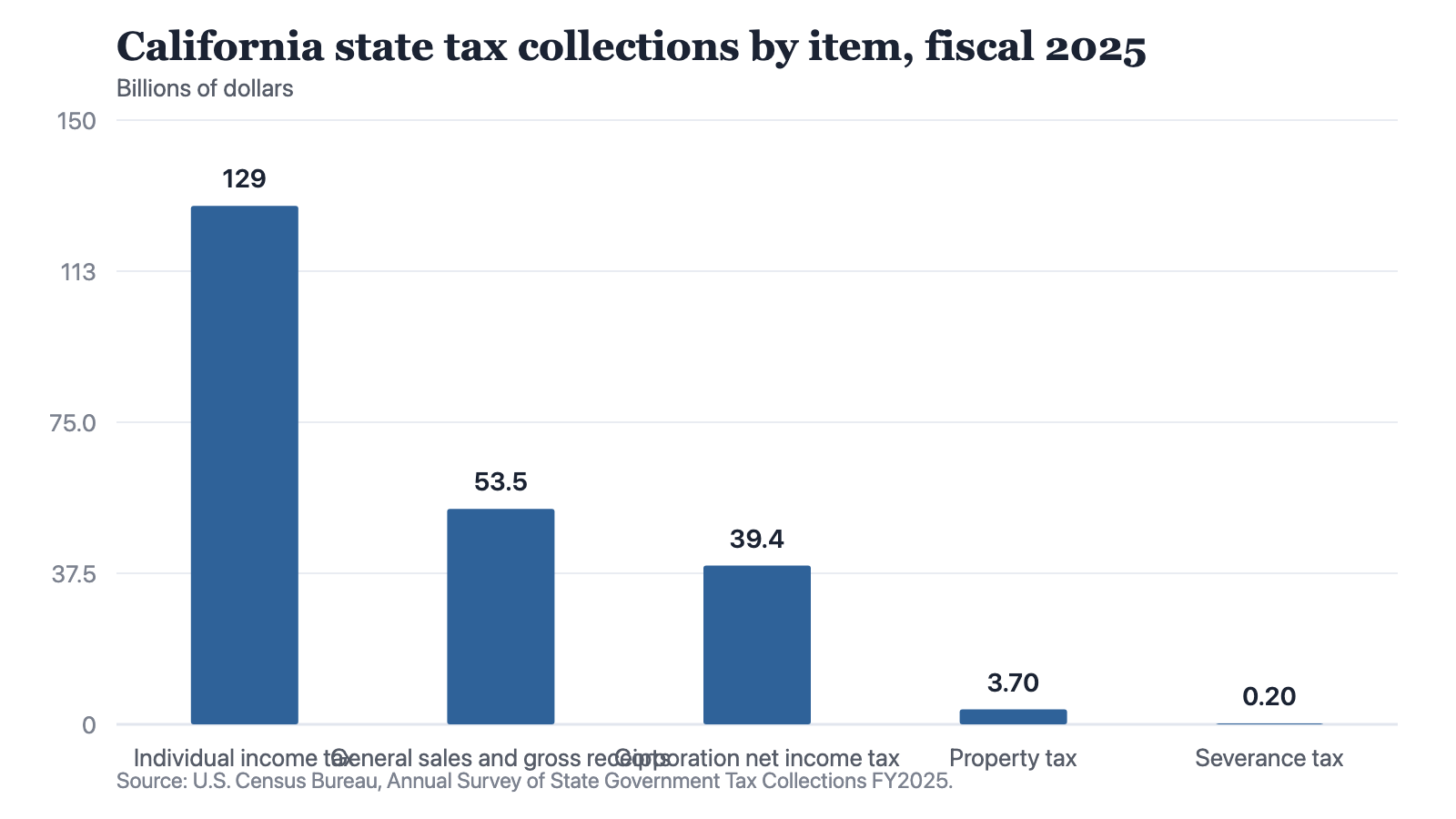
Notes: Source: U.S. Census Bureau, Annual Survey of State Government Tax Collections FY2025. These five items do not sum to the state's total collections, which include other taxes.
Source: The Cefa Brief
Chart description
Five vertical bars, ordered from largest to smallest. The individual income tax dominates at 128.7 billion dollars, more than twice the second bar. General sales and gross receipts follows at 53.5 billion, then the corporation net income tax at 39.4 billion. The last two are small enough to be almost flat against the axis: property tax at 3.7 billion and severance tax at 0.2 billion. The shape is a steep three-step descent and then a near-collapse to the floor.
Five vertical bars, ordered from largest to smallest. The individual income tax dominates at 128.7 billion dollars, more than twice the second bar. General sales and gross receipts follows at 53.5 billion, then the corporation net income tax at 39.4 billion. The last two are small enough to be almost flat against the axis: property tax at 3.7 billion and severance tax at 0.2 billion. The shape is a steep three-step descent and then a near-collapse to the floor.
The order the money leaves the account
The document that governs a revenue bond, usually called an indenture or a bond resolution, sets out a flow of funds. Money arrives in a single account and leaves it in a fixed order, and the order is the whole argument. It is often called a waterfall, because nothing reaches a lower step until the step above it is full.
- Operating and maintenance expenses, so the system that produces the revenue keeps running.
- Debt service on the senior bonds: interest first, then principal as it comes due.
- Deposits to a debt service reserve, topping it back up after any draw.
- Debt service on subordinate bonds, which get paid only if the senior steps are full.
- A renewal and replacement fund for the pumps, roofs and pavement that wear out between rebuilds.
- Whatever is left, released to the issuer to spend as it likes.
Where operating expenses sit decides what the pledge is worth. A net revenue pledge puts them first, as above: bondholders are paid out of what remains after the system is run. A gross revenue pledge puts debt service ahead of operating costs. Gross sounds stronger and is, on paper. It is also the structure most likely to starve the asset that produces the revenue, which is why it is rarer than it first appears.
The covenant that does the work
A pledge of revenue is worth little if the issuer can set the price at zero. So the indenture carries a rate covenant: a binding promise to set charges high enough that net revenue covers debt service by a stated multiple, commonly something above one so that a bad year still clears the payment. That multiple is the coverage ratio, and it is reported every year. An additional bonds test sits beside it, barring the issuer from selling more debt on the same lien unless the revenue, tested against a defined historical or projected standard, would still cover everything. Those two clauses, not the lien itself, are what an analyst actually reads.
Size is only half of what makes a stream pledgeable. Steadiness is the other half, and the two are not related. A tax on personal income in a state that taxes capital gains rises and falls with asset markets; a general sales tax moves with consumption, which moves less; a severance tax follows the price of a commodity nobody at the treasury controls. A large stream that swings can carry less debt safely than a smaller one that does not.
Where the disagreement is
The fence is exactly what is argued about. Supporters of revenue pledges say they put the cost on the people who use the thing and impose a discipline general taxation never does: if nobody will pay the toll, the project should not be built. Critics answer that the discipline is partly theatre. Rate covenants require elected boards to raise charges on households during precisely the years households can least afford it, and when that becomes politically impossible the choice is between a default and a rescue from the general fund that the structure promised would never be needed. Both sides agree the pledge transfers risk. They disagree about whether it transfers it to people who can carry it.
The test to apply is a reading test. In any document about a revenue bond, find the two sentences that name the rate covenant and the additional bonds test. If the covenant multiple is barely above one, the structure has left itself no room for a bad year. If the additional bonds test is written against projected revenue rather than collected revenue, the fence can be moved by a forecast. And if neither sentence exists, whatever is being sold is not a revenue pledge in the sense used here, whatever the press release calls it.
About the author
Each author told us that for this piece they hold no interest a reader would think relevant.
Explainers are written and kept up to date by The Cefa Brief’s editors. An Explainer is background CEFA stands behind. It is not one author’s argument, and it is not a CEFA position on what anyone should do. If something here is wrong or out of date, write to applied@thecefa.org.
© 2025 Center for Economics & Foreign Affairs. To republish it, see our republication terms. Republishing
Share
The Cefa Brief · applied.thecefa.org/cefa-brief/what-a-revenue-pledge-is · Printed from the web edition