
Six states raise no income tax and no two replace it the same way
Alaska, Florida, Nevada, South Dakota, Texas and Wyoming levy no individual income tax. The FY2025 collections file shows what each one leans on instead, and the answer is narrower and less uniform than the shorthand suggests.
by
Published 4 minute read

插图:The Cefa Brief
The sentence gets repeated as though it settled something: six states have no income tax. It is true. Alaska, Florida, Nevada, South Dakota, Texas and Wyoming raise no individual income tax, and the FY2025 collections file records that as a structural fact about each state rather than as a missing number. But the sentence is usually deployed to mean something else, that these are low-tax states with small governments and a common model, and the same file will not support that reading. What these six have in common is an absence. What they do instead differs enough that treating them as a category is a mistake, and an expensive one if you are deciding where to put a plant.
My position is simple. Read the composition, not the headline. A state that raises no income tax has to raise the money somewhere, and where it raises it tells you far more about how the place will behave over a twenty-year asset life than the absence ever will.
What replaces it
For four of the six, the answer is a consumption tax doing most of the work. General sales and gross receipts collections come to 62.9 percent of Florida's total state tax collections in FY2025, 62.8 percent of Texas's, 61.6 percent of South Dakota's and 52.4 percent of Nevada's. Across the 47 jurisdictions in the file that levy a general sales line at all, the median share is 31.0 percent. These states are not simply doing without one tax; they are running a base roughly twice as concentrated in consumption as the typical state.
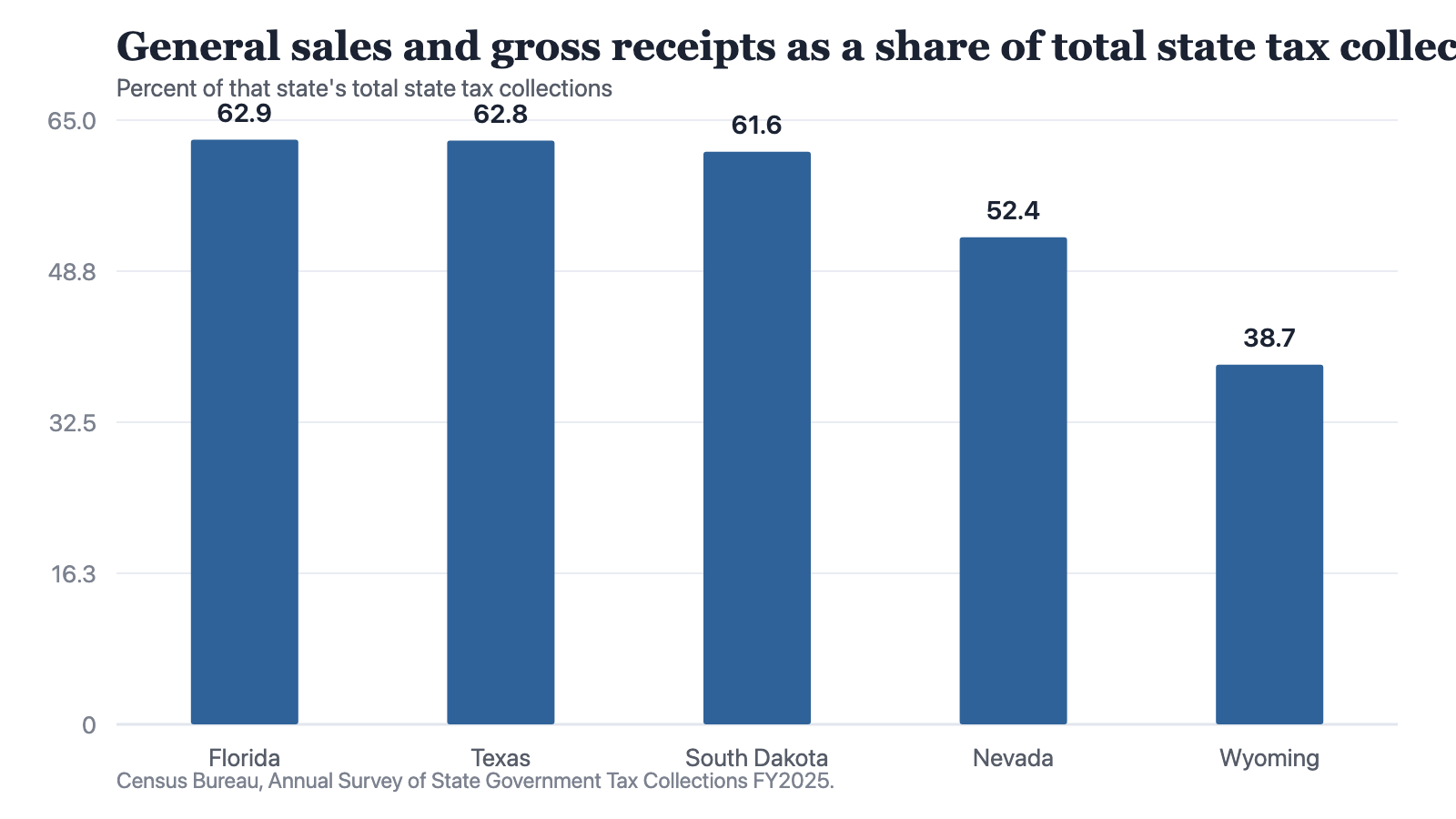
Notes: Alaska does not appear: it levies no general sales and gross receipts tax, which the source records as an absence rather than a zero. Across the 47 jurisdictions that do levy the item, the median share is 31.0 percent.
Source: The Cefa Brief
Chart description
Five bars. Florida stands at 62.9 percent, Texas at 62.8, South Dakota at 61.6, Nevada at 52.4 and Wyoming at 38.7. The first three sit within about a point of each other and roughly double the 31.0 percent median across the 47 levying jurisdictions. Wyoming is the outlier of the group, and the gap between its 38.7 percent and Florida's 62.9 is filled mainly by severance tax, which the chart does not show.
Five bars. Florida stands at 62.9 percent, Texas at 62.8, South Dakota at 61.6, Nevada at 52.4 and Wyoming at 38.7. The first three sit within about a point of each other and roughly double the 31.0 percent median across the 47 levying jurisdictions. Wyoming is the outlier of the group, and the gap between its 38.7 percent and Florida's 62.9 is filled mainly by severance tax, which the chart does not show.
Wyoming is the exception in that group, and Alaska is outside it entirely. Wyoming's general sales line is 38.7 percent of its collections; its severance tax is 27.7 percent. Alaska levies no general sales tax whatever, and its severance tax alone is 43.9 percent of everything the state collects. Those are not consumption states with a quirk in the mix. The single largest revenue line in each is set by a market outside the state, and a legislature that writes a budget against it is writing against a price it does not control.
Texas is narrower still in a different way. Of the five named levies in the file, Texas carries exactly two: general sales and severance. It levies no state property tax, no individual income tax and no corporation net income tax. A base with two legs is not fragile in the way a small state's is, because 62.8 percent of $89.9 billion is a great deal of money. But it is a base with two legs.
The objection worth taking seriously
The strongest objection is that this file is measuring the wrong level of government. Texas, Florida and South Dakota levy no state property tax, and the obvious retort is that the property tax has not gone anywhere; it has moved down to counties, cities and school districts, which this dataset does not cover. Someone buying a site in Houston pays the tax whatever the state ledger says. The objection is correct, and I would rather state it than let a reader discover it later.
It does not rescue the shorthand, though. It sharpens the point. If the money is raised locally, then the relevant fiscal question for anyone siting a facility is local, and a state-level ranking answers a question nobody asked. The absence of a state income tax tells you nothing about the millage rate on the parcel. It tells you which government will be negotiating with you, which is useful, and it tells you nothing about how much you will pay, which is what people use it for.
The second objection is that these are low-tax states and the composition is a detail. Join collections to the Vintage 2024 population and the claim splits in half. Alaska raises $2,279 per resident, the lowest of the 51 jurisdictions; Florida $2,719, forty-ninth; Texas $2,874, forty-eighth; South Dakota $2,906, forty-sixth. Then Wyoming raises $4,371 and Nevada $4,444, which places them twenty-third and twentieth, both above the $4,244 median. Two of the six states in the no-income-tax club collect more per head than most states with an income tax.
Reading a state the way you would read a credit
If you handed an analyst two revenue lines and asked which obligor she preferred, she would want to know what drives each one and how correlated the drivers are with the thing being financed. That is the question the shorthand suppresses. A base that is 62.9 percent consumption moves with household spending and with the price level, and it moves reasonably quickly in both directions. A base that is 43.9 percent severance moves with a commodity price, on a schedule set elsewhere, and the correlation with a state's own economic cycle can be close to one at the worst moment. Neither is bad. They are different instruments and they fail differently.
There is a limit to what one year of collections licenses. This is FY2025 alone. It shows composition, not volatility, and a single observation cannot tell you how far Alaska's severance line falls in a bad year. A reader who wants that needs a run of years this file does not carry, and should say so rather than extrapolate from one.
What the one year does establish is that the category is not a category. Six states share a missing tax and little else: one funded by consumption at twice the national median concentration, one funded by oil, one with a two-legged base and the largest collections of the group, one with no sales tax at all. Anyone who moves capital on the strength of the phrase is buying the absence and ignoring the structure, and the structure is the part that will still be there in 2046.
About the author

Each author told us that for this piece they hold no interest a reader would think relevant.
This commentary carries its author's name because the view in it is the author's own. An editor reviewed it before publication, which is not the same as agreeing with it. It is not a position of the Center for Economics & Foreign Affairs or of Applied America.
© 2024. The author or authors hold the copyright in this commentary; CEFA publishes it with their permission. This edition, its editing and its presentation are © 2024 Center for Economics & Foreign Affairs. To republish it, see our republication terms. Republishing
Share
The Cefa Brief · applied.thecefa.org/cefa-brief/six-states-raise-no-income-tax · Printed from the web edition