
The industrial index has spent six years going almost nowhere
Industrial production ended 2025 at 101.2 on a 2017 base of 100. It has moved 1.9 points in four years, and the 2025 reading sits 0.2 above 2022.
by
Published 3 minute read

插图:The Cefa Brief
The Federal Reserve's industrial production index ended 2025 at 101.2. Its base year is 2017, where the index equals 100. Eight years on from that base, the industrial sector of the American economy produced 1.2 percent more than it did at the start of the count. That is the finding, and it does not improve when looked at from another angle.
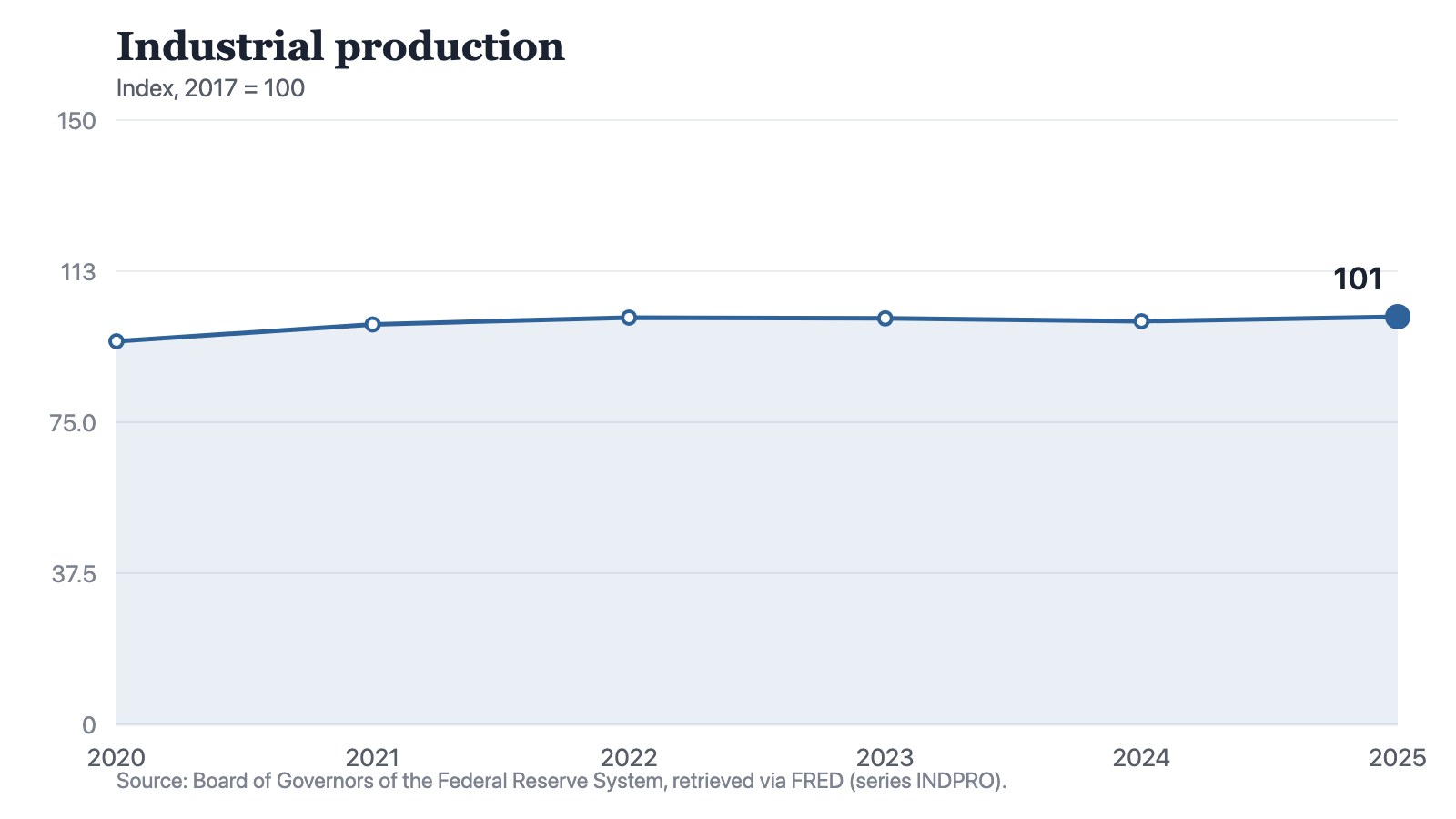
The six annual readings run 95.1 in 2020, 99.3 in 2021, 101 in 2022, 100.8 in 2023, 100.1 in 2024 and 101.2 in 2025. The entire six-year range is 6.1 index points wide, and 4.2 of those points were covered in the single move out of 2020.
The recovery, and everything after it
Notes: Annual observations. The index carries manufacturing, mining and utilities together and is not adjusted here for the composition of output.
Source: The Cefa Brief
Chart description
A line chart showing the index at 95.1 in 2020, climbing to 99.3 in 2021 and 101 in 2022, then easing to 100.8 in 2023 and 100.1 in 2024 before returning to 101.2 in 2025. Almost all of the movement in the chart happens between the first two points.
A line chart showing the index at 95.1 in 2020, climbing to 99.3 in 2021 and 101 in 2022, then easing to 100.8 in 2023 and 100.1 in 2024 before returning to 101.2 in 2025. Almost all of the movement in the chart happens between the first two points.
Read the series in two parts. The first is a recovery: 95.1 to 101 between 2020 and 2022, the industrial economy climbing back to and just past where it stood in 2017. The second is three years in which it went nowhere. 2022 reads 101. 2025 reads 101.2. The difference is two tenths of an index point.
A reader who arrived in 2023 and has been told since that American industry is being rebuilt will find nothing in this series that contradicts the rebuilding and nothing that confirms it. The index has sat inside a band from 100.1 to 101.2 for four consecutive years. Whatever has been happening, it has not yet arrived as more industrial output in aggregate.
One component that did move
Not everything inside the industrial statistics is flat. Domestic semiconductor production, published in the same Federal Reserve industrial production release and on the same 2017 base, reads 121 in 2021, 131 in 2022, 135 in 2023, 144 in 2024 and 165 in 2025. It rose 44 index points over four years while the aggregate rose 1.9.
That contrast is real and easy to over-read. A component can rise that far without moving the total either because it is a small share of the total or because other components fell. This site holds the two indices and not the weights that connect them, so I cannot tell you which, and nor can anyone working from these two lines alone. What the pair does establish is that a flat aggregate is not evidence that nothing inside it is moving.
The industrial sector produced 1.2 percent more in 2025 than in 2017. Every claim about industrial revival has to survive that sentence.
What the series will not settle
These are annual observations and there are six of them. They cannot show a turning point inside a year. They cannot separate manufacturing from mining and utilities, which the index carries together. They say nothing about what comes next. An index of output is also not employment, not capital spending and not profit, and it should not be pressed into answering for any of them.
The use of a number like this is as a check on the claims made around it. When a programme is defended on the ground that it will rebuild industrial capability, this series is where the claim eventually has to land. It has not landed yet. The 2025 reading is the highest in the window, which counts for something, and it is 0.2 above the reading three years earlier, which is worth being honest about.
I would rather report a flat line accurately than dress it up. The aggregate has barely moved; at least one component has moved a great deal; the connection between the two is not something these figures can supply. A reader holding those three sentences together knows more about American industrial output than one who has been handed a direction of travel.
Method and data
The figures are annual observations of the industrial production index, series INDPRO, published by the Board of Governors of the Federal Reserve System, redistributed by FRED and retrieved for this site on 19 September 2026. The index is set to 100 in 2017 and carries manufacturing, mining and utilities together. It measures real output. It is not employment, not investment, not value added and not profit, and six annual points cannot show anything that happened inside a year.
How to cite
Jag DeSaint, "The industrial index has spent six years going almost nowhere," The Cefa Brief, Applied America, 2025年3月4日, https://applied.thecefa.org/cefa-brief/industrial-production-six-flat-years.
About the author

Each author told us that for this piece they hold no interest a reader would think relevant.
This Insights piece carries its author's name because the view in it is the author's own. An editor reviewed it before publication, which is not the same as agreeing with it. It is not a position of the Center for Economics & Foreign Affairs or of Applied America.
© 2025. The author or authors hold the copyright in this Insights piece; CEFA publishes it with their permission. This edition, its editing and its presentation are © 2025 Center for Economics & Foreign Affairs. To republish it, see our republication terms. Republishing
Share
The Cefa Brief · applied.thecefa.org/cefa-brief/industrial-production-six-flat-years · Printed from the web edition