
A foreign ministry cannot spend attention on fifty states, and should not try
California holds 39,431,263 residents and Wyoming 587,618, and each sends the same two senators to Washington. A ministry with a finite diary has to decide which of those two facts it is optimising against, because the rankings they produce are not the same.
by
Vantage point
I write from the editor's desk of this brief, working from the federal population and collections files this publication holds, with no brief from any government and no stake in where anyone opens an office.
Published 7 minute read

插图:The Cefa Brief
Every foreign ministry runs on a fixed stock of attention. There are so many officers, so many consulates, so many weeks in which a minister can be somewhere other than the capital, and so many times a trade mission can be organised before the people organising it stop answering. The stock is small, it is not expandable in the short run, and in the United States it has to be spread across fifty-one jurisdictions that differ from one another more than some countries differ from their neighbours.
The Census Bureau's Vintage 2024 estimates put California at 39,431,263 residents and Wyoming at 587,618, a difference of roughly sixty-seven to one. Both send two senators to Washington. Those two facts describe the same country and point in exactly opposite directions, and almost every argument inside a ministry about where to open an office, where to send a mission and whose governor to invite is an unacknowledged argument about which of them matters more.
My position is that the argument should be acknowledged and settled explicitly, once, at the level of the ministry rather than the desk, because the three plausible objectives produce three different maps and a plan built on an average of them is a plan for none.
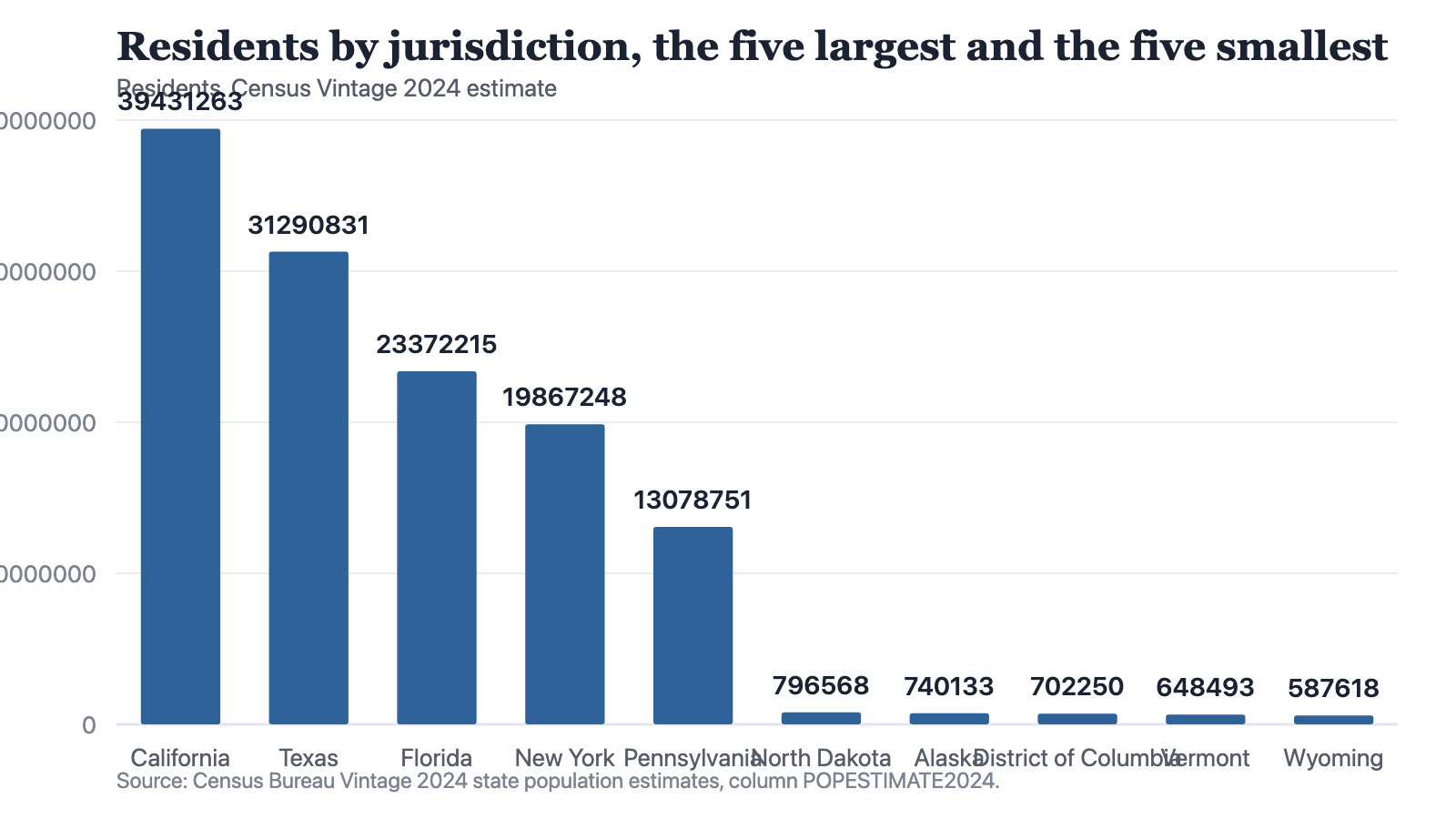
Notes: Census Bureau Vintage 2024 state population estimates, column POPESTIMATE2024, as held on this site. A single estimate; the file carries no earlier year.
Source: The Cefa Brief
Chart description
California holds 39,431,263 residents, Texas 31,290,831, Florida 23,372,215, New York 19,867,248 and Pennsylvania 13,078,751. At the other end, North Dakota holds 796,568, Alaska 740,133, the District of Columbia 702,250, Vermont 648,493 and Wyoming 587,618. The largest jurisdiction holds about sixty-seven times the population of the smallest, and every one of these ten is a separate government with its own tax code, its own procurement and its own economic development office.
California holds 39,431,263 residents, Texas 31,290,831, Florida 23,372,215, New York 19,867,248 and Pennsylvania 13,078,751. At the other end, North Dakota holds 796,568, Alaska 740,133, the District of Columbia 702,250, Vermont 648,493 and Wyoming 587,618. The largest jurisdiction holds about sixty-seven times the population of the smallest, and every one of these ten is a separate government with its own tax code, its own procurement and its own economic development office.
Three rankings, one map
The first ranking is market size, and population is its roughest proxy. California, Texas, Florida, New York and Pennsylvania lead it. The second is the size of the government itself, which matters to any firm selling to the public sector or seeking a state's help. In the fiscal 2025 collections file, California leads at 275,041,333 thousand dollars, followed by New York at 131,284,169, Texas at 89,943,632, Illinois at 71,309,239 and Florida at 63,550,663.
Those two orderings are close at the very top and diverge quickly below it. New York is fourth by population and second by collections. Illinois is sixth and fourth. New Jersey is eleventh and seventh. Massachusetts is sixteenth by population and eighth by collections. In the other direction, Ohio is seventh by population and thirteenth by collections, and Georgia is eighth and fifteenth. A mission planned around the largest populations and a mission planned around the largest state budgets would not visit the same places. Neither ordering is wrong. They are answers to different questions, and the divergence between them is largest exactly in the middle of the table, where most missions actually spend their time.
The third ranking is political access, and it is flat by construction. Every state has the same two senators whatever its population, while the District of Columbia, which sits in these files alongside the states, has none. That means a relationship with a small state buys the same quantity of a particular kind of influence as a relationship with a large one, at a fraction of the effort and against far less competition for the attention of its officials. Nothing in any data file says this; it is the structure the data sits inside, and ministries respond to it whether or not they admit it.
An exporter of consumer goods cares about the first ranking. A firm chasing state contracts or incentives cares about the second. A government that wants a hearing in Washington cares about the third. These are legitimate objectives and they are not reconcilable in a single itinerary.
In practice a fourth ranking usually beats all three, and nobody writes it down. Attention follows invitations, and invitations follow whoever has an office, a diaspora association, a university link or a governor with an interest in foreign travel. That is not corrupt and it is not even unreasonable as a starting filter, since a host who invites you is a host who will meet you. It is simply not a strategy, and it produces the characteristic pattern of a programme that is busy everywhere and consequential nowhere. The test is easy to apply: ask why the last three missions went where they went, and see whether the answer references any of the three rankings above or only the sequence of letters that arrived.
Attention spread evenly across fifty-one jurisdictions is a decision about none of them.
Concentration is the argument for choosing
The distribution itself makes the case. Of the 340,110,988 residents in the file, the five largest jurisdictions hold 127,040,308 between them. The twenty-five smallest hold 50,926,104 in total, less than half of what those five hold, spread across twenty-five separate governments, twenty-five legislatures, twenty-five economic development agencies and twenty-five sets of officials who all reasonably expect a visitor to have done the reading.
A ministry that distributes attention evenly is spending the same on a jurisdiction of 587,618 people as on one of 39,431,263, and paying the coordination cost twenty-five times over at the thin end. If the objective is commercial, that is not balance. It is a failure to choose, dressed as fairness. The coordination cost is the part that is always underestimated, because it does not appear in any budget line: the briefing that has to be written, the officer who has to keep the file current, and the second visit that has to be found room for once the first one has created an expectation.
The even spread is not irrational for every objective, and it is worth saying so before dismissing it. If what a ministry wants is votes, sponsors, co-signatories or simply the ability to say it is present across the country, then the flat third ranking is the correct one to optimise against, and the small jurisdictions are cheap. What is indefensible is spreading attention evenly while describing the programme as commercial, because the two objectives are then quietly funding each other's failures.
What a headcount cannot carry
Population is a count of people and nothing more. It says nothing about what those people earn, what industries employ them, what the state buys, or whether a foreign supplier can sell into it without a domestic partner. None of the other files here closes that gap. They can tell you what an occupation pays in a state and which taxes a state levies, and they hold no measure of demand for any particular product, no procurement volume, and no figure for any other country against which a ministry might calibrate its expectations.
The file is also a single Vintage 2024 estimate with no earlier year inside it, so it cannot support a sentence about where Americans are moving. That is a real limit for this subject, because a ministry allocating a ten-year presence would sensibly want direction as well as level, and this file cannot give it. The honest use of a population map is therefore negative. It rules plans out; it does not select one. A commercial programme whose three priority destinations are among the five smallest jurisdictions needs a reason, and the reason has to be something other than the market.
The cost of not choosing
Attention is not only money. It is minister-days, the credibility of a second visit, and the willingness of the people on the other side to take a call in eighteen months. A programme that visits six states once and returns to none of them is worse than one that visits two and returns to both, because the first teaches every host that the relationship is ceremonial.
That matters more in a federal system than in a unitary one. A foreign ministry's counterpart in a state has a term, a budget cycle and no obligation to inherit a predecessor's enthusiasms. The relationship has to be renewed by people, repeatedly, or it decays into a plaque. Spreading thin does not hedge that risk; it guarantees that no relationship is ever renewed often enough to survive one election.
The strongest objection to concentration is exposure. A ministry that puts everything into two jurisdictions has tied its American programme to two political environments it does not control and cannot vote in, and both can turn. A programme that depends on two administrations is one election away from starting again, and the officials who built it will be the ones explaining why.
The answer is to diversify on what a jurisdiction is rather than on how many flags are on the map: a state whose government is large relative to its population and one whose economy is large relative to its government, a state whose revenue leans on consumption and one whose revenue leans on income, a state where the work you need is common and one where it is scarce. Two or three jurisdictions chosen along those lines are a portfolio. Fifteen chosen by invitation are a mailing list.
None of this tells a ministry which states to pick, and it is not meant to. It tells it what it is choosing between, which is the part that usually goes unexamined, and it puts a number on the cost of leaving the choice to whoever happens to have issued the most recent invitation. A ministry that can state, in one sentence, which of the three rankings its American programme is built on has already done something most cannot, and it will be able to tell in three years whether the programme worked, because it will know what it was for.
How to cite
Jag DeSaint, "A foreign ministry cannot spend attention on fifty states, and should not try," The Cefa Brief, Applied America, 2026年8月12日, https://applied.thecefa.org/cefa-brief/cannot-spend-attention-on-fifty-states.
About the author

Each author told us that for this piece they hold no interest a reader would think relevant.
This Perspectives piece carries its author's name because the view in it is the author's own. An editor reviewed it before publication, which is not the same as agreeing with it. It is not a position of the Center for Economics & Foreign Affairs or of Applied America.
© 2026. The author or authors hold the copyright in this Perspectives piece; CEFA publishes it with their permission. This edition, its editing and its presentation are © 2026 Center for Economics & Foreign Affairs. To republish it, see our republication terms. Republishing
Share
The Cefa Brief · applied.thecefa.org/cefa-brief/cannot-spend-attention-on-fifty-states · Printed from the web edition